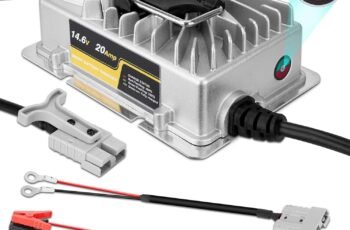
Have we ever wished charging our 12V lithium batteries could be faster, safer, and a lot less confusing?

What Is the 12V 10A Lithium Battery Charger from VATRER POWER?
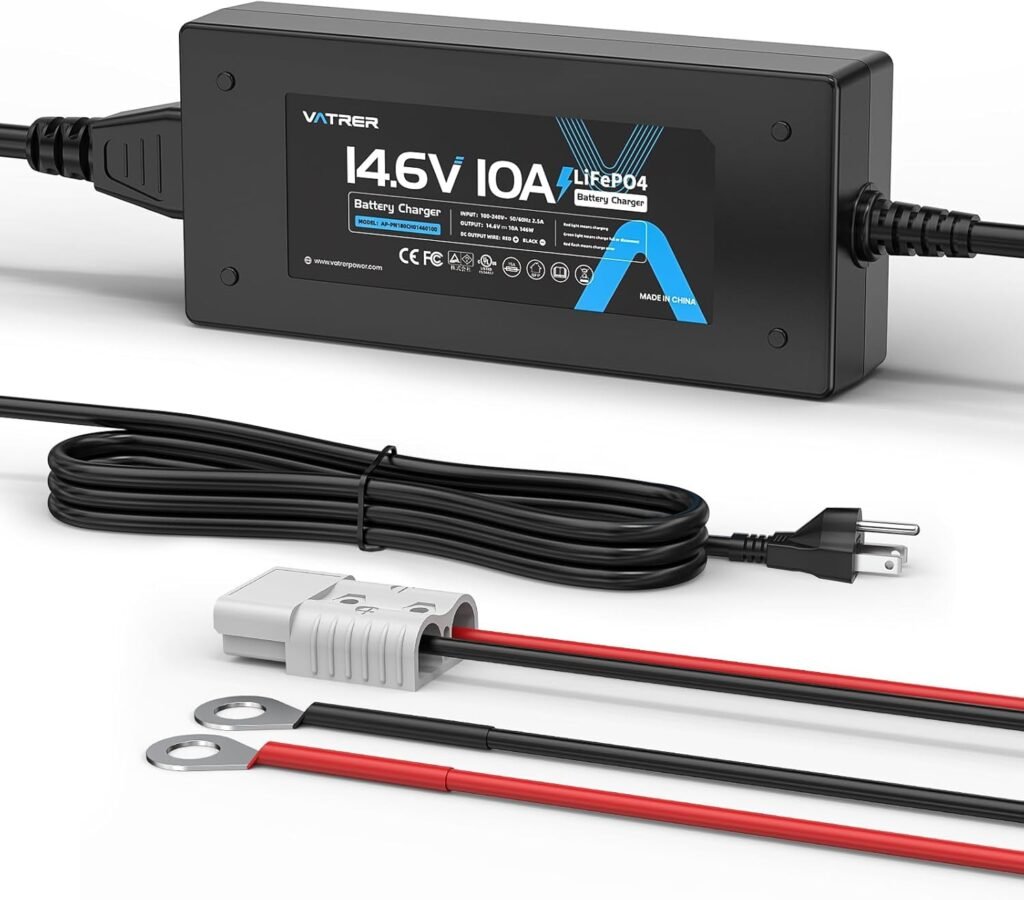
This 12V 10A Lithium Battery Charger from VATRER POWER is designed specifically for 12V lithium and LiFePO4 batteries. It gives us a 14.6V output with up to 10A of current and supports 0V activation, so even deeply depleted batteries can be brought back to life.
We get a compact charger that works with standard household power (100–240V AC), making it suitable for home, garage, or workshop use. It’s aimed at users running deep cycle batteries in boats, RVs, solar systems, and similar setups.
Key Specifications at a Glance
To make things easier to understand, we can break down the core specs and features in a simple table. This helps us see quickly whether this charger fits our system and battery type.
| Feature | Details |
|---|---|
| Product Name | 12V 10A Lithium Battery Charger VATRER POWER 14.6V LiFePO4 Battery Charger |
| Battery Type | 12V lithium & LiFePO4 deep cycle batteries |
| Charging Voltage | 14.6V (constant voltage) |
| Charging Current | Up to 10A (constant current) |
| Input Voltage | 100–240V AC, 50/60Hz |
| 0V Activation | Yes – can reactivate over-discharged batteries |
| Charging Stages | CC (Constant Current), CV (Constant Voltage), Float/Automatic Cutoff |
| Safety Protections | Over-voltage, short-circuit, over-temperature, and more |
| Capacity Range (Recommended) | Approximately 20Ah to 100Ah 12V lithium/LiFePO4 batteries |
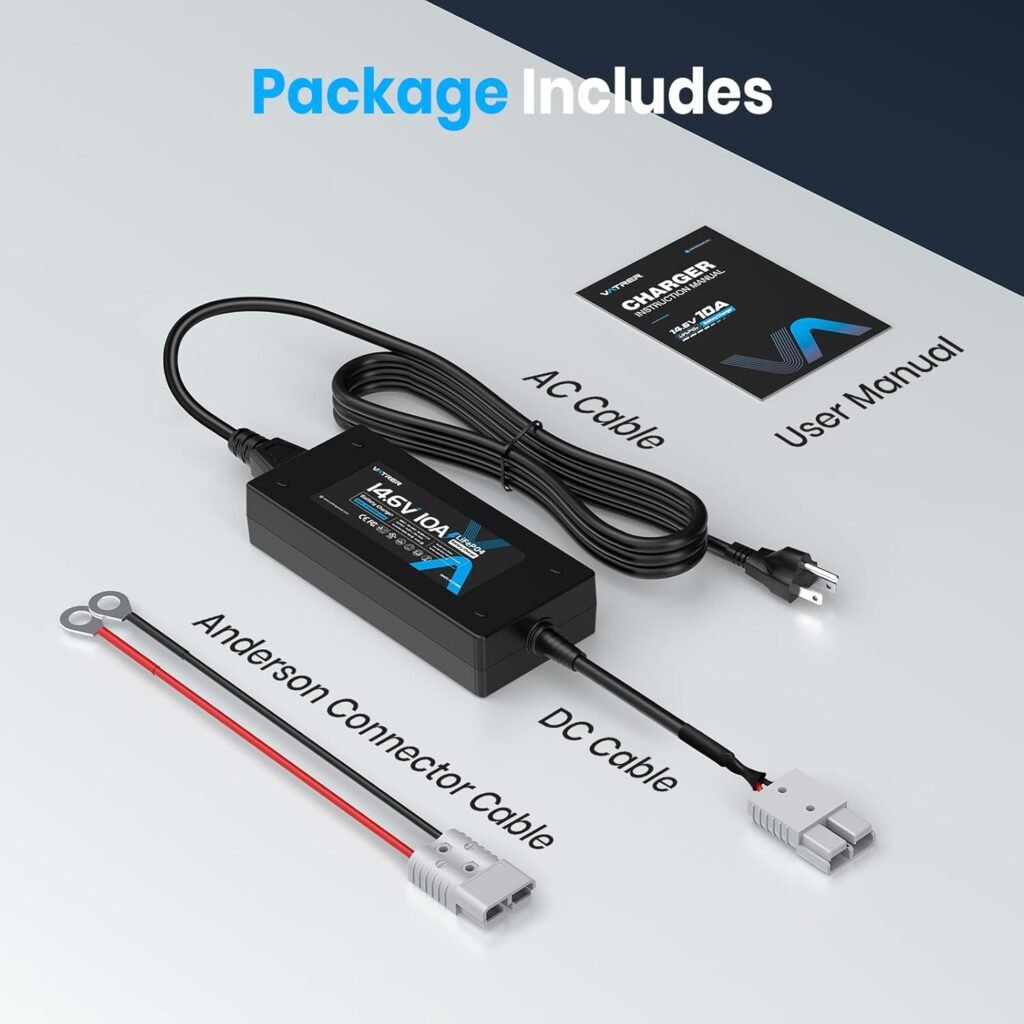
| Connectors | Heavy-duty M8 terminal connectors & Anderson connector |
| Cooling | Built-in cooling fan |
| Indicator | LED status indicator (charging / full / fault / protection) |
| Typical Use Cases | Boat, RV, solar storage, backup power, off-grid setups, mobility applications |
We can think of this charger as a dedicated tool for 12V lithium and LiFePO4 systems, rather than a universal charger that tries to do everything and ends up doing nothing particularly well.
Who Is This Charger Best Suited For?
This charger makes the most sense for those of us running 12V deep cycle lithium or LiFePO4 batteries in real-world setups. That can be anything from a weekend RV setup to a small solar bank on a cabin.
If any of the following describes us, we’re likely in the right place:
- We use 12V lithium or LiFePO4 batteries in an RV, camper van, or boat.
- We rely on a 12V 50–100Ah battery for trolling motors, camping setups, or backup power.
- We want faster charging than a basic 5A charger can provide.
- We’re worried about battery safety and want built-in protection features.
- We sometimes run our batteries very low and need reliable 0V activation.
If we’re using lead-acid, AGM, or gel batteries as our main bank, this charger is not for us; it’s specifically tuned for lithium chemistry, especially LiFePO4.

Charging Performance and Speed
We care about how long it takes to get our battery from empty to full, especially when we’re on the road or out on the water. The VATRER POWER 12V 10A charger focuses on delivering a fast but controlled charge.
How Fast Does It Charge?
The manufacturer estimates that a 12V 100Ah lithium battery can be charged to 100% in about 10 hours. That’s based on a steady 10A charge rate and ideal conditions.
To put that into context:
- A 5A charger would take roughly twice as long (around 20 hours).
- With 10A, we cut that time in half, which is significant for off-grid living or time-limited shore power connections.
In real life, we can expect some variation depending on:
- The actual usable capacity of our battery.
- The battery’s starting state of charge.
- Ambient temperature and battery health.
Still, going from a full day of charging to roughly half a day is a meaningful improvement, especially when we’re relying on that battery for our lighting, refrigeration, electronics, or trolling motor.
CC/CV Charging Profile for Lithium
Lithium and LiFePO4 batteries prefer a specific charging algorithm, usually referred to as CC/CV:
- CC (Constant Current): The charger pushes a steady 10A up to a set voltage.
- CV (Constant Voltage): Once 14.6V is reached, it holds that voltage and lets the current taper off as the battery fills up.
This charger follows that method and then automatically transitions to float or cut off when the battery is full. That means we don’t have to babysit the charger or worry about overcharging when we forget to unplug it at the exact right time.
0V Activation: Bringing “Dead” Batteries Back
Many of us have had that sinking feeling when a battery won’t wake up because it dropped too low and the built-in BMS shut it off. A standard charger often can’t even recognize that kind of battery, never mind restore it.
What 0V Activation Does for Us
0V activation is a feature where the charger can send a small, controlled current to a battery that reads essentially 0 volts at the terminals. This helps:
- Wake up the battery management system (BMS).
- Gently reactivate batteries that have been over-discharged.
- Save us from having to jump through hoops with complex manual recovery methods.
We should still avoid repeatedly draining our batteries that far, as it’s not healthy for them long-term. But it’s reassuring to know that if a battery gets too low, we have a tool that can often recover it instead of leaving us stuck or forcing an early battery replacement.
Safety and Protection Features
When we’re dealing with lithium batteries and 120V or 240V mains power, safety absolutely matters. VATRER POWER builds in several layers of protection into this charger.
Built-in Protections
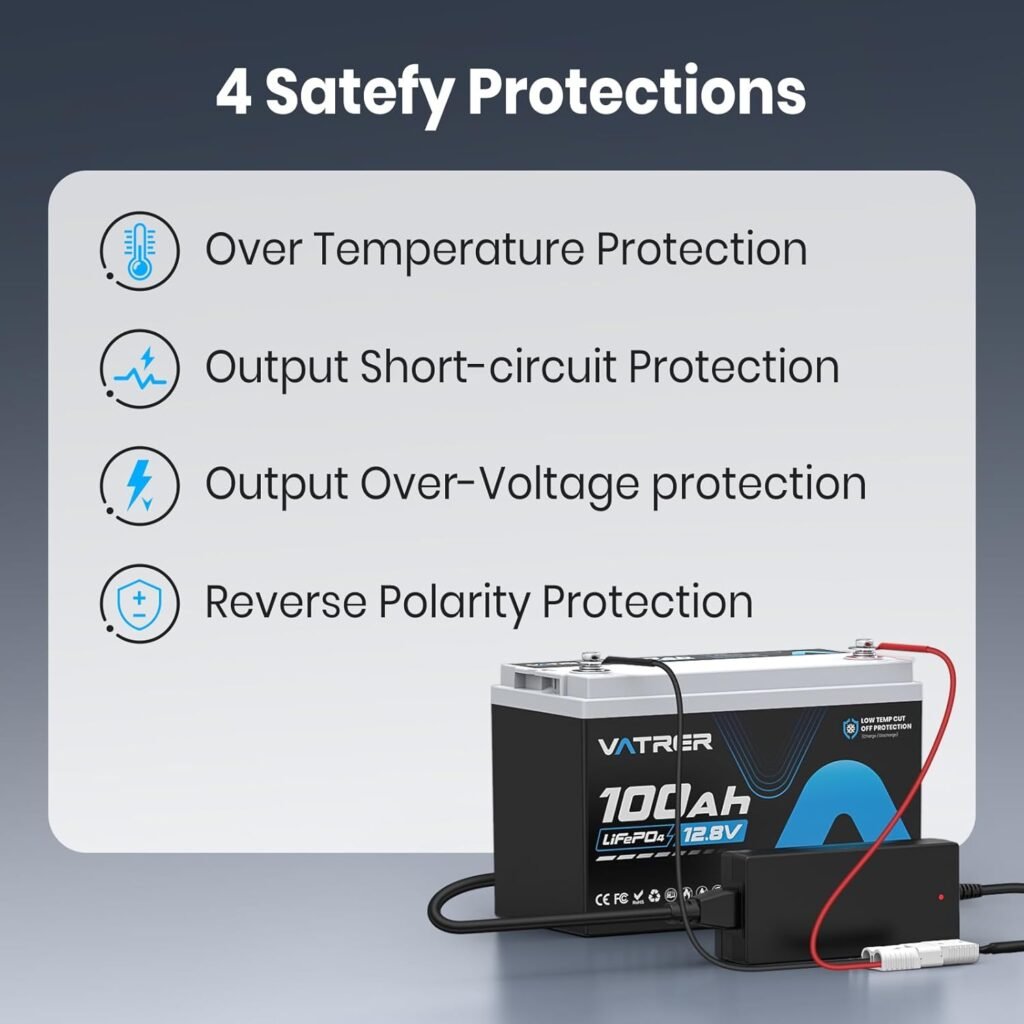
Here’s what the charger is designed to guard against:
- Over-voltage protection – Prevents the charger from pushing too high a voltage to the battery.
- Short-circuit protection – Shuts down output if there’s a direct short at the terminals or in the wiring.
- Over-temperature protection – Monitors internal temperature and reduces power or shuts down if things get too hot.
These protections work together to reduce the risk of damage to both the charger and our battery. While we still need to follow basic safety practices (good wiring, proper connections, correct polarity), the electronics act as an extra safety net if something goes wrong.
Automatic Charging Stages
The charger automatically transitions among:
- Constant Current
- Constant Voltage
- Float or Cut-Off / Protection
That means:
- We don’t need to select modes manually.
- The charger adapts automatically as the battery’s voltage and charge level change.
- Once the battery is full, charging is reduced or stopped to minimize stress on the cells.
This “set it and let it work” style is especially handy for RV or boat owners who want to plug in at camp or dock and not worry all night about micromanaging their charger.
Connection Options: M8 Terminals and Anderson Plug
Having multiple ways to connect a charger matters because our setup might involve different types of wiring, bus bars, or quick-connect systems.
Heavy-Duty M8 Terminal Connectors
The M8 terminals are threaded posts that let us:
- Connect charging leads directly to battery posts or bus bars.
- Use ring terminals for a secure and low-resistance connection.
- Set up semi-permanent wiring in a battery compartment.
These connectors are great for stationary setups or for systems where we want a solid bolted connection, like on a dedicated house battery in an RV or boat.
Anderson Connector for Quick Connection
The Anderson connector is a popular quick-connect solution for:
- Plugging and unplugging chargers without tools.
- Swapping the charger among multiple batteries with matching Anderson leads.
- Using a single charger on different rigs (like a boat, an RV, and a workshop backup battery).
If we build Anderson connectors into our system, we can keep our charging process clean and convenient. Plug in, charge, unplug, and store the charger without fussing over alligator clips or loose connections.
Cooling and Thermal Management
Any charger that puts out a steady 10A needs to handle heat effectively. Excess heat is the enemy of electronic components and reliability.
Built-In Cooling Fan
This charger includes an internal fan that:
- Actively removes heat from inside the charger during operation.
- Helps maintain stable performance during long charging sessions.
- Supports long-term reliability by preventing components from overheating.
We can expect the fan to make some noise when the charger is under load. That’s normal and usually means the charger is doing its job to manage temperature and keep the output stable.
If we tend to charge in an enclosed compartment, we should give the unit some breathing room so the fan can move air effectively.
LED Status Indicator and User Feedback
We don’t want to stand there with a multimeter every time we plug in our charger. A clear visual indicator allows us to tell what’s going on at a glance.
LED Charging Indicator States
The charger’s LED indicator provides several status cues:
- Charging – Shows that the battery is currently accepting power.
- Full – Indicates that the battery has reached a full charge and current has tapered off.
- Fault or Protection – Alerts us that the charger has encountered a problem (such as short-circuit, over-temperature, or over-voltage) and has shifted to a protective state.
Having these states clearly visible helps us:
- Confirm quickly that the charger is working.
- Know when it’s safe to disconnect and use our battery.
- Spot potential issues early, such as a damaged cable or incorrect connection.
We don’t get a detailed digital screen or exact voltage/current readout, but the LED system keeps things simple and reliable for everyday use.
Compatibility with 12V Lithium and LiFePO4 Batteries
One of the most important questions we should ask is: does this charger match our battery chemistry and size?
Designed for 12V Lithium and LiFePO4 Only
This charger is specifically geared toward:
- 12V lithium-ion batteries
- 12V LiFePO4 batteries
It is not intended for:
- Traditional lead-acid
- AGM
- Gel cells
Using it with non-lithium chemistries could result in improper charging and possible damage, because the voltage and charging profile are tailored for lithium.
Recommended Capacity Range: 20Ah to 100Ah
The charger is best suited for batteries in the 20Ah to 100Ah range. Here’s why:
- For very small batteries (below 20Ah), 10A might be too aggressive and put extra strain on the cells.
- For very large batteries (over 100Ah), charging will still work but will naturally take longer.
As an example:
- A 20Ah battery at 10A: roughly 2–3 hours from low to full (theoretical).
- A 50Ah battery at 10A: roughly 5–6 hours.
- A 100Ah battery at 10A: roughly 10 hours, as stated by the manufacturer.
If we have larger battery banks (like 200Ah, 300Ah, or more), we can still use this charger, but we need to accept proportionally longer charging times or consider using multiple chargers or a higher-amp model if available.
Real-World Use Cases
To see how this charger fits into our life, it helps to picture some real scenarios where it can make a difference.
RV and Camper Van Owners
For those of us with a 12V lithium battery powering our RV or van:
- We can plug in at a campsite with shore power and use this charger to bring the battery back to full overnight.
- If we rely on solar during the day, the charger can serve as a backup on cloudy days or when we’re parked in shade.
- The M8 terminals often integrate nicely with existing battery banks, while the Anderson connector can be used for a portable auxiliary battery.
The 10A output is strong enough to handle a typical 50–100Ah house battery in reasonable time while still being compact and easy to stow.
Boat and Marine Applications
On a boat, reliability is crucial. We might use this charger to:
- Charge a dedicated trolling motor battery.
- Maintain a house battery for lights, radios, fish finders, and navigation gear.
- Keep an emergency backup battery topped up at the dock.
The ability to safely float or cut off once the battery is full makes it well suited for marina or dock charging without constant supervision.
Off-Grid and Solar Backup
If we run a small off-grid system or a backup power setup:
- This charger can serve as a shore-power backup when solar can’t keep up.
- It works well for small cabin systems using a single 12V LiFePO4 battery.
- 0V activation helps save batteries that might have been left connected to loads too long.
In this role, the charger becomes a key part of a resilient power strategy, letting us recover quickly when the sun doesn’t cooperate.
Workshop, Garage, and Hobby Use
In a shop environment, we might use the charger to:
- Maintain lithium batteries for test benches, inverters, or 12V tools.
- Quickly bring a battery up to full before a project or trip.
- Cycle-test lithium batteries or verify their health over time.
The LED indicator gives us quick feedback so we can keep working without constantly checking instruments.
Pros and Cons from a User Perspective
No product is perfect for every situation, so we find it useful to look at both strengths and trade-offs.
What We Tend to Appreciate
- Optimized for LiFePO4: We get a charging profile designed for lithium, not a “one-size-fits-all” compromise.
- 0V Activation: This is a big plus if we’ve ever had a lithium battery shut down due to over-discharge.
- Fast 10A Charging: Cutting charge time in half compared with a 5A charger can be a game changer for RV and marine use.
- Multiple Connection Options: The combination of M8 and Anderson connectors increases flexibility in how we wire our system.
- Safety Protections: Over-voltage, short-circuit, and over-temperature protection give us peace of mind.
- Simple LED Feedback: Easy to understand at a glance without extra complexity.
Potential Limitations to Keep in Mind
- Not for Lead-Acid or AGM: We still need a separate charger if we maintain other battery chemistries.
- 10A Limit: For very large banks (200Ah+), charging will take a while. It’s best for small to medium battery sizes.
- Fan Noise: The cooling fan is necessary but may be noticeable in very quiet environments.
- No Detailed Display: We don’t get precise numbers for voltage or current; we only get status via LED.
For most typical 12V 20–100Ah LiFePO4 setups, these trade-offs are minor. Still, it helps us align our expectations before we buy.
How We Would Use It Step by Step
To get an idea of daily use, we can walk through a sample charging routine.
Basic Charging Routine
-
Check Our Battery Type
We confirm that we’re using a 12V lithium or LiFePO4 battery in the 20–100Ah range. -
Connect to the Battery
We decide between:- M8 terminal connection (more permanent, solid connection), or
- Anderson connector (quick and convenient plug-in).
We ensure correct polarity: positive to positive, negative to negative.
-
Plug into AC Power
We connect the charger to a power outlet (100–240V AC). As the charger powers up, the LED indicator will show charging status. -
Monitor the LED Indicator
- LED shows charging while current is flowing.
- Once charged, the LED indicates full or float state.
- If there is a fault, the LED shows an error state and we can investigate connections or battery condition.
-
Disconnect When Done
Once full, we can unplug the AC side and then disconnect from the battery (or leave it connected if we’re using it as a maintainer and the charger supports that safely).
This kind of routine suits RVs, boats, and backup systems alike. The fact that the charger moves automatically through its stages keeps daily use simple.
Durability and Long-Term Use Considerations
When we’re buying a charger for repeated use, we want to know how it’s likely to hold up over time.
Build and Components
While we don’t have direct teardown details here, certain design choices give us confidence:
- Active cooling fan: Indicates an intention to manage heat carefully, which supports long-term reliability.
- Dedicated lithium charging profile: Reduces stress on both the charger and battery by avoiding mismatched charging methods.
- Protection circuitry: Helps the charger survive many common electrical faults without damage.
To keep it functioning well:
- We should store it in a dry, cool place when not in use.
- Keep vents unblocked so the fan can move air freely.
- Avoid dropping or subjecting it to heavy impacts.
In an RV or boat, we might want to mount or store it in a padded compartment or at least somewhere it won’t slide around.
Comparing 10A Charging to Lower-Amp Chargers
If we’ve used 3A or 5A chargers before, we’ll notice a difference in how 10A charging feels in daily use.
Time Savings in Practical Terms
For a 100Ah battery, we’re looking at roughly:
- 5A charger: ~20 hours from low to full (theoretical).
- 10A charger: ~10 hours from low to full (theoretical).
That’s the difference between:
- Charging over two nights, or
- Charging overnight and having a full battery the next day.
On smaller batteries, the time savings are still noticeable. For a 50Ah battery:
- 5A charger: roughly 10 hours.
- 10A charger: roughly 5 hours.
These savings matter the most when we are:
- On short trips.
- Relying on campground or marina power with time limits.
- Topping up before heading back off-grid.
Why a Dedicated Lithium Charger Matters
We might wonder why we need a lithium-specific charger when some chargers claim to handle multiple chemistries.
Matching Lithium’s Needs
Lithium and LiFePO4 batteries require:
- A slightly higher and very precise charge voltage (14.4–14.6V, depending on battery manufacturer).
- A well-controlled CC/CV charging profile.
- No equalization or long float stages like lead-acid chargers sometimes use.
By using a charger specifically tuned to 14.6V for lithium, we:
- Charge efficiently and fully.
- Help extend battery life by avoiding inappropriate charging behaviors.
- Reduce the risk of triggering the battery’s BMS unnecessarily.
A generic multi-chemistry charger might work “okay,” but a dedicated lithium charger like this one is more likely to get us consistent, safe, and optimized performance.
Our Overall Impression and Value Assessment
When we look at the VATRER POWER 12V 10A Lithium Battery Charger as a whole, we see a focused, purpose-built device rather than a jack-of-all-trades.
Strengths That Stand Out
- It is tailored for 12V lithium and LiFePO4, which is what many of us are migrating to in our off-grid and mobile setups.
- The 10A current rating hits a good balance between speed and practicality for 20–100Ah batteries.
- 0V activation is a practical feature that can save an otherwise “dead” battery in real-world scenarios.
- Safety and protections are clearly thought through, which is important when working with high-energy battery systems.
- Connectors and LED indicators are user-friendly for everyday charging.
Where It Fits in Our System
We would see this charger as:
- A primary shore-power charger in an RV or small boat.
- A supplemental charger for a solar-based off-grid system.
- A workshop or garage tool for maintaining and testing 12V lithium packs.
For those of us who value a simple, solid, and chemistry-specific charging solution for 12V LiFePO4 batteries, this unit offers a compelling balance of speed, safety, and convenience.
Final Thoughts: Is It Right for Our Setup?
If we currently use, or are moving to, 12V lithium or LiFePO4 deep cycle batteries in the 20–100Ah range and we want:
- Faster charging than basic 5A units,
- Protection features that keep our battery and charger safe,
- 0V activation for battery recovery,
- And easy connection via M8 terminals or an Anderson plug,
then the 12V 10A Lithium Battery Charger VATRER POWER 14.6V LiFePO4 Battery Charger is a strong match.
If, on the other hand, we mostly run large multi-battery banks or we need compatibility with lead-acid chemistries, we may want to consider additional chargers or higher-amp solutions alongside this one.
For the typical RV, boat, or small off-grid user running a single 12V lithium battery, this charger lines up well with our everyday needs and gives us a reliable way to keep our power system ready whenever we are.
Disclosure: As an Amazon Associate, I earn from qualifying purchases.