?Are we looking for a compact, versatile inverter charger that can handle off-grid living, home energy storage, and UPS duties without taking up a ton of space?

Product Overview: LiTime 3500W All-in-One Solar Inverter Charger, 48V DC to 120V AC Pure Sine Wave Inverter, Built in 80A MPPT Charge Controller, for 48V Lead Acid/LiFePO4 Battery, Home Energy Storage, Off-Grid
We want to provide a balanced, practical review of the LiTime 3500W All-in-One Solar Inverter Charger so you can decide whether it fits your energy plans. This section gives a high-level summary of what the unit promises and why it could suit a small to medium off-grid or hybrid home setup.
The LiTime unit combines inverter, MPPT charge controller, and charger into a single housing designed to save space and simplify installation. With 3,500W continuous output and a claimed 6,000W surge, it targets users who want a compact hybrid inverter with built-in UPS capability and advanced charging flexibility.
What this product is aimed at
We see this product targeted at homeowners and cabin owners who need a mid-power all-in-one solution for backup power, solar energy integration, and simple energy management. It’s also meant for installers who prefer fewer components and simpler wiring.
Users who want to replace a traditional generator for short outages or who want to reduce grid reliance will find the feature set compelling. The integrated MPPT and communication options make it usable for small-home or off-grid systems with a single battery bank.
Key Specifications and Quick Facts
We find that a clear set of specs helps us understand system limits and compatibility before going deeper into features. Below is a concise breakdown of the most important specifications to reference quickly.
| Feature | Specification |
|---|---|
| Model | LiTime 3500W All-in-One Solar Inverter Charger (48V) |
| Continuous AC Output | 3500W |
| Peak Surge Output | 6000W |
| DC Input | 48V |
| AC Output Voltage | 120V AC, Pure Sine Wave |
| Built-in MPPT Charge Controller | 80A |
| Supported Battery Types | 48V Lead Acid, LiFePO4, user mode, LiTime 51.2V100Ah ComFlex Edition |
| Charging Modes | Solar Only, Utility Priority, Solar Priority, Hybrid |
| Output Modes | Inverter Priority, PV Priority, Utility Priority |
| UPS Switch Time | Milliseconds (auto-switch to backup) |
| Protections | Short-circuit, over-temperature, overload, intelligent cooling |
| Communication | RS485, built-in LCD display |
| Typical Use Case | Home energy storage, off-grid, cabin, UPS for sensitive electronics |
We like to keep this table handy when sizing the system or comparing compatibility with existing batteries and loads. The combination of inverter and MPPT in one package simplifies planning for many small installations.

Physical Design and Space Savings
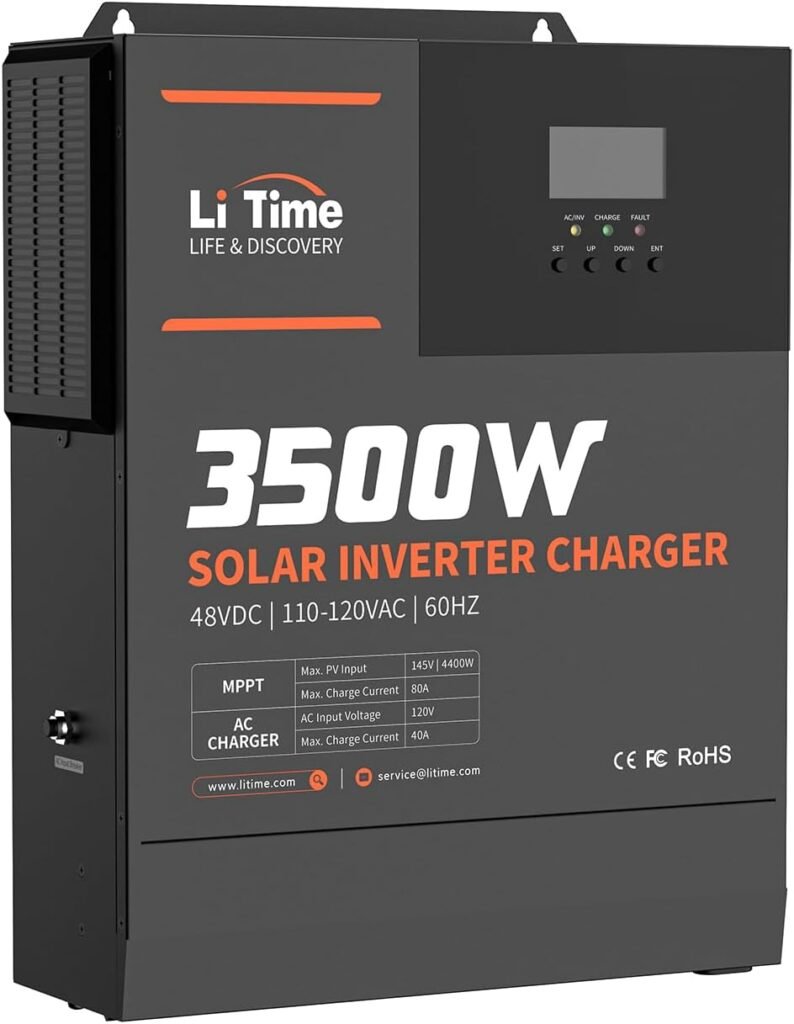
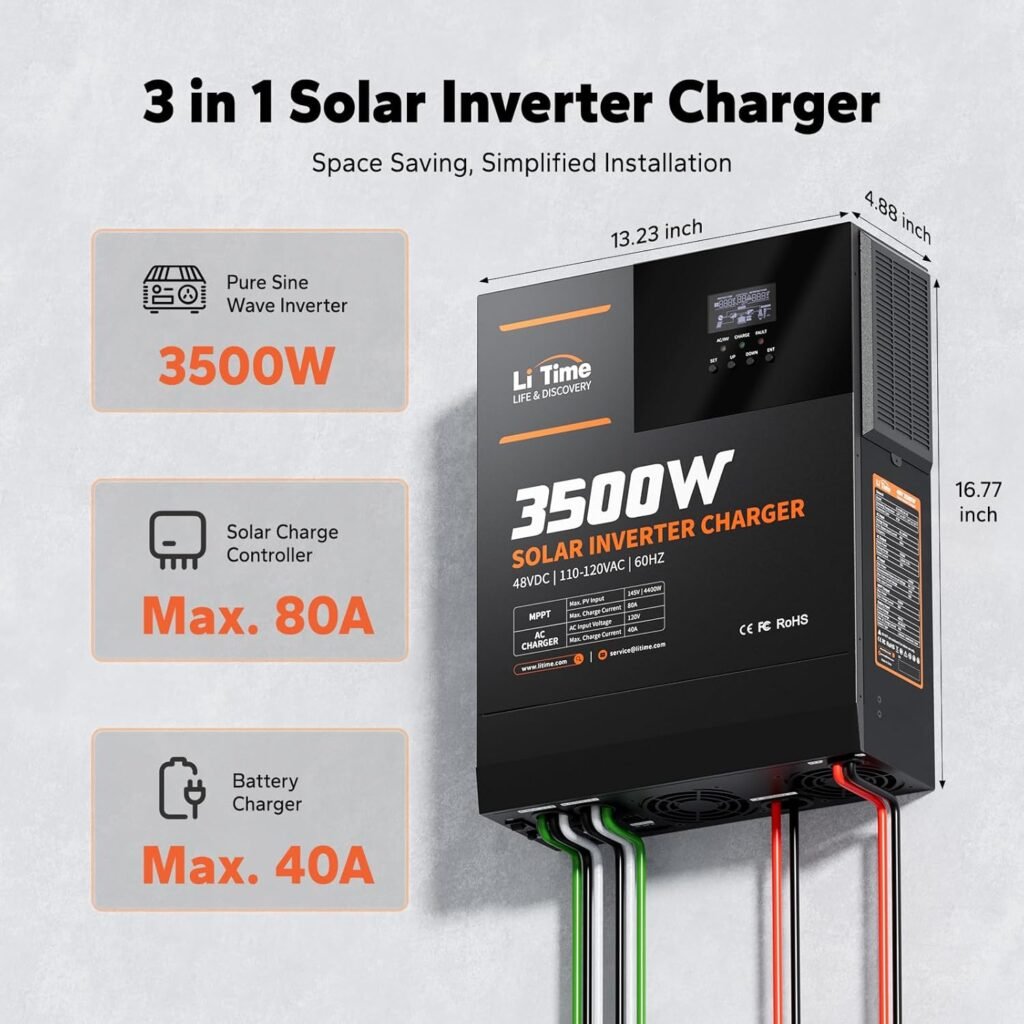
We appreciate compact devices when space is limited in utility closets, sheds, or small server rooms. The all-in-one design is the main selling point here, because it reduces the number of separate boxes, wiring runs, and mounting points.
The enclosure integrates the inverter, charge controller, and AC charger, so we avoid dedicated racks or additional mounts for separate equipment. This reduces clutter and can make installations faster and neater, particularly in small cabins or tight utility closets.
Build quality and form factor
The unit appears to be built with a focus on home and light commercial use. We notice a robust metal housing and thoughtful placement of connectors and cooling fans for airflow. It’s not a super-heavy industrial unit, but it feels solid enough for residential installations.
We also like that the LCD display is included for basic configuration and monitoring without needing external tools. For many users, this makes commissioning and status checks straightforward.
Installation Considerations
Installing an inverter-charger is part electrical work and part systems planning. We want to flag several points to make sure the LiTime 3500W fits your setup without surprises.
First, you must plan for a 48V battery bank that matches the device’s input. The device supports various 48V battery chemistries, but correct battery sizing, cabling, fuse protection, and ventilation are required. Second, ensure the AC breaker and wiring are sized for 3,500W continuous output with the appropriate surge margin for motor loads.
Mounting, wiring, and space
We recommend mounting the unit on a wall or sturdy panel with space for airflow around the built-in fans. Allow clearance above and below the unit for heat dissipation, and keep the unit away from dusty or corrosive environments.
Cabling between battery, PV array, and AC mains should follow local electrical codes. Use appropriately sized battery cables to prevent voltage drop and overheating; typically, 48V systems need thicker conductors for safety and efficiency. Fuses or circuit breakers on the DC side are essential for protection.
MPPT Charge Controller and Solar Integration
We appreciate built-in MPPT controllers because they simplify solar integration and reduce component count. The LiTime unit’s 80A MPPT controller provides a solid charging current for a variety of PV array sizes and battery banks.
MPPT technology maximizes power harvest from the solar array by adjusting the charge voltage dynamically. With 80A capacity, we can pair modest to moderate PV arrays for daily charging of a 48V battery bank depending on system sizing and location.
Solar charging modes and flexibility
We like that the inverter supports multiple charging and output modes, giving us flexibility to prioritize solar, utility, or configure hybrid behavior. The four charging modes—Solar Only, Utility Priority, Solar Priority, and Hybrid—allow us to tune how the system uses solar and grid power.
This flexibility is valuable for cost management and resilience. For example, Solar Priority can minimize grid usage during sunny hours, while Utility Priority keeps the battery charged from the grid when solar is insufficient.
Inverter Performance and Pure Sine Wave Output
For us, Pure Sine Wave output is non-negotiable when powering sensitive electronics, motors, and appliances. The LiTime 3500W provides a pure sine wave output at 120V AC, which should handle most household loads without causing issues with sensitive devices.
The 3,500W continuous capacity covers many household needs, including refrigerators, lighting, electronics, and smaller power tools. The claimed 6,000W surge capability helps start motor-driven loads like compressors, pumps, and some power tools, though we recommend confirming startup current requirements for the largest loads.
Efficiency and thermal management
We look for inverters that convert power efficiently and manage heat well. The LiTime unit uses intelligent cooling fans to maintain stable temperature and performance under load. Efficient conversion helps reduce energy losses and extends runtime for battery-powered operation.
Thermal throttling or fan noise could be considerations in tight spaces, so place the unit in a ventilated area if long durations of high power are expected. The unit’s protections against over-temperature conditions help prevent damage from prolonged overloads.
UPS Functionality and Outage Behavior
We find the built-in UPS function one of the most compelling features for home users. The inverter’s automatic switch to battery backup in milliseconds means sensitive electronics like routers, medical devices, and computers remain powered during short outages.
A UPS integrated into an inverter-charger is a practical convenience because it reduces transfer time and avoids interruptions that can corrupt data or interrupt critical processes. For longer outages, the battery sizing will determine how long the system can keep loads running.
Transfer speed and reliability
The automatic switch time being in the millisecond range makes the system suitable for most loads that cannot tolerate interruptions. We still recommend using a small, separate UPS for extremely sensitive systems where even micro-second switching is critical, but for the vast majority of home electronics, the LiTime’s UPS feature will be more than adequate.
Reliability is enhanced by the unit’s protections and automatic engagement of battery backup. If the grid drops or voltage fluctuates, the unit steps in quickly to stabilize supply.
Battery Compatibility and User Modes
We like when an inverter supports multiple battery chemistries, because it allows upgrading or mixing technologies as needs evolve. The LiTime unit supports 48V lead-acid and LiFePO4 batteries and has user modes including compatibility with LiTime’s own 51.2V100Ah ComFlex Edition battery.
Supporting different battery chemistries means we can configure charging profiles that match the battery manufacturer’s recommended voltages and charge currents. It also makes the unit adaptable to existing battery banks if you’re replacing an inverter or expanding storage.
Configuration and battery management
The built-in LCD and RS485 communications enable basic battery monitoring and parameter adjustment. We appreciate being able to set proper charge voltages, float voltages, and cut-off thresholds to prolong battery life and ensure safe operation.
For LiFePO4 batteries, we recommend enabling the specific LiFePO4 profile if available, since those batteries have different charge termination and float behaviors compared with lead-acid. If you’re unsure, consult your battery documentation or the vendor for recommended settings.
Protection Features and Safety
Our priority with any power equipment is safety and reliability. The LiTime 3500W includes several protections such as short-circuit, over-temperature, and overload protection, plus intelligent cooling to manage heat.
These protections reduce the risk of catastrophic failure and help the unit recover safely from abnormal conditions. Properly integrated protection circuits are essential, particularly in systems with high currents and potentially large battery banks.
What protections mean for real-world use
In practice, these protections mean the unit will shut down or limit output if it detects dangerous conditions. For instance, if a motor stalls and draws excessive current, the overload protection prevents wiring or components from being damaged. Over-temperature protection prevents prolonged heat stress that can shorten lifespan.
Still, we recommend fuses or breakers on the DC side, correct cable sizing, and regular inspection of connections to minimize the chance of faults.
Communication and Monitoring Capabilities
Monitoring is key to good energy management, and we appreciate the inclusion of RS485 and an LCD display for status. These tools let us check battery voltage, solar input, AC status, and error codes without complex setups.
RS485 allows integration with external monitoring systems or data loggers for more advanced setups, and having an onboard LCD speeds troubleshooting and daily checks. Remote monitoring may require additional adapters or gateway devices depending on what ecosystem you use.
How monitoring helps optimize performance
With monitoring, we can verify that solar is producing as expected, the battery is charging correctly, and the inverter is operating within safe limits. This visibility helps us adjust usage, change charging modes, or diagnose issues early.
Set up alerts and regular checks to catch undervoltage, overvoltage, or communication errors before they become larger problems.
Practical Use Cases and Real-World Scenarios
We find the LiTime 3500W to be suited for several common applications. Here are scenarios where we’d consider it a good fit and how we’d configure it for those uses.
- Off-grid cabin or tiny home: Pair with a modest PV array and a LiFePO4 battery to provide reliable power for lights, refrigeration, and small appliances. Use Solar Priority mode to maximize self-consumption.
- Home backup for outages: Keep critical circuits on the inverter with Utility Priority or Inverter Priority, ensuring quick transfer for essential loads like Wi-Fi, fridges, and medical equipment.
- Home energy storage to reduce grid draw: Configure hybrid or solar priority modes to shift consumption to solar-generated energy, reducing utility bills during peak rates.
- Worksite power: Use as a compact inverter-charger with battery storage for intermittent job-site power where grid access is limited.
Load planning examples
We recommend creating a load list to size the battery and PV array appropriately. For example, running a 100W fridge compressor intermittently and a few LED lights could be on a small battery bank, while adding heavy loads like electric ovens or AC units would require much larger batteries and possibly multiple inverters.
Always verify surge requirements for motors and pumps to ensure the 6,000W peak is sufficient.
Pros and Cons — Balanced View
We want to give an honest appraisal, listing what we appreciate and where we see limitations so readers can weigh trade-offs.
Pros:
- All-in-one design reduces equipment and installation complexity.
- Pure sine wave output for sensitive electronics.
- Built-in 80A MPPT simplifies solar integration.
- Multiple charging and output modes for flexibility.
- UPS functionality with fast transfer minimizes interruptions.
- Supports common 48V battery types including LiFePO4.
- RS485 and LCD for monitoring and configuration.
Cons:
- 3,500W continuous output limits suitability for larger homes with heavy HVAC or multiple large appliances.
- Fan noise and heat management may be considerations in tight or quiet installations.
- Advanced remote monitoring might require additional equipment or manufacturer-specific integrations.
- Installation still requires proper electrical work; this is not a plug-and-play full-house solution without planning.
How we interpret these pros and cons
We see this unit as ideal for mid-size systems and users who want a tidy, integrated solution. It may not replace larger three-phase inverters or multi-inverter setups for big homes, but it provides a strong feature set for its power class.
We’d recommend it for users willing to manage battery sizing and accept modest limits on continuous power.
Sizing and System Design Tips
We often see performance issues traced back to poor sizing choices. To get the most from the LiTime 3500W, plan battery capacity, PV array, and load distribution carefully.
First, calculate daily energy consumption (in kWh) and then size the battery to provide desired autonomy. For example, if we need 5 kWh per day and want two days backup, aim for at least 10 kWh usable capacity; for LiFePO4, use depth-of-discharge to determine total bank size. Next, size the PV array to replenish that energy within your typical sunlight hours. The 80A MPPT will limit solar input current, so stay within those bounds.
Wiring and protection suggestions
Use heavy gauge battery cables and high-quality terminals to minimize voltage drop and heat. Install DC fuses near the battery terminals and AC breakers sized for the inverter output. Ensure the ground is correctly connected and bonding follows local codes.
If using the unit to feed a subpanel, label critical circuits and coordinate with a qualified electrician to avoid back-feeding the grid unintentionally.
Installation Checklist
We like checklists to make sure installations are safe, correct, and efficient. Use the following as a basic guide before powering up the LiTime unit.
- Confirm battery chemistry and voltage match the inverter (48V nominal).
- Inspect battery condition and connections; ensure cells are balanced.
- Install DC fuses/breakers on battery positive near the battery.
- Size and route battery cables with adequate gauge and short runs where possible.
- Mount the inverter in a ventilated, dry area with clearance for fans.
- Connect the PV array to the MPPT respecting voltage and current limits.
- Install AC transfer breaker and configure output prioritization as desired.
- Configure battery parameters on LCD or via RS485 to match battery specs.
- Perform a controlled boot-up and test load transfer and UPS behavior.
- Monitor for alarms, unusual heat, or irregularities during initial operation.
Safety and compliance
We insist on following local electrical codes and involving a licensed electrician for grid-tied or complex installations. While the unit simplifies some aspects, electrical safety and permitting are still crucial.
Maintenance and Troubleshooting
We want systems to run reliably for years with minimal fuss. Regular maintenance includes checking cable connections, monitoring battery health, and ensuring the cooling fans are free of dust.
Monitor the LCD for warnings and perform periodic load tests to ensure the UPS function switches cleanly. If problems arise, recorded error codes and RS485 data can assist diagnostics. Replace batteries when capacity drops significantly rather than relying on weak banks that stress the inverter.
Common troubleshooting steps
If the inverter won’t start, verify battery voltage and DC connections first. If solar charge is low, check PV array wiring and voltage at the MPPT input. For frequent overloads, review load lists and redistribute high-startup devices or stagger heavy loads. When in doubt, consult the manual and support resources or contact a qualified technician.
Comparison with Similar All-in-One Units
We find it helpful to compare with similar units in the market to set expectations. The LiTime 3500W sits among other 3–5 kW hybrid inverters that combine MPPT and inverter functions.
Compared to separate inverter + MPPT setups, the all-in-one approach reduces wiring and space but may offer less modularity for future expansion. Competing models may differ in surge rating, MPPT capacity, communication options, or supported battery chemistry. We recommend comparing surge capability, MPPT current, and communication features when choosing among similar models.
When to choose separate components
If you expect to grow your system significantly or want redundancy, separate components might allow incremental upgrades and redundancy by adding another inverter or controller. For most small-to-medium home systems, however, this integrated unit strikes a good balance.
Real-World Performance Expectations
From our experience, users of similar hybrid inverters report stable performance for typical home loads and satisfactory solar harvest when panels are sized appropriately. Expect efficient operation during typical sunny conditions and reliable UPS switching during brief outages.
Battery life will depend heavily on battery chemistry, charge profiles, and depth-of-discharge. With LiFePO4 configured properly, longevity is substantially better than lead-acid alternatives, but correct settings and monitoring are still necessary.
What to watch over time
Over months and years, monitor battery capacity retention and maintain temperature control around the inverter and battery bank. Keep firmware updated if the manufacturer releases updates and ensure RS485/monitoring links remain functional for remote checks.
Final Thoughts and Recommendation
After reviewing the features, protections, and practical considerations, we find the LiTime 3500W All-in-One Solar Inverter Charger to be a compelling option for mid-sized off-grid and hybrid home systems. The unit’s integrated MPPT, UPS function, and multiple charging modes deliver flexibility and convenience that reduce installation complexity.
We recommend the unit for cabins, small homes, and backup applications where 3,500W continuous power is sufficient and where a compact, integrated solution is preferred. For larger homes with heavy HVAC loads, consider parallel units or larger-purpose inverters, but for most residential and light commercial needs, this product offers strong value.
Who should buy this unit
- Homeowners wanting a compact hybrid inverter for backup and solar integration.
- Cabin and RV users needing a reliable UPS and battery-charging solution.
- Installers seeking reduced system complexity with integrated MPPT.
- Users planning to use LiFePO4 batteries and who want configurable charging behavior.
We advise consulting with an electrician or installer for proper sizing and to ensure code compliance, and to verify battery compatibility and settings for safe, long-term operation.
Frequently Asked Questions (FAQ)
We often get similar questions about installation, compatibility, and performance, so we’ve compiled practical answers to help you make an informed decision.
Q: Can this power an entire house? A: It depends on your load. 3,500W continuous is sufficient for many essentials, but whole-house support for electric heating, large AC units, or heavy loads will require larger systems or load management. We recommend a load audit to confirm.
Q: Can we use it with existing batteries? A: Yes, provided the existing battery bank is 48V nominal and the chemistry and specs match supported configurations. Configure the inverter’s charging profile to match battery manufacturer recommendations.
Q: How much solar can the MPPT handle? A: The built-in 80A MPPT dictates the maximum charging current. Panel wattage depends on system voltage and expected charging currents; design your PV array so current into the MPPT doesn’t exceed 80A under peak production.
Q: Is remote monitoring included? A: The unit supports RS485 for communication and has a built-in LCD for local monitoring. For remote monitoring, additional gateway hardware or manufacturer-specific solutions may be required.
Q: What maintenance is required? A: Regularly inspect connections, ensure the cooling fans are unobstructed, monitor battery health, and check for error messages on the LCD. Replace batteries as capacity declines.
We hope this FAQ covers the immediate concerns and helps with planning and ongoing operation. If you need help with system design or specific load calculations, we’re happy to assist further.
Disclosure: As an Amazon Associate, I earn from qualifying purchases.