Have we ever wished charging our LiFePO4 batteries could be simpler, safer, and more predictable, especially when we are on the road or camping off-grid?

What Is the LiTime 10 Amp Lithium Battery Charger?
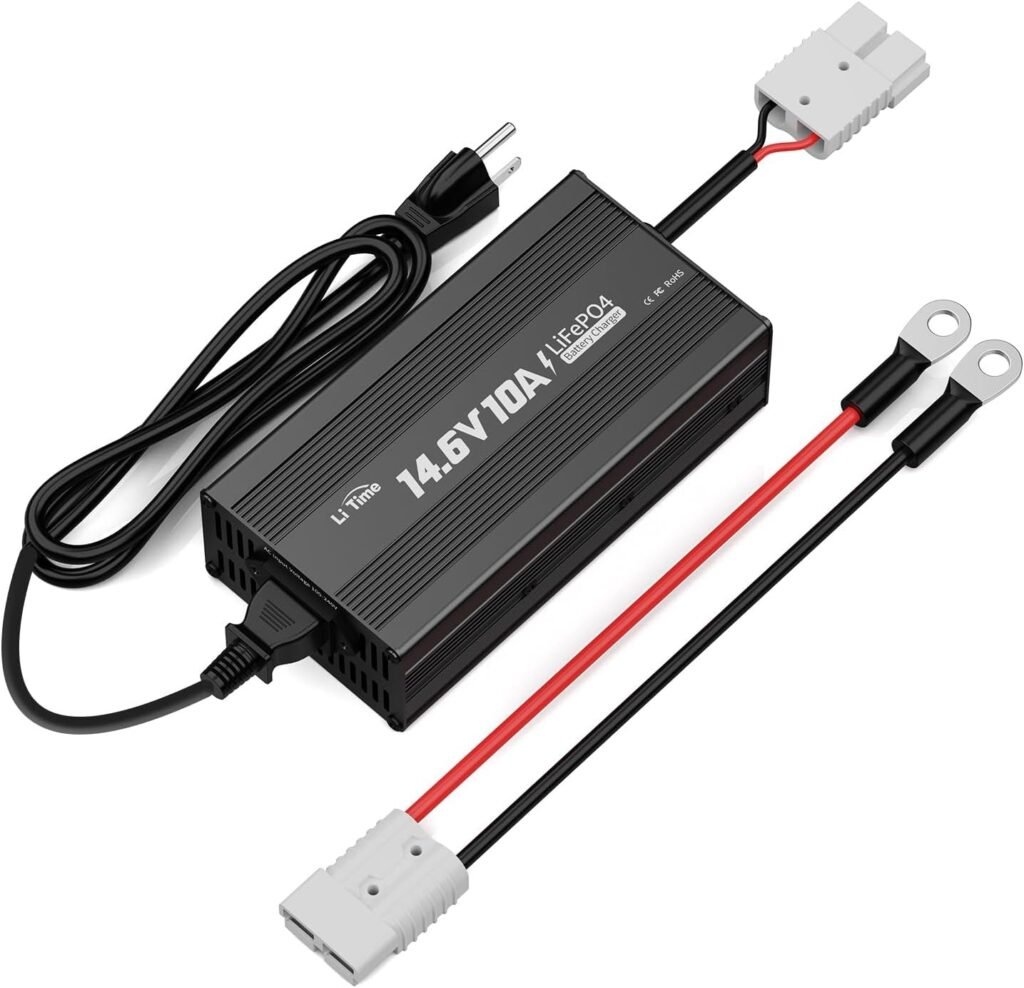
This charger is a 14.6V AC-DC LiFePO4-specific battery charger designed for 12V (12.8V nominal) lithium iron phosphate batteries. It delivers up to 10 amps of charging current and comes with an Anderson connector and LED indicators for clear, real-time status feedback.
We can think of it as a purpose-built tool: it is not a generic charger that works “well enough” with everything, but a specialized unit meant to charge deep cycle LiFePO4 batteries safely and efficiently in cars, trucks, RVs, and solar setups.
Key Features at a Glance
Before we go deeper into how it performs, it helps to see the main points in one place. This quick breakdown gives us a sense of what we are getting with this charger.
| Feature | Details |
|---|---|
| Battery Type | 12V (12.8V) LiFePO4 lithium batteries (deep cycle) |
| Output Voltage | 14.6V (LiFePO4 charging profile) |
| Charging Current | 10A (constant current) |
| Charging Mode | CC/CV with automatic Float/Cut-off |
| 0V Activation | Yes – can help revive batteries under BMS protection |
| Cooling System | Built-in active cooling fan |
| Operating Temperature | Approx. -4°F to 104°F (designed for hot and cold conditions) |
| Safety Certifications | FCC, CE, RoHS, PSE certified |
| Protection Features | Over-temperature, reverse polarity, short circuit, over-voltage |
| Indicator | LED status indicator |
| Connector Type | Anderson connector |
| Ideal Use Cases | RVs, trucks, cars, off-grid solar, deep cycle lithium setups |
| Warranty | 2-year quality warranty |
| Support | Phone and online support with response typically within 24 hours |
| Water Resistance | Not waterproof; not suitable for marine environments (boats, yachts, trolling motors, etc.) |
This snapshot already tells us that the LiTime charger is tuned around safety, lithium-specific charging, and outdoor usability—just not for wet or marine setups.
Design and Build Quality
Overall Construction
The physical design focuses on practicality rather than flash. We are getting a straightforward, functional housing with an integrated cooling system and clear LED indicators.
We tend to appreciate this type of build when we are in a workshop, RV bay, or garage, because we want something that feels solid, straightforward, and not overly complicated with fragile parts or odd shapes.
Size, Weight, and Portability
While exact dimensions can vary slightly by batch, the charger is compact enough to store easily in an RV compartment, toolbox, or vehicle trunk. It is not ultra-mini, but it is comfortably portable for anyone moving between different battery banks.
From a usability perspective, it hits the right middle ground: large enough to feel sturdy and dissipate heat properly, yet small enough that we can carry it around without thinking twice.

Charging Technology: CC/CV and Why It Matters
Smart 14.6V Charging for LiFePO4
LiFePO4 batteries require a specific charging profile to deliver long cycle life and consistent performance. This charger outputs a fixed 14.6V, which is the proper full-charge voltage for a 12V LiFePO4 battery.
We are not dealing with a generic “12V charger” here. Instead, it is tuned to the LiFePO4 chemistry, which helps avoid chronic undercharging or overcharging that can reduce battery life.
CC/CV Charging Explained
This model uses the common CC/CV (Constant Current / Constant Voltage) method:
- Constant Current (CC): At the start, the charger provides up to 10A while the battery voltage rises. This is where the bulk of the charging happens.
- Constant Voltage (CV): Once the battery reaches around 14.6V, the charger maintains that voltage while the current gradually tapers down as the battery reaches full capacity.
- Float/Cut-off: When the battery is fully charged, the charger transitions automatically—either stopping or dropping to a maintenance mode as designed for LiFePO4.
We benefit from this approach because it gently tops off the battery without pushing it beyond its safe limits.
0V Activation: Helping Recover Protected Batteries
What 0V Activation Means
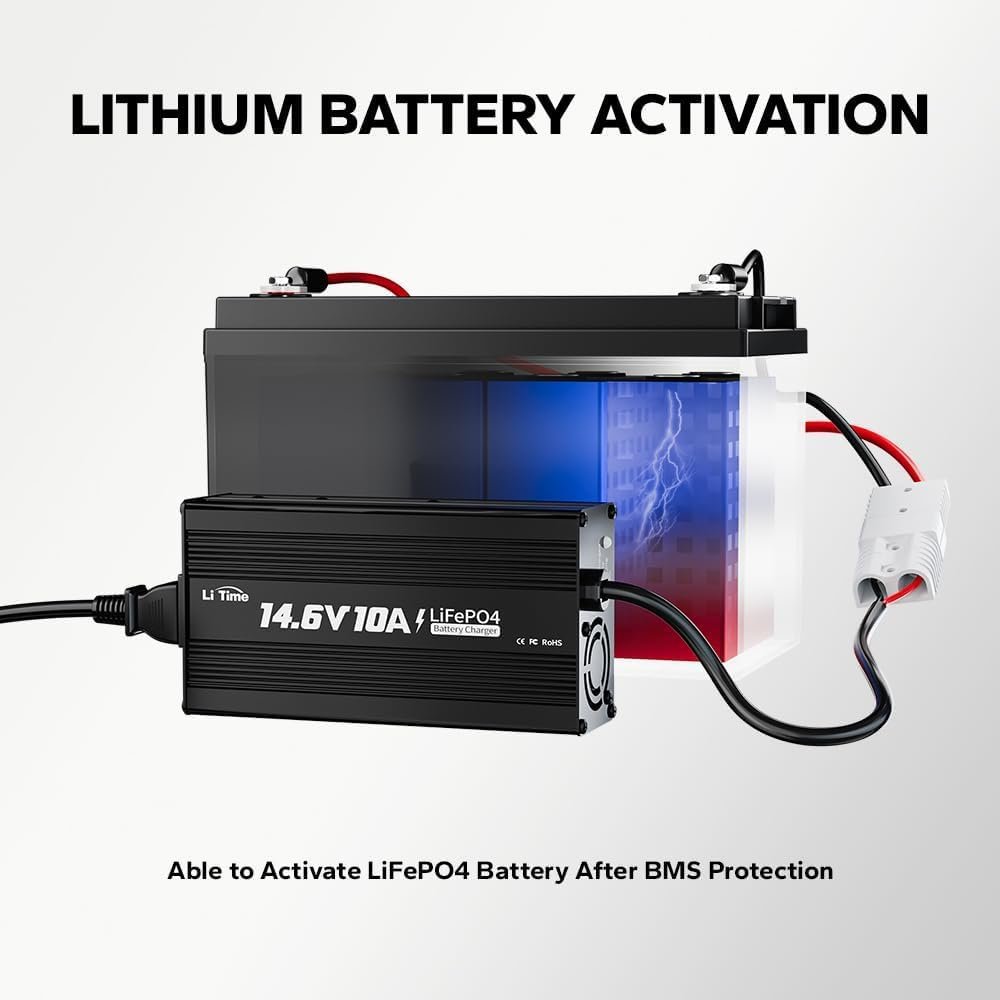
Some LiFePO4 batteries have built-in Battery Management Systems (BMS) that shut down output in protection mode, often appearing as “0V” on a meter. Many standard chargers will refuse to charge these because they detect no voltage.
The LiTime 10A charger supports 0V activation, meaning it can send a controlled current to wake up batteries that are in a BMS-protected state, assuming the battery is still otherwise healthy.
When This Becomes Useful
We might run into this scenario if:
- We accidentally discharge our battery too low in an off-grid or RV setting.
- A battery has been left unused for a long period and the BMS has cut off to protect it.
- We inherit or buy a battery that is in a protected “sleep” mode.
In such cases, having a charger that can initiate recovery gives us a second chance, instead of having to declare the battery dead immediately.
Cooling Performance and Working in Extreme Temperatures
Built-In Cooling Fan
The charger includes an internal fan to manage heat, which is especially helpful when charging at the full 10A rate. Under continuous load, the internal electronics generate heat, and active cooling ensures components remain within safe operating limits.
We might notice the fan noise while it is running, but it is a tradeoff for maintaining performance and extending charger life.
Operating Temperature Range
It is designed to function from roughly -4°F to 104°F. That means it is suitable for:
- Cold mornings at a winter campsite or off-grid cabin.
- Hot afternoons inside an RV bay or in a garage in summer.
We still want to avoid completely enclosed, unventilated spaces, but this range gives us confidence that the charger is built with real-world climate variations in mind.
Safety, Certifications, and Protection Features
Certified for Safety
The charger is listed as compliant with several recognized standards:
- FCC – electromagnetic compatibility
- CE – general safety and compliance (commonly required in Europe)
- RoHS – restriction of hazardous substances
- PSE – electrical safety standard (commonly associated with Japan)
These certifications signal that the device has gone through testing for electrical safety and environmental standards, which we value when hooking up expensive battery banks.
Built-In Protection Systems
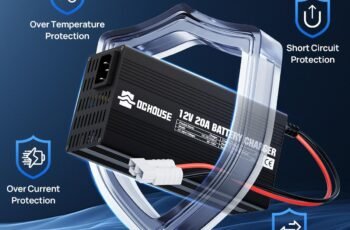
The LiTime 10A charger includes several protective measures:
- Over-temperature protection – reduces risk of damage or failure if internal temperatures get too high.
- Reverse polarity protection – if we accidentally connect positive to negative and vice versa, the charger is designed to guard against damage.
- Short-circuit protection – if the output is shorted, the charger will protect its circuitry.
- Over-voltage protection – prevents the battery from being exposed to unsafe voltage levels.
These layered safeguards give us peace of mind while charging, especially when we connect and disconnect frequently in an RV or mobile setup.
LED Indicator and Ease of Use
LED Status Indicator
The charger uses an LED indicator system to inform us of charging status. While the exact color scheme may be outlined in the printed manual, typical behavior includes:
- Power on / stand-by
- Charging in progress
- Fully charged or charging complete
- Fault or error status (if applicable)
We like this because we can glance at the charger and quickly understand whether the battery is still charging or is basically ready to go.
Simple Operation
Using the charger tends to come down to three basic steps:
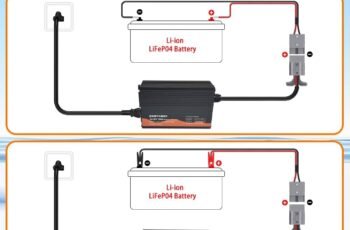
- Connect the charger output (via Anderson connector or adapters) to the battery.
- Plug the charger into AC power.
- Monitor the LED to confirm operation.
There are no complicated menus or buttons to navigate. This simplicity is helpful for those of us who want a “plug-and-charge” experience without having to manually configure voltage and current settings.
Anderson Connector and Connection Flexibility
Why the Anderson Connector Matters
The LiTime charger comes with an Anderson connector on the output side. These connectors are widely used in off-grid, RV, ham radio, and DC power applications because they:
- Are robust and rated for higher currents.
- Connect and disconnect quickly.
- Reduce the risk of wrong polarity when used with matching plugs.
When our system wiring uses Anderson connectors, we can click this charger into our setup with minimal effort.
Adapting to Other Connection Types
If our battery has ring terminals or different connectors, we can easily use an adapter cable from Anderson to alligator clips or Anderson to ring terminals. This makes the charger more flexible over time, especially if we build out multiple battery banks or change our setups.
We appreciate having the Anderson as the base connection, since it is generally easier to adapt outward from this standard than from a proprietary plug.
Performance with 12V LiFePO4 Batteries
Suitable for Deep Cycle Packs
This unit targets 12V (12.8V nominal) LiFePO4 deep cycle batteries. That includes many typical capacities such as:
- 12V 50Ah
- 12V 80Ah
- 12V 100Ah
- 12V 200Ah (it will just take longer to charge)
It is not meant for lead-acid, AGM, or gel batteries, and not for lithium chemistries that need different voltages. Matching the chemistry is important for both safety and longevity.
How Long Charging Might Take
As a rough rule of thumb, charging time can be estimated with:
Charging Time ≈ Battery Ah / Charger A (plus 10–20% overhead)
For example:
- A 12V 50Ah LiFePO4 battery:
50Ah / 10A ≈ 5 hours (plus a bit of time in CV phase) - A 12V 100Ah LiFePO4 battery:
100Ah / 10A ≈ 10 hours (plus CV top-off) - A 12V 200Ah LiFePO4 battery:
200Ah / 10A ≈ 20 hours
We should remember that if our battery is not fully discharged, it will take less time. The tapering in the CV stage also means the last few percent of charge might stretch a bit longer than the simple math.
Real-World Use Cases: Where the Charger Shines
RV and Camper Setups
For RV owners running 12V LiFePO4 house batteries, this charger fits naturally into the workflow. We can:
- Charge our batteries at campsites with shore power.
- Top up our battery bank after several days of boondocking.
- Keep a portable LiFePO4 pack topped off for lights, fridges, and inverters.
Because it is lithium-specific, we do not have to worry about whether the voltage profile will cause damage over time.
Trucks, Cars, and Auxiliary Batteries
If our vehicle has a 12V LiFePO4 auxiliary battery—for inverters, fridges, lights, or tools—this charger offers a reliable way to maintain it when the engine is off. We can plug it into a standard AC outlet at home or in a workshop and keep the battery in good shape.
We can also use it to maintain a LiFePO4 starter or accessory battery in a car or truck, as long as the battery manufacturer supports that application.
Off-Grid and Solar Systems
In off-grid solar setups, we often have a solar charge controller handling daytime charging. However, sometimes we:
- Do not get enough sun.
- Need to bring a battery indoors for maintenance charging.
- Want an AC backup charging method from a generator or grid power.
This charger provides that AC backup. We can hook it directly to our battery bank and top it up when solar alone is not enough.
What About Boats and Marine Use?
Important Limitation: Not Waterproof
A critical point with this charger is the manufacturer’s warning:
This 12V 10A lithium battery charger is not waterproof and not suitable for marine environments such as boats, ships, yachts, and trolling motors.
That means:
- We should not use it in areas where it may be splashed, rained on, or exposed to heavy moisture.
- It is not designed for the harsher corrosion and humidity conditions typical of marine installations.
We might still be able to use it indoors in a dry, protected boathouse to charge removable batteries off the vessel, but it should not be integrated directly into a wet marine area.
Why This Matters
Water and AC-powered devices do not mix safely. Since the charger is not sealed, moisture can enter the casing, leading to shock hazards, corrosion, or failure. We need to respect the limitation and choose a marine-rated charger if we need something hard-mounted on a boat or near water.
Reliability, Warranty, and Support
2-Year Warranty
The LiTime 10A charger includes a 2-year quality warranty, which is a reasonable length in this price and product category. We interpret that as a sign that the manufacturer expects the unit to hold up under normal usage for a good amount of time.
If something fails prematurely under normal conditions, we have a defined window for repair or replacement.
Technical Support and Customer Service
LiTime mentions professional technical support via:
- Phone assistance
- Online services (likely email, chat, or ticketing)
With an aim of responding within 24 hours, this can be helpful if we:
- Are unsure about compatibility with a particular battery model.
- Have questions about wiring and connectors.
- Need help diagnosing a charging issue or error indication.
We like knowing that we are not left alone if something does not work exactly as expected, especially when dealing with battery systems that can be expensive to replace.
Pros and Cons of the LiTime 10A Lithium Battery Charger
To keep our assessment balanced, it helps to summarize what stands out positively and where potential drawbacks lie.
Advantages
- LiFePO4-specific profile: 14.6V output tailored for 12V lithium iron phosphate batteries.
- 10A output: A good middle ground between speed and battery longevity.
- CC/CV with auto transition: Intelligent charging with automatic shift to float/cut-off.
- 0V activation: Capable of reviving LiFePO4 batteries under BMS protection, when appropriate.
- Active cooling: Built-in fan helps sustain performance under load and in higher temperatures.
- Safety protections: Includes multiple layers of electrical and thermal protection.
- Certifications: FCC, CE, RoHS, PSE compliance gives extra confidence in design and safety.
- Anderson connector: Practical connection standard for RV and off-grid use.
- User-friendly: Simple LED indicators and plug-in operation, no complex programming.
- Decent warranty and support: 2-year warranty plus technical support resources.
Limitations
- Not waterproof: Cannot be used in wet or marine environments like open boat compartments.
- Single chemistry focus: Not suitable for lead-acid or other lithium chemistries that require different voltages.
- Limited to 10A: Larger banks (e.g., 200Ah or more) will take longer to charge; some users might want higher current.
- Active fan noise: The cooling fan brings some noise, which might be noticeable in quiet indoor spaces.
Understanding these trade-offs helps us decide whether this charger fits into our specific setup or if we need something with different characteristics.
How It Fits into Our Power System
For Those of Us with LiFePO4 Banks
If we already own LiFePO4 batteries (or plan to switch from lead-acid), a dedicated charger like this lets us:
- Protect our investment by using the right voltage and charging profile.
- Get predictable charging times and behavior.
- Avoid manually adjusting a variable charger every time we plug in.
It is particularly appealing if we are building a system where we want things to “just work” without babysitting voltage settings.
As a Backup to Solar or Alternator Charging
Many RVs or off-grid systems rely primarily on:
- Solar charge controllers for charging during the day.
- Vehicle alternators (sometimes with DC-DC chargers) while driving.
This LiTime charger fits well as a third charging source from AC power. We can:
- Use it with shore power when parked at a campground.
- Run it off a generator during extended cloudy weather.
- Plug it in at home to maintain batteries during off-season storage.
Having multiple ways to charge our batteries makes the entire system more resilient.
Practical Tips for Getting the Most Out of the Charger
Check Compatibility Before Using
Before hooking up the charger, we should:
- Confirm our battery is a 12V (12.8V) LiFePO4 model.
- Verify that the recommended charging voltage and current from the battery manufacturer is compatible with 14.6V and 10A.
- Avoid using it on automotive lead-acid or AGM batteries that expect different profiles.
Matching specs up front can prevent issues and prolong battery life.
Give the Charger Room to Breathe
Since the charger has a fan, we should:
- Place it in a well-ventilated area.
- Avoid covering it with bags, blankets, or tools.
- Keep it off damp surfaces or locations where condensation might form.
Good airflow helps the cooling system do its job and prevents unnecessary thermal stress.
Respect the Dry Environment Requirement
For safety and longevity:
- Use the charger only in dry locations.
- Keep it away from spray, puddles, or dripping water.
- Do not hard-mount it in exposed marine compartments.
If we need a charger in a wet or semi-wet environment, we should look for a waterproof, marine-rated model instead.
Who This Charger Is Best Suited For
Ideal Users
We see this charger working especially well for:
- RV owners with 12V LiFePO4 house batteries who want a reliable AC charging option.
- Off-grid cabin or tiny home owners using LiFePO4 batteries and needing a shore-power or generator-based charger.
- Vehicle owners with LiFePO4 auxiliary or starter batteries who want a lithium-correct charger.
- DIY solar and battery enthusiasts building lithium-based systems who value a simple, safe charger rather than a general-purpose alternative.
If we fall into one of these groups, the LiTime 10A Lithium Battery Charger slots naturally into our workflow.
Who May Need Something Else
On the other hand, this charger may not be the best fit if:
- We only use lead-acid/AGM batteries and have no plan to switch to LiFePO4.
- We need a marine-grade waterproof charger permanently mounted on a boat deck or in a very wet environment.
- We manage very large battery banks (e.g., multiple 300Ah packs) where a higher-current charger would dramatically cut charge times.
In those cases, a different design or higher amperage charger would probably be more appropriate.
Our Overall Impression
The LiTime 10 Amp Lithium Battery Charger 14.6V AC-DC LiFePO4 is a focused, lithium-specific charging solution that emphasizes safety, correct charging profiles, and practical usability for RVs, vehicles, and off-grid systems.
We appreciate several aspects:
- The 14.6V output tuned precisely for 12V LiFePO4.
- The 0V activation capability for recovering BMS-protected batteries.
- The built-in safety features and recognized certifications.
- The Anderson connector, which integrates nicely into many DC systems.
- The straightforward LED status and plug-and-play operation.
We do need to remember two main limitations: it is not waterproof, and it is not meant for other battery chemistries. As long as we operate within those boundaries, it offers a reliable and user-friendly way to keep our LiFePO4 batteries charged and ready.
If our priority is trustworthy charging for 12V LiFePO4 deep cycle batteries in an RV, truck, car, or off-grid application—and we are working in a dry environment—this charger stands out as a strong, sensible choice that fits neatly into an everyday power setup.
Disclosure: As an Amazon Associate, I earn from qualifying purchases.