Have we ever dreamed of giving our golf cart the kind of power, range, and reliability we usually expect from an electric vehicle, not a weekend toy?

What Makes the LiTime 48V 120Ah GC2 Golf Cart Battery Stand Out?
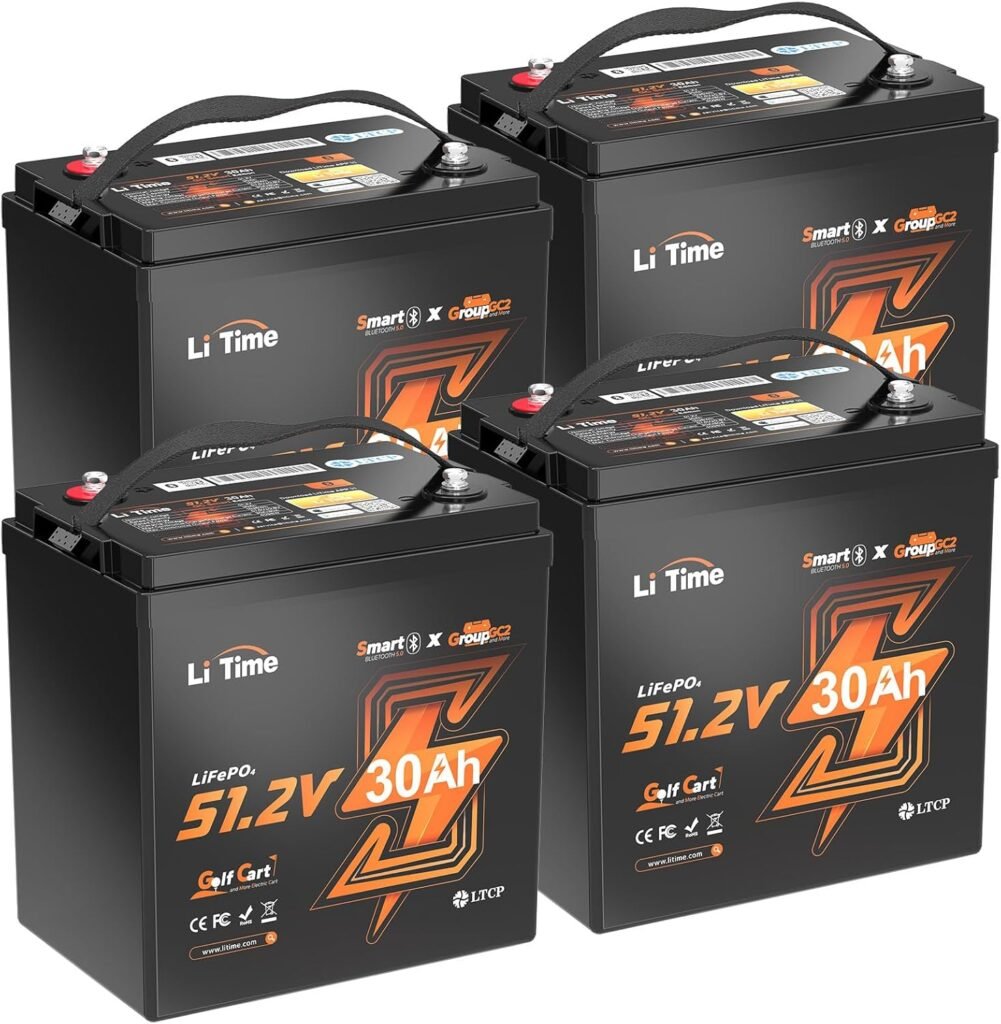
When we first look at the LiTime 48V 120Ah (4-Pack 48V 30Ah) GC2 Golf Cart LiFePO4 Lithium Battery with Bluetooth & Low-Temp Protection, it feels like a big step up from the usual lead-acid setup. This pack is designed not just as a replacement, but as a real upgrade for our golf cart’s performance, longevity, and convenience.
This system combines modern lithium iron phosphate (LiFePO4) chemistry, a smart Bluetooth-enabled BMS, and a GC2 form factor that fits many golf carts without awkward modifications. It is built to handle demanding use while staying safe, efficient, and incredibly long-lived.
Key Specifications at a Glance
Sometimes battery specs look like a jumble of numbers, so it helps to see them laid out clearly. Below is a quick summary of the main features and what they mean for us in everyday use.
| Feature | Specification / Description |
|---|---|
| Battery Type | LiFePO4 (Lithium Iron Phosphate) |
| Pack Configuration | 4 × 48V 30Ah batteries (total nominal 48V 120Ah) |
| Nominal Voltage | 48V |
| Capacity (per battery) | 30Ah |
| Total Capacity (4-pack) | 120Ah |
| Energy (per battery) | ~1536Wh |
| Total Energy (4-pack) | ~6144Wh (6.144kWh) |
| Max Usable Energy (8 in parallel) | Up to 12.288kWh |
| Continuous Output Power (per battery) | Up to 3000W |
| Motor Support | Compatible with electric motors up to 3kW |
| Cell Type | EV A+ Grade Steel Case Cylindrical Cells |
| Cycle Life | Up to 15,000 cycles (under ideal conditions) |
| Expected Lifespan | Up to 10 years |
| Form Factor | GC2 size, designed for golf carts |
| BMS | Built-in 100A Smart BMS |
| Protections | Over-charge, over-discharge, over-current, high temp, short-circuit, low-temp cut-off |
| Connectivity | Bluetooth 5.0 with LiTime APP |
| Range (per 48V 30Ah battery) | About 12–14 miles per full charge (cart and usage dependent) |
| Weight vs Lead-Acid | Significantly lighter, 3–5× higher energy density than comparable AGM/lead-acid |
| Charging Requirement for Activation | Needs lithium-activation charger or MPPT charger to wake up Bluetooth after shipping/off |
This combination of high-specific-energy, long cycle life, and smart monitoring is what separates this pack from traditional batteries we might be used to in older golf carts.
Design and Build Quality
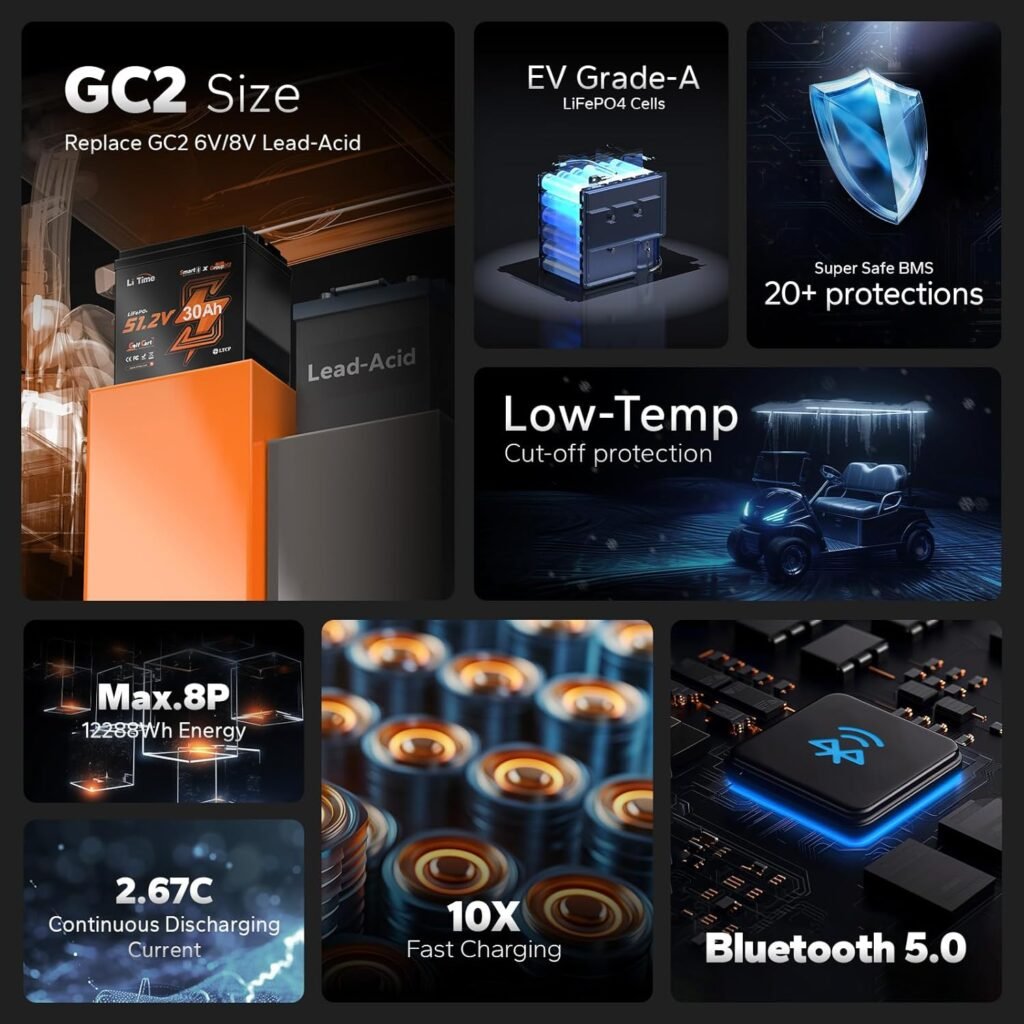
We can feel that this battery pack is designed for real-world golf cart life, not just lab specs. The GC2 size means it is intended to be a direct, practical replacement for the usual 6V or 8V lead-acid sets we see under the seat.
GC2 Form Factor for Golf Carts
The GC2 size is one of the most common standards in the golf cart world. LiTime has purpose-built this pack to match that footprint, so we are not wrestling with awkward fitment or custom brackets.
This means we can modernize an existing cart without having to reinvent the entire battery compartment. We simply remove the old batteries and slot these in, following the appropriate wiring layout for the pack.
EV A+ Grade Steel Case Cylindrical Cells
Instead of using cheaper prismatic or pouch cells, LiTime uses EV A+ grade steel case cylindrical cells. This cell style has a few big benefits for us:
- Better structural integrity under vibration and bumps
- Improved heat dissipation through the metal casing
- More consistent performance between cells
For a golf cart that regularly rattles over uneven ground, these rugged cells can really help with longevity and reliability.
Performance: Power, Speed, and Handling
Performance is where we really start seeing the difference between a modern LiFePO4 pack and an older lead-acid bank. The LiTime 48V 120Ah pack is built to handle substantial continuous loads and maintain voltage more consistently under hard acceleration.
Continuous Discharge and Motor Support
Each 48V 30Ah battery supports a continuous discharge current around 2.67C, which translates to solid power output for its size. The pack is rated to support up to a 3kW electric motor, which lines up well with what many golf carts use for upgraded or stock electric powertrains.
Because LiFePO4 maintains its voltage much more steadily than lead-acid as it discharges, we often get:
- Stronger hill-climbing performance later in the day
- Less “sluggish” feeling when the battery is partially depleted
- More predictable behavior across the charge range
Improved Handling from Lower Weight
One understated but very real benefit: weight. LiFePO4 packs like this one are significantly lighter than the equivalent lead-acid setup. LiTime notes roughly 3–5 times higher energy density compared to traditional AGM batteries.
For us, that means:
- Better acceleration with the same motor
- Reduced strain on suspension and tires
- More nimble handling on uneven terrain
On a cart loaded with clubs, coolers, and passengers, shaving weight off the battery bank can make the ride feel noticeably more responsive and less “bottom-heavy.”

Range and Real-World Use
We usually care about two simple things: how far we can go on a charge, and how long the batteries last before they need replacing. This pack is tuned to excel at both.
Estimated Range per 48V 30Ah Battery
LiTime rates each 48V 30Ah battery at roughly 12–14 miles per full charge, depending on cart configuration, terrain, load, and driving style. With four 30Ah batteries combined into a 48V 120Ah system, we are effectively quadrupling that per-pack capacity.
In practical terms, that means we can comfortably get multiple full rounds of golf, or a solid day of use in a community or on a course, without stressing about running out of power.
Scaling Up with Parallel Packs
For those of us running heavier carts, carrying multiple passengers, or needing extended range, LiTime supports up to 8 batteries in parallel. At that point, total energy storage reaches up to about 12.288kWh.
That is a huge amount of usable energy for a golf cart and moves us into territory similar to small electric vehicles. The ability to scale in this way is a key advantage of modular lithium systems over one-piece sealed lead packs.
Smart BMS and Bluetooth Connectivity
This is where the batteries start to feel truly modern. Instead of guessing the state of charge by how sluggish the cart feels, we can actually see what is going on inside the pack in real time.
Built-in 100A Smart BMS
The integrated 100A BMS (Battery Management System) acts as our battery’s onboard guardian. It constantly monitors and manages:
- Over-charge protection
- Over-discharge protection
- Over-current protection
- High-temperature protection
- Short-circuit protection
This smart supervision increases safety, protects our investment, and helps the cells last as long as the cycle life rating suggests. It also gives us peace of mind when pushing the motor under heavier loads.
Bluetooth 5.0 and the LiTime APP
The Bluetooth 5.0 module and LiTime APP support are a major convenience. Using our smartphone, we can monitor battery health and performance instead of relying only on a voltage meter or guesswork.
Through the app, we can typically view:
- Real-time voltage and current
- State of charge (SOC)
- Remaining capacity
- Temperature readings
- Cycle count and status information
For anyone who likes keeping an eye on system health, or who has ever been surprised by a dying lead-acid pack, this level of transparency is incredibly useful.
Low-Temperature Protection and Safety
Temperature extremes are tough on batteries. Lithium chemistry, in particular, is more sensitive to cold when it comes to charging, which is why the low-temperature cut-off feature matters so much.
Low-Temperature Cut-Off Function
The enhanced low-temp protection automatically stops charging when temperatures drop below a safe threshold. This protects the cells from plating damage and long-term capacity loss that can occur if lithium batteries are forced to charge in freezing conditions.
We can still discharge in colder weather within allowed limits, but the battery quietly looks after itself on the charging side. For carts used in colder regions or during early mornings and late evenings, this protection is especially important.
Comprehensive Safety Suite
Combined with over-current, high-temperature, and short-circuit protection, the BMS and protective logic work together to:
- Prevent dangerous operating conditions
- Shut down or limit current before damage occurs
- Help ensure long-term safety, even with frequent use
For a vehicle carrying people across a course or neighborhood, this kind of robust safety layer is exactly what we want from a modern battery system.
Lifespan, Cycle Life, and Long-Term Value
Battery life is where LiFePO4 really leaves lead-acid behind, and the LiTime 48V 120Ah pack makes full use of that chemistry advantage.
Up to 15,000 Cycles Under Ideal Conditions
LiTime quotes a maximum cycle life of up to 15,000 cycles, under appropriate conditions and moderate depth-of-discharge. Even at more typical usage patterns, we can expect thousands of cycles before capacity noticeably drops.
To put this in perspective, most lead-acid golf cart batteries struggle to exceed a few hundred deep cycles before performance falls off, and many need replacement within 3 to 5 years depending on care.
10-Year Lifespan Expectation
With good charging habits and within recommended temperature ranges, LiTime projects up to a 10-year lifespan. Over that period, the batteries can:
- Reduce replacement frequency compared to AGM or flooded lead-acid
- Lower total cost of ownership in the long run
- Save us time, maintenance effort, and disposal headaches
We may pay more upfront, but the longevity and reduced maintenance make the economics much more attractive over the life of the cart.
Comparing to Traditional AGM and Lead-Acid Batteries
Most of us upgrading to this pack are coming from a bank of 6V or 8V lead-acid batteries. Comparing the two helps show what kind of upgrade we are really getting.
Weight and Energy Density
LiTime states an energy density 3–5 times higher than typical AGM batteries. That means more energy in less space and at a lower overall weight.
Benefits for us include:
- Easier installation and handling
- Improved cart performance with less weight to move
- Less frame and suspension stress over time
We are essentially getting more usable energy with far less bulk.
Usable Capacity and Voltage Sag
Lead-acid batteries suffer voltage sag and should not be deeply discharged if we want them to last. LiFePO4, on the other hand:
- Maintains a flatter voltage curve during discharge
- Provides more stable power for longer stretches
- Can be safely used to a deeper depth-of-discharge within recommended limits
In everyday terms, we do not feel the cart “bog down” as quickly with LiFePO4 as we would with lead-acid at similar remaining capacity.
Maintenance and Convenience
Lead-acid batteries often require:
- Periodic water top-offs (for flooded models)
- Terminal cleaning due to corrosion
- Ventilation to prevent gas buildup during charging
With LiFePO4, we get a maintenance-light solution:
- No watering
- Greatly reduced corrosion issues
- More efficient charging with less wasted energy as heat
This makes owning and operating our cart a lot simpler and cleaner.
Installation and Compatibility
While every cart model is a bit different, LiTime has done a lot of the upfront work to make these batteries a straightforward swap for many golf carts that use GC2-sized bays.
GC2 Replacement Fit
The GC2 form factor means we typically drop these into the same physical slots as our old lead-acid batteries. That minimizes cutting, custom brackets, or fabrication work.
We do need to pay attention to:
- Cable routing and terminal connections
- Correct series and/or parallel configuration according to the pack design
- Ensuring all batteries are properly secured to handle bumps and vibration
If we are comfortable working with battery wiring, the process is fairly direct. For those of us who are not, it may be worth involving a golf cart tech or electrician.
Electrical Compatibility
The pack is designed for 48V golf cart systems and supports motors up to 3kW, which covers a wide range of popular carts and aftermarket upgrades.
In some cases, we may need or want:
- A lithium-compatible charger (strongly recommended)
- Updates to any built-in state-of-charge gauge or meter
- Verification that any existing accessories can handle the stable LiFePO4 voltage profile
Using the right charger is especially important, both for safety and to get the full benefit of the LiFePO4 chemistry.
Charging: What We Need to Know
Charging lithium batteries is not complicated, but there are a few details that differ from lead-acid that we need to understand.
Lithium-Activation or MPPT Charger Requirement
LiTime specifies that when we first receive the battery, or if it has been switched off, we must use:
- A lithium-activation charger, or
- An MPPT (Maximum Power Point Tracking) charger
to activate the Bluetooth function and properly wake the packs from storage mode.
This is not a defect; it is a protective measure. The batteries ship in a safe, low-power state. Once properly charged with the right profile, they come fully online, and Bluetooth starts broadcasting for the app.
Optimal Charging Profile
To get the best life and performance from these batteries, we should:
- Use a charger with a proper LiFePO4 profile
- Avoid overcharging or letting voltage exceed recommended limits
- Not leave the pack at 0% or 100% for extended periods when not in use
Following these guidelines helps us approach that long cycle life and 10-year lifespan the pack is designed for.
Everyday Experience and Convenience
Beyond the specs, we care about what using these batteries actually feels like day to day. This pack is clearly aimed at making our cart feel more like a quiet, effortless electric vehicle and less like a machine we constantly baby.
Quieter, Smoother Power Delivery
LiFePO4 packs typically run quietly and smoothly. With stable voltage and the BMS managing current flow, we tend to notice:
- Fewer dips or surges in power
- Consistent performance from the first hole to the last
- Less battery-related drama on hills or during spirited driving
The cart’s character becomes much more predictable.
Monitoring with the LiTime APP
Being able to glance at our phone and see:
- State of charge
- Voltage
- Current draw
- Temperature
gives us a sense of control and awareness that lead-acid simply cannot match. If we are planning a longer route or a full day of use, we can quickly check whether we have enough capacity and adjust plans accordingly.
Who Is This Battery Pack Best For?
Not every owner needs a top-tier LiFePO4 system, but for many of us, the LiTime 48V 120Ah GC2 pack fits perfectly.
Golf Cart Owners Focused on Performance
If we:
- Have upgraded our motor or controller
- Use our cart on hilly courses or in communities with inclines
- Want a stronger, more responsive ride
this battery pack’s power handling and stable voltage can transform how the cart feels underfoot.
Long-Term Owners and Heavy Users
For those of us who:
- Use our cart multiple times per week
- Put serious mileage on the batteries each season
- Are tired of replacing lead-acid banks every few years
the 10-year lifespan and thousands of cycles make these batteries an investment, not just a purchase.
Owners in Colder or Variable Climates
The low-temperature cut-off, solid BMS protections, and LiFePO4 chemistry stability are particularly helpful if we:
- Store our cart in unheated spaces
- Occasionally run it in early spring or late fall
- Want to avoid cold-weather charging damage
The batteries essentially look out for themselves, so we do not have to constantly worry about outside conditions.
Pros and Cons at a Glance
We find it helpful to summarize what we gain and what trade-offs we accept with a system like this.
Advantages
- Huge Cycle Life: Up to 15,000 cycles, leading to a potential 10-year lifespan.
- GC2 Direct Replacement: Designed specifically for golf cart battery compartments.
- High Energy Density: 3–5× higher energy density than AGM; much lighter system.
- Strong Performance: Supports up to a 3kW motor with stable voltage and power.
- Smart BMS: Over-charge, over-discharge, over-current, high-temp, and short-circuit protection.
- Bluetooth Monitoring: Real-time data through the LiTime APP via Bluetooth 5.0.
- Low-Temp Protection: Safe charging behavior in cold conditions with cut-off logic.
- Scalability: Up to 8 batteries in parallel for a massive 12.288kWh capacity.
Possible Drawbacks
- Higher Upfront Cost: LiFePO4 packs typically cost more than lead-acid sets initially.
- Charger Requirements: We may need to upgrade to a lithium-compatible or MPPT charger.
- Initial Activation Step: Requires lithium-activation or MPPT charger to wake Bluetooth and full function.
- Installation Care: While straightforward, installation still requires attention to wiring and configuration.
For many of us, the long-term savings in replacements and the performance gains more than offset the higher purchase price, but it depends on how long we plan to keep and use our cart.
Tips for Getting the Most Out of the LiTime 48V 120Ah Pack
To fully benefit from this system, a few usage habits go a long way.
Follow Charging Best Practices
We should:
- Use a LiFePO4-compatible charger whenever possible.
- Avoid repeatedly draining the pack to absolute zero.
- Not leave the battery sitting at full charge for very long periods if we are storing the cart.
Keeping the battery in a moderate state of charge when not in use helps slow aging and preserves cycle life.
Mind Temperature and Storage
With the BMS and low-temp cut-off, a lot of the protection is automatic, but we can help by:
- Avoiding extended storage in extreme heat or deep freeze conditions.
- Storing the pack in a partially charged state if the cart will sit for months.
- Periodically checking status via the APP if the cart is idle for a long time.
These little habits help us get closer to that upper-end lifespan rating.
Use the APP as a Tool, Not a Distraction
The LiTime APP is very handy, but we can treat it like an instrument panel, not a constant obsession. By checking in occasionally, we can catch issues like:
- Abnormal temperature readings
- Unexpectedly fast capacity drop (which may indicate a wiring or load issue)
- Unusual cycle counts or usage patterns
Early detection can keep small problems from becoming expensive ones.
Final Thoughts: Is the LiTime 48V 120Ah GC2 Golf Cart Battery Worth It?
If we are serious about upgrading our golf cart from a basic utility vehicle to a smooth, modern, and reliable electric machine, the LiTime 48V 120Ah (4-Pack 48V 30Ah) GC2 Golf Cart LiFePO4 Lithium Battery with Bluetooth & Low-Temp Protection, Built-in 100A BMS, Max. 15000 Cycles, Support 3kW Electric Motor, Perfect for Golf Carts delivers a compelling package.
We gain:
- A purpose-built GC2-sized lithium solution tailored to golf carts
- A massive bump in longevity and cycle life compared to lead-acid
- Lighter weight and better handling on the course and around the community
- Real-time insight and safety via the smart BMS and Bluetooth APP
- Protection against extremes, including low-temperature charging damage
We do accept a higher upfront cost and the need for a suitable charger, along with a bit of care during installation. Yet once set up properly, this battery pack largely looks after itself and lets us simply enjoy our cart.
For those of us who plan to keep our golf cart for years, use it often, and want reliable performance round after round, this LiTime system feels less like an accessory and more like a foundational upgrade to the entire vehicle.
Disclosure: As an Amazon Associate, I earn from qualifying purchases.