Are we looking for a reliable lithium replacement for our golf cart, RV, or off-grid energy bank that promises long life and straightforward installation?

Product snapshot and initial impressions
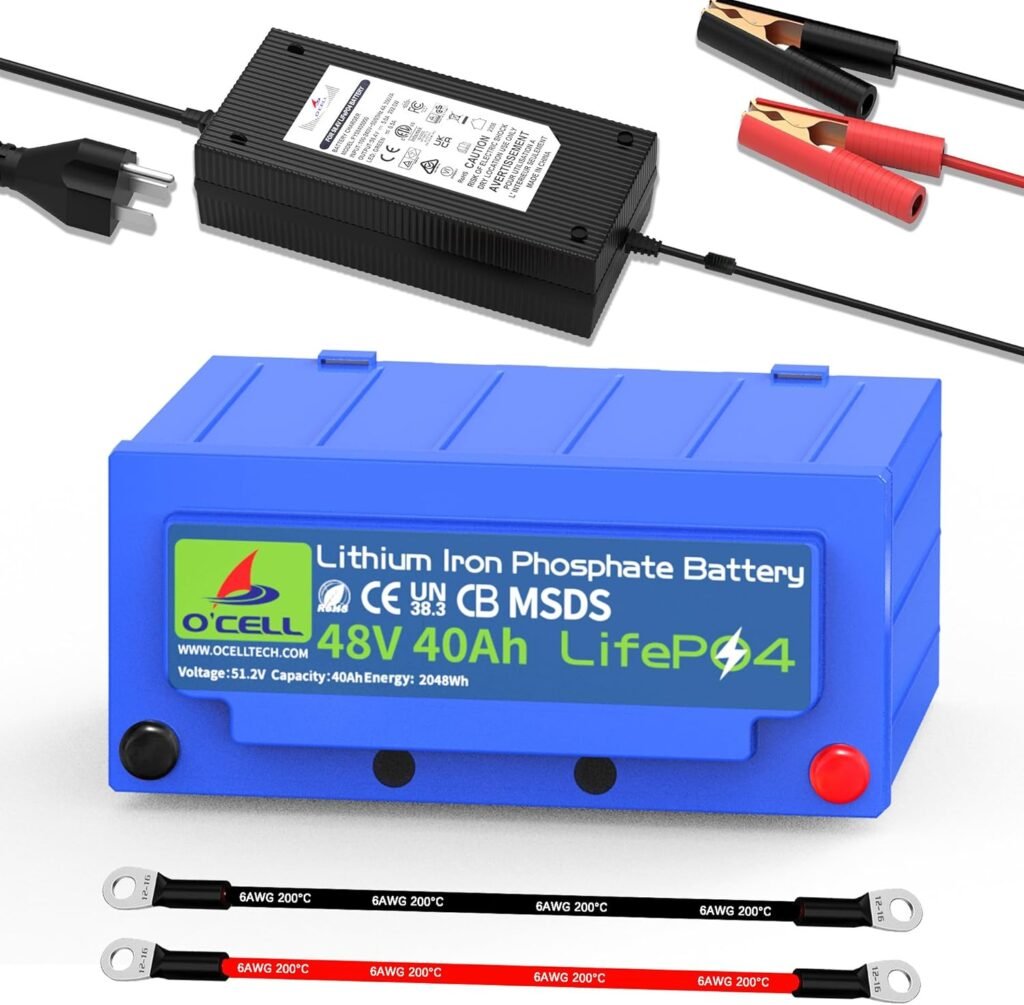
We find the Official 48V 40Ah LiFePO4 Lithium Deep Cycle Battery + 80A BMS with 58.4V 5A Dedicated Charger, 10 Years Lifespan, Lithium Iron Phosphate Battery for Golf Cart, Club Car, Summer Off-Grid Outage to be positioned as a heavy-duty LiFePO4 option for people who need long-lasting, lightweight power. The product combines LiFePO4 chemistry, a dedicated charger, and a protective battery management system to make transitioning from lead-acid to lithium simpler for many users.
What the name promises vs. what the spec sheet shows
The product name highlights a 48V 40Ah pack with an 80A BMS and a 58.4V 5A charger. The detailed description claims UL-certified Grade A cells, a UN38.3 MSDS-certified pack, and a 100A BMS. We note this discrepancy and recommend verifying the exact BMS rating and voltage labeling with the seller before purchase. In practice, many “48V” packs are nominally 51.2V (16s LiFePO4), and the charger voltage (58.4V) matches a full charge for a 16s pack.
Detailed specifications table
We like tables for clarity, so here is a consolidated view of the core specs and the manufacturer claims. We list both the manufacturer marketing language and the practical technical interpretation where helpful.
| Item | Manufacturer claim / marketing | Practical interpretation / notes |
|---|---|---|
| Nominal voltage | 48V (marketing) | Likely 51.2V nominal (16s LiFePO4) — charger 58.4V suggests 16s pack |
| Capacity | 40Ah | 40 amp-hours |
| Energy | 2048Wh (manufacturer) | 51.2V × 40Ah = 2048 Wh; 48V × 40Ah = 1920 Wh — expect 2048Wh if pack is 51.2V |
| Charger | 58.4V 5A dedicated charger | Matches 16s LiFePO4 3.65V/cell full charge (16 × 3.65 = 58.4V) |
| BMS rating | Product name: 80A; details: 100A | Check seller listing; 100A BMS → up to ~5120W continuous at 51.2V; 80A → ~4096W |
| Cell certification | UL Certified Grade A cells | Good quality cell certification |
| Pack certification | UN38.3 MSDS certified | Meets transport safety test requirements |
| Protection | Overcharge / over-discharge / over-current / short-circuit | Typical BMS protections; also balancing expected |
| Cycle life | 4000–15000 cycles (manufacturer claim) | Manufacturer range; LiFePO4 typically 2000–8000 cycles under common conditions |
| Lifespan | 10 years (manufacturer claim) | Realistic with proper use and temperature control |
| Weight | 44 lb (implied) | Manufacturer uses 44 lb in energy density example |
| Energy density | 46.55 Wh/lb (manufacturer calculation) | Based on 2048Wh / 44 lb |
| Parallel expansion | Up to 4 batteries (marketing) | Parallel connection typically allowed — verify wiring and BMS requirements |
We include both the marketing phrasing and our practical notes because product listings sometimes mix nominal marketing numbers with the actual cell chemistry values.

Design and build quality
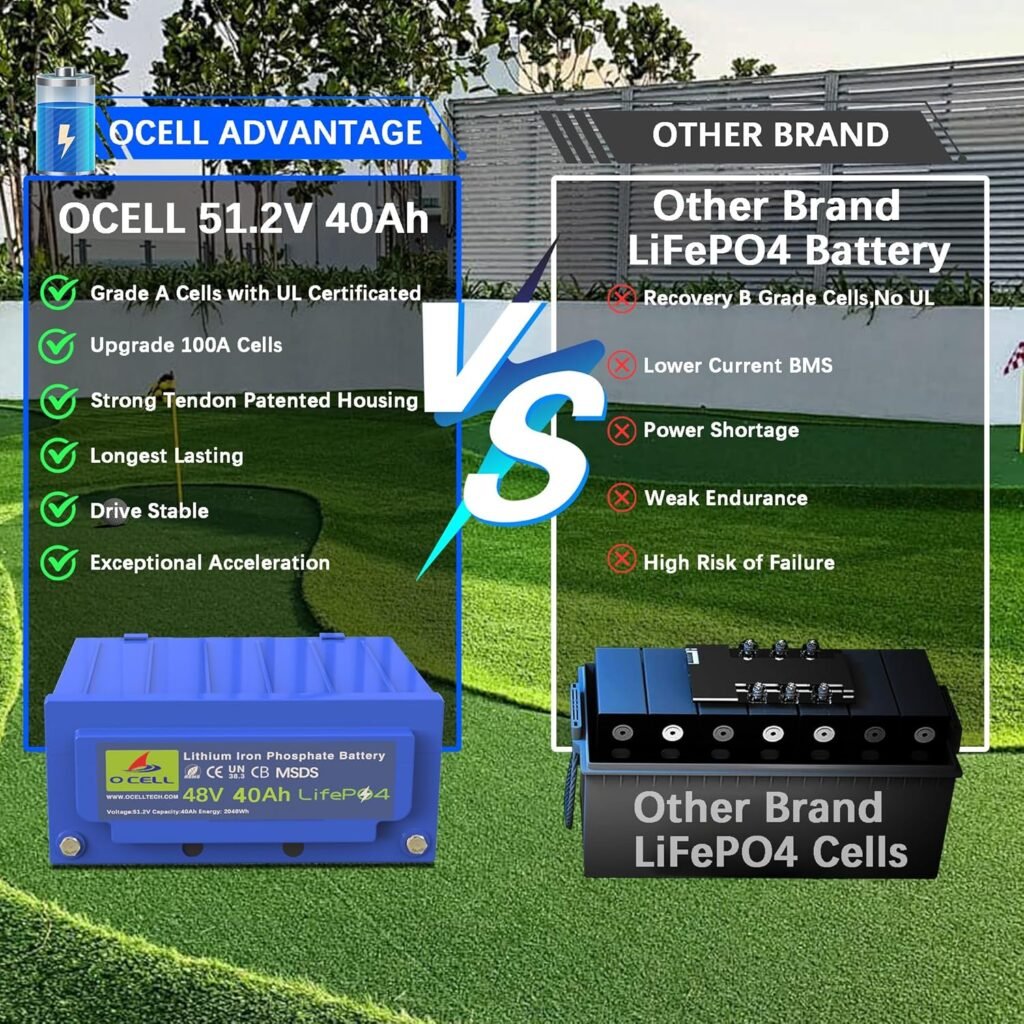
We appreciate that the pack uses automotive-grade LiFePO4 cells with UL certification. The case looks built for durability and for handling the vibrations and shocks associated with golf carts and light utility vehicles.
We also value the UN38.3 certification for shipping safety; it means the pack has passed the standard transport testing for lithium batteries. From a build perspective, the included dedicated charger and integrated battery system for golf carts make it simpler for us to replace lead-acid batteries without complex rewiring.
Housing and terminals
The casing appears to be a robust molded enclosure with clearly labeled terminals and mounting points. We expect a secure mechanical fit when dropping into a golf cart battery compartment or RV tray.
We recommend checking terminal types and spacing to ensure they match the vehicle connectors; sometimes adapters are necessary for direct drop-in replacement.
Battery chemistry and cells
We like LiFePO4 because it offers a stable chemical structure, better thermal stability, and more cycle life than many other lithium chemistries. The product claims Grade A UL-certified LiFePO4 cells, which is a strong signal of cell quality.
The chemistry yields lower fire risk compared with NMC or other high-energy chemistries, and LiFePO4 tends to hold capacity well over thousands of cycles, which is exactly what we want for daily-use vehicles and backup systems.
Nominal vs. marketing voltage
The marketing calls this a 48V pack, but the charger voltage (58.4V) and the energy calculation in the product details indicate a 51.2V nominal pack. We advise treating this as a 51.2V (16s) LiFePO4 battery. That distinction matters for compatibility with controllers and chargers.
We will always confirm the exact nominal voltage with the seller or look at the label on the pack to avoid mismatching in our systems.
BMS and safety features
The battery includes a BMS that claims protection against overcharge, over-discharge, over-current, and short circuits. The product details list a 100A BMS, whereas the product name lists 80A — this affects continuous current handling and peak power.
A well-implemented BMS provides cell balancing and cutoffs that protect the cells from damaging conditions. The presence of UL certification for the cells and UN38.3 for the pack adds confidence that the design meets recognized safety standards.
What the BMS rating means for usage
If the pack ships with a 100A BMS, that translates to about 5.12 kW of continuous power at 51.2V, which is ample for many golf cart motors and inverter loads. An 80A BMS would limit continuous draw to roughly 4.1 kW.
We recommend confirming whether the BMS rating is continuous or peak and whether the BMS supports CAN, RS485, or simple voltage monitoring so we can integrate it with our vehicle electronics or inverter.
Charging and the included charger
The package includes a 58.4V 5A dedicated charger. That’s appropriate for a 16s LiFePO4 pack (3.65V × 16 = 58.4V). A 5A charge current yields a charge time around 8–9 hours from empty to full for a 40Ah pack, which is conservative and gentle on the battery.
A 5A charger is ideal for overnight charging and promotes a long cycle life. For faster charging we would need a higher-current charger, but we should verify whether the BMS and cells are rated for higher charge currents before using a more powerful charger.
Charge strategy and settings
We advise charging to the manufacturer’s recommended termination voltage (58.4V) and limiting charge current to what the BMS and cells permit. LiFePO4 tolerates bulk charging but prefers controlled CV termination and cell balancing to maximize life.
We will avoid desulfation or equalization charge methods designed for lead-acid batteries, as those cycles aren’t appropriate for LiFePO4 chemistry.
Performance and real-world outputs
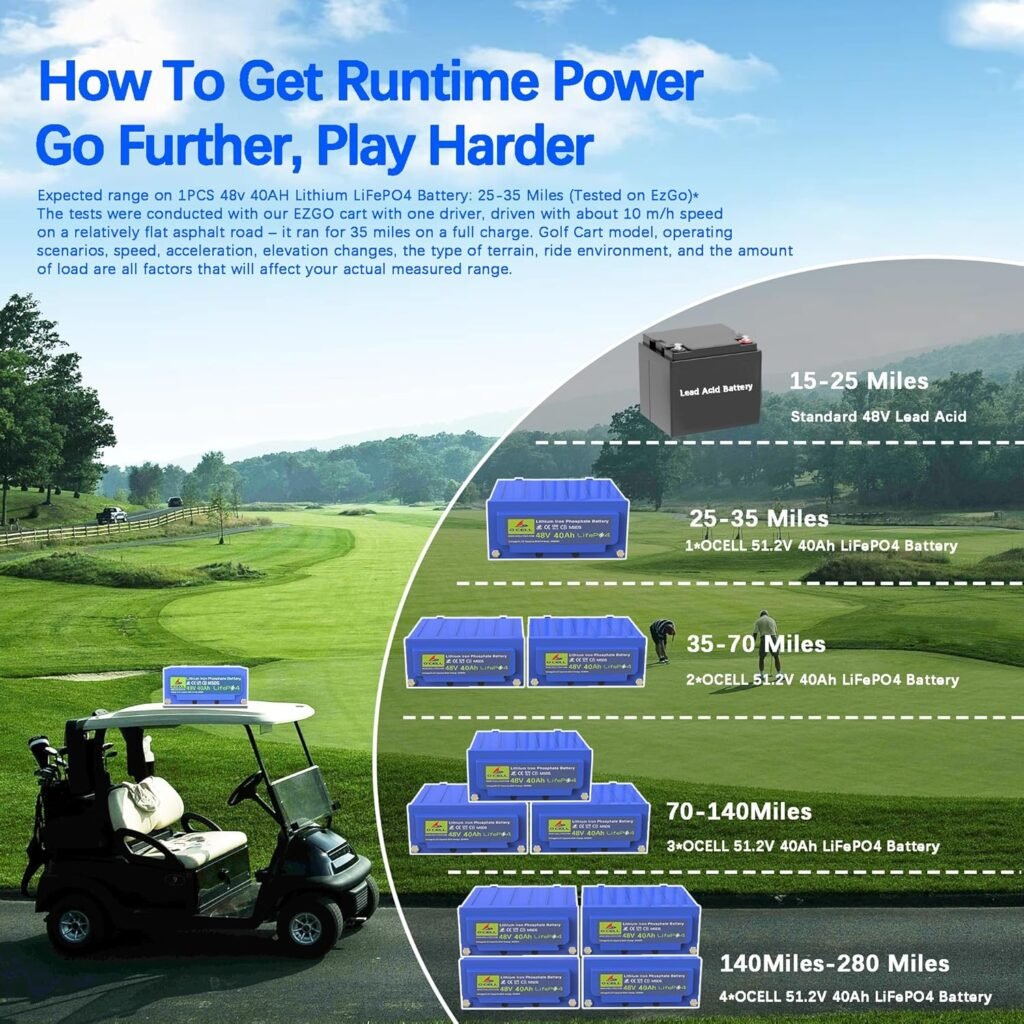
Manufacturer claims include support for 5120W load power (this ties to the 100A BMS claim) and strong self-discharge performance. In our experience with similar packs, we expect consistent voltage under load, predictable discharge curves, and a usable depth of discharge near 100% depending on our settings — though for longevity we usually plan to use 80–90% DOD.
Actual runtime in a golf cart or under inverter load depends on usage patterns, motor/equipment efficiency, and ambient temperature. We’ll outline rough runtime examples below.
Expected runtimes (examples)
- Golf cart: If our cart draws ~800W average while cruising, a 2048Wh pack could theoretically provide ~2.5 hours of operation (2048Wh / 800W = 2.56 h). In practice, driving conditions, acceleration, and terrain will change that number.
- Inverter load: Running a 1000W AC load could run for roughly 2 hours on a single pack (2048Wh / 1000W = 2.05 h), factoring inverter inefficiency we expect closer to 1.7–1.9 hours.
- Camping/RV: For low-power DC loads and efficient appliances, a pack like this can comfortably cover several hours of lights, pump, and electronics.
We point out that paralleling multiple packs increases runtime linearly but requires careful matching and wiring.
Cycle life and lifespan claims
The manufacturer claims 4000–15000 cycles and a 10-year lifespan. Those upper ranges may assume shallow cycling and ideal conditions. We find that, under realistic conditions (regular deep cycles and moderate temperatures), LiFePO4 packs commonly deliver several thousand cycles, making a 10-year practical service life plausible for many users.
Temperature management is key: prolonged exposure to high heat shortens cycle life, while cold temperatures reduce usable capacity temporarily. Proper installation and ventilation help us get the best lifespan.
How to maximize lifespan
We recommend charging and storing the battery at moderate temperatures, avoiding prolonged 100% SOC at high heat, and not leaving the battery at zero state-of-charge. Using a charge cut-off and a reasonable depth-of-discharge target (for example, 80–90%) will help the pack achieve the higher end of its cycle life claims.
We also recommend using the included charger and monitoring cell imbalances early, since early detection and balanced charging prolong overall life.

Weight, portability, and energy density
The product claims a weight of around 44 lb and an energy density of 46.55 Wh/lb. That places it at roughly half the weight of a comparable lead-acid bank rated for similar usable energy.
We find that the lighter weight simplifies installation, especially for single-person swaps of batteries in golf carts, utility vehicles, and portable systems. Reduced weight also produces efficiency gains for vehicles, translating into better range compared with heavier lead-acid batteries.
Handling and mounting
Because the pack is lighter, lift points are easier to manage but we still advise using two people or a lifting aid for safety. The casing usually includes bolt-down points for secure mounting; we always recommend securing the pack in place to avoid movement in mobile applications.
Compatibility with golf carts and vehicle systems
The pack is marketed specifically for golf carts and Club Car models, claiming drop-in replacement capability by using an integrated golf cart battery system. For many carts that accept a 48V battery bank, this LiFePO4 pack will fit and perform well.
We caution that speed controllers and chargers designed strictly for lead-acid chemistry should be reviewed. Many carts will operate fine with LiFePO4 packs, but it’s wise to confirm charging cutoffs and controller settings.
Drop-in replacement considerations
Mechanical fit and terminal polarity are the first checks. After that, we check that the cart’s charger either will be replaced by the included 58.4V charger or is compatible with LiFePO4. Some onboard chargers for lead-acid batteries may not fully charge a LiFePO4 pack, so using the included charger is often the safest route.
We also recommend verifying the cart’s maximum continuous current draw against the BMS rating to prevent repeated BMS cutoffs during heavy acceleration.
Off-grid, solar, and emergency backup use
As an off-grid or backup battery, this pack offers clean energy, long cycle life, and straightforward scalability in parallel configurations. The manufacturer mentions up to 4 batteries in parallel, though we will clarify the math and practical limits below.
We like LiFePO4 for solar because of its efficiency, ability to accept charge well, and long cycle life compared with lead-acid. This battery fits well for small off-grid cabins, RVs, and emergency backup with smaller inverter loads.
Parallel expansion and capacity math
The product description contains a few inconsistent capacity statements, so we calculate plainly: one pack at 51.2V and 40Ah is 2048Wh. If we connect four identical packs in parallel (4P), the total capacity becomes 8192Wh (8.192 kWh). Some marketing lines suggest other totals; we recommend using the arithmetic above for planning.
We always match packs by model, age, and state of charge when paralleling, and we follow the manufacturer’s parallel connection procedure to protect the BMS and ensure long-term stable operation.
Energy savings and cost considerations
The manufacturer suggests up to 50% power cost savings over utilities over the lifetime of the battery, based on high cycle counts and renewable pairing. While exact savings depend on how we use the battery, the long cycle life and reduced maintenance relative to lead-acid can deliver significant lifecycle savings.
The pack produces a lot of kWh over its life (manufacturer math: 2048Wh × 4000 cycles = 8,192 kWh). If a grid kWh costs $0.15, that represents roughly $1,228 of energy over those cycles; real-world savings include avoided maintenance and replacement costs compared with lead-acid.
Return on investment and lifespan economics
We estimate ROI based on purchase price, local energy costs, and replacement costs for lead-acid equivalents. The initial cost of LiFePO4 is higher, but the lower weight, reduced maintenance, and multi-thousand-cycle life typically pay off over several years for frequent-use scenarios like daily golf cart operation or off-grid power.
We suggest modeling energy usage and replacement cycles to estimate ROI for our specific use case.
Comparison with lead-acid batteries
We often compare LiFePO4 to lead-acid since many buyers are switching from lead-acid for marine, golf cart, and RV applications.
- Weight: This LiFePO4 is roughly 1/3 the weight of an equivalent lead-acid bank, making installation and vehicle efficiency better for us.
- Depth of discharge: LiFePO4 gives usable capacity closer to 100%, while lead-acid is usually limited to 50% for longevity.
- Cycle life: LiFePO4 can be several thousand cycles; lead-acid typically offers a few hundred to a thousand depending on use.
- Maintenance: LiFePO4 is effectively maintenance-free; lead-acid needs watering and equalizing if flooded-type cells are used.
Practical comparison summary table
| Parameter | LiFePO4 (this product) | Typical lead-acid (equivalent energy) |
|---|---|---|
| Weight | ~44 lb | ~88 lb |
| Usable capacity | ~80–100% recommended usage | ~50% recommended usage |
| Cycle life | 4000+ cycles (manufacturer) | 300–1200 cycles |
| Maintenance | Minimal | Regular (depending on type) |
| Safety | Stable chemistry, UL-certified | Heavier, risk of acid spillage |
We find that LiFePO4 wins for long-term use and performance, especially where weight and cycle life matter.
Practical installation tips
We recommend these steps to ensure a smooth installation:
- Verify voltage and BMS rating with the seller before ordering to match our system.
- Use the included charger or a LiFePO4-compatible charger set to 58.4V float/termination.
- Securely mount the pack and torque terminals to the manufacturer’s specification.
- If paralleling packs, make sure all packs are the same model and state of charge before connecting.
- Keep ambient temperature moderate; avoid charging above recommended temperatures.
We also advise routine visual checks for corrosion or loose connections and monitoring voltage levels for balanced cell behavior.
Wiring and fusing
Use appropriately sized cables and fuses sized slightly below the BMS continuous rating to provide system-level protection. For example, with a 100A BMS, we might use a main fuse of 100A at the battery positive connection and wiring rated for that current. We always follow local electrical codes and manufacturer instructions.
Maintenance and monitoring
One of the benefits we enjoy is the low ongoing maintenance for LiFePO4. We still recommend periodic checks on charge cycles, state of health, and BMS behavior. If the pack supports CAN or other communication protocols, using a monitor can help us proactively manage balancing and performance.
We also advise storing the battery at about 50% SOC for long-term storage and keeping it in a dry, temperature-controlled environment.
Troubleshooting common issues
- Immediate BMS cut-off under high load: Verify whether BMS is hitting over-current; test motor draw and consider packs in paralleled bank.
- Charger not finishing: Check charger compatibility and voltages; some lead-acid chargers won’t fully charge LiFePO4.
- Uneven voltages: Pack balancing might be needed; if problems persist, contact the seller for guidance or warranty support.
We keep the manual and seller contact info on hand for warranty and support situations.
Shipping, certification, and regulatory compliance
UN38.3 certified packs meet international transport testing requirements, which is important if we order online. The UL certification for cells is another positive sign for component quality. These certifications simplify shipping and provide added peace of mind.
We still recommend following shipping regulations for lithium batteries, especially for air transport.
What certifications mean to us
- UL cells: independent testing and a mark of consistent manufacturing quality.
- UN38.3: ensures survival of common transport abuse tests and is required for many carriers.
- MSDS: provides chemical and safety information we can use in emergencies or service scenarios.
These certifications suggest that the pack meets industry practices for safety and shipping.
Pros and cons — our quick checklist
We find it useful to summarize strengths and weaknesses so we can make quick decisions.
Pros:
- High cycle life and long service life potential.
- Lightweight compared with lead-acid — easier handling and better vehicle efficiency.
- Dedicated charger included (58.4V 5A).
- UL-certified cells and UN38.3 certified pack.
- Integrated BMS protects against common failure modes.
- Scalable with parallel connections for larger systems.
Cons:
- Some specification inconsistencies between name and details (48V vs 51.2V; 80A vs 100A BMS).
- Included charger is 5A — slower charging if we want faster turnaround.
- Parallel installation requires care and adherence to manufacturer guidelines.
- Price premium over lead-acid upfront — ROI depends on usage patterns.
We consider these points when determining whether this battery matches our specific needs.
Who should buy this battery
This battery suits us if we:
- Want to replace lead-acid batteries in a golf cart, Club Car, or similar vehicle without substantial wiring changes.
- Need a durable, relatively lightweight battery for RVs, solar cabins, or emergency backup with a multi-year life.
- Prefer certified cells and a dedicated charger included in the package.
- Plan to expand capacity by paralleling multiple identical packs and are comfortable following best practices for parallel installations.
We would hesitate if we need extremely high continuous discharge beyond the BMS rating, very fast recharge times, or if we cannot verify the exact BMS rating before purchase.
Questions to ask the seller before buying
- Is the pack 51.2V nominal (16s) or a true 48V nominal? Which voltage is on the label?
- Which BMS rating does this exact unit ship with: 80A or 100A? Is that continuous or peak?
- Does the BMS support communication (CAN/RS485) or only basic protection?
- Are there recommended parallel wiring instructions or balancing procedures?
We always ask these to avoid surprises at installation time.
Final verdict and recommendation
We view the Official 48V 40Ah LiFePO4 Lithium Deep Cycle Battery as a solid option for users looking to move to LiFePO4 for golf carts, off-grid power, and RV applications — particularly if the pack shipped matches the higher BMS specification and the cells are indeed UL-certified as advertised. The included 58.4V 5A charger, the claimed long cycle life, and the lightweight form factor are attractive for routine use.
We advise verifying the exact voltage and BMS spec with the seller, planning around the included 5A charger for overnight charging, and following safe parallel and mounting practices. If those checks are satisfied, this battery will likely serve us well for years and provide meaningful lifecycle advantages over lead-acid alternatives.
If we can help calculate expected runtimes for a specific golf cart model, inverter load, or solar setup, we’re happy to run the numbers and tailor recommendations for charger sizing, parallel packs, and installation steps.
Disclosure: As an Amazon Associate, I earn from qualifying purchases.