Have we ever stared at our LiFePO4 battery, watched the voltage sag, and thought, “We really need a charger that can keep up with our setup”?

What Is the PowerQueen 14.6V 40A Lithium Battery Charger?
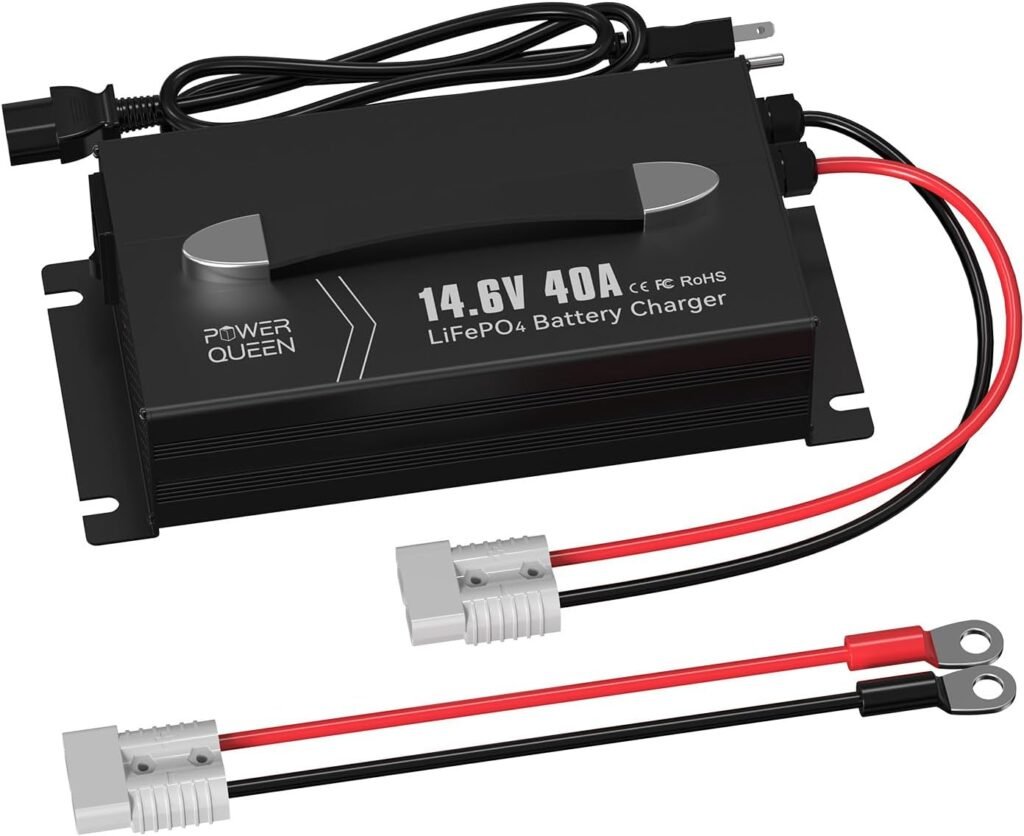
This PowerQueen 14.6V 40A Lithium Battery Charger for 12V LiFePO4 Battery is designed specifically for deep cycle LiFePO4 batteries, not generic lead-acid or mixed chemistries. We’re looking at a high-current, fast-charging unit that focuses on safety, efficiency, and usability for 12V systems.
At its core, it offers a 40A charge current, automatic multi-stage charging, a pre-charging (0V) mode for slept batteries, and real-time status indicators. For anyone running larger capacity LiFePO4 batteries—whether in RVs, off-grid solar, or backup power setups—this charger aims to take the guesswork out of proper lithium charging.
Key Features at a Glance
We like to get a quick snapshot of what a product can do before committing, so it helps to summarize the highlight features of this charger.
This PowerQueen unit combines fast charging, multi-level protection, and intelligent charging modes designed specifically for LiFePO4 chemistry. It’s not trying to be a universal, do-everything charger; instead, it focuses on doing one job exceptionally well.
| Feature | Description |
|---|---|
| Charger Type | 14.6V, 40A charger for 12V LiFePO4 batteries |
| Supported Battery Types | 12V LiFePO4 deep cycle batteries (not for lead-acid) |
| Maximum Output Current | 40A |
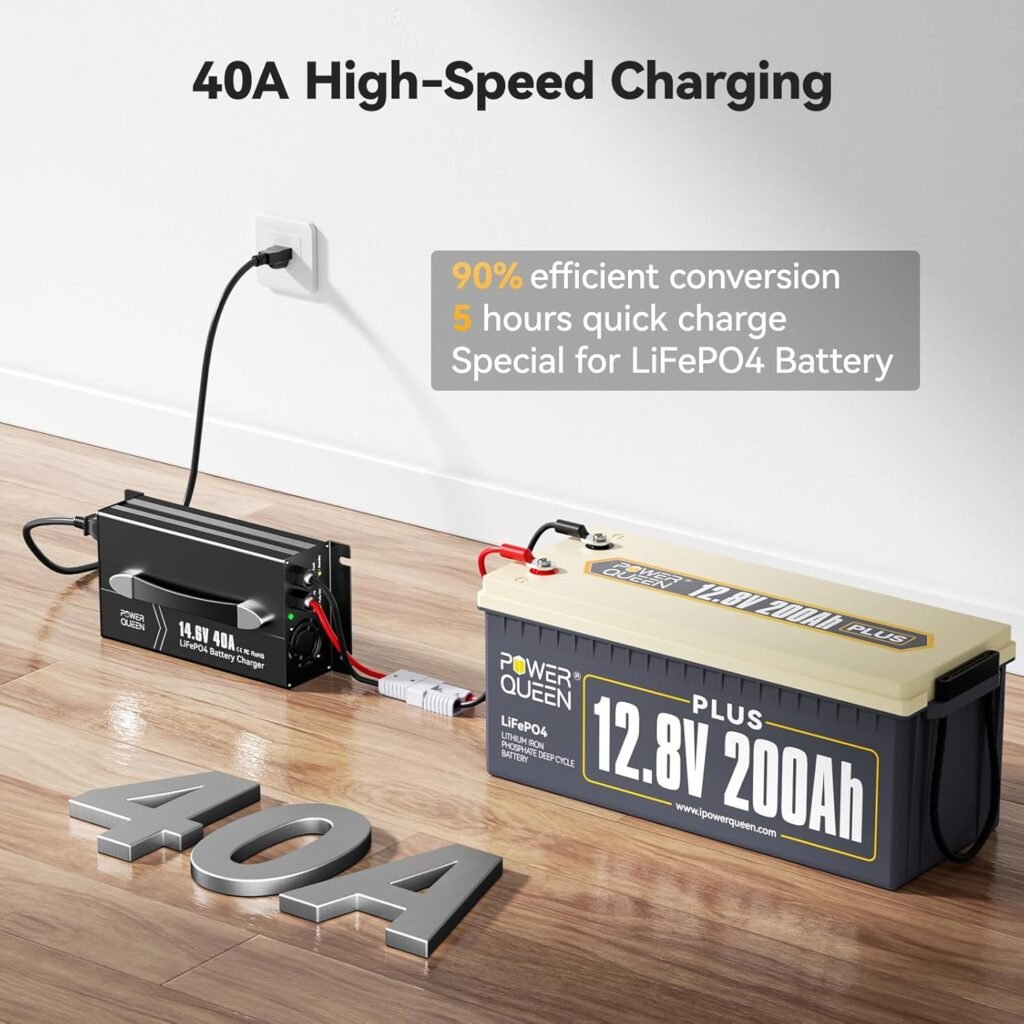
| Approx. Charge Time (12V 200Ah) | ~5 hours (from low to full) |
| Approx. Charge Time (12V 300Ah) | ~7.5 hours |
| Approx. Charge Time (12V 400Ah) | ~10 hours |
| Charging Modes | Pre-Charge (0V recovery), Constant Current (CC), Constant Voltage (CV) |
| Protection Functions | Over-temperature, output short-circuit, output over-voltage, reverse polarity connection |
| Status Indication | LED real-time charging status (standby, charging, full, anomaly) |
| Quality Management Standard | Produced under ISO9001:2008 quality management system |
| Application Scenarios | RVs, marine, off-grid solar, backup power, trolling motors, and general 12V LiFePO4 systems |

Fast Charging Performance for Larger Capacity LiFePO4 Batteries
When we run larger batteries—like 200Ah, 300Ah, or 400Ah—waiting half a day or more for them to charge can be frustrating and inefficient. This is where the 40A charging current of the PowerQueen charger becomes really meaningful.
With 40 amps on tap, we can significantly reduce downtime between uses. Instead of leaving our batteries on a low-amp charger overnight and hoping they’re ready by morning, we get a predictable, fast, and controlled charge.
How Fast Does It Actually Charge?
We often see “fast charge” thrown around as a marketing term, but the PowerQueen charger backs it with practical numbers. Assuming our batteries are properly sized and in good health, the estimated charging times are:
- About 5 hours for a 12V 200Ah LiFePO4 battery
- About 7.5 hours for a 12V 300Ah LiFePO4 battery
- About 10 hours for a 12V 400Ah LiFePO4 battery
These are rough estimates, of course, but they line up well with what we’d expect from a 40A charger using a controlled, multi-stage charge profile. They also assume our battery is significantly discharged—not just topping off from 80% to 100%.
This means we can realistically manage our energy usage: if we know we’ve got a 300Ah battery at low state-of-charge, we can plan around a same-day turnaround rather than a multi-day wait.
Why 40A Matters for Deep Cycle Applications
For deep cycle usage, especially in off-grid or mobile setups, we typically discharge our batteries deeper and more frequently than, say, a small backup UPS battery. A 40A charger is especially useful when:
- We run multiple loads (inverters, fridges, lights, electronics) off a single battery bank.
- We rely on generator charging and want to minimize run time and fuel usage.
- We have limited charging windows (like when solar conditions fluctuate or generator hours are restricted).
At the same time, 40A is a current level that fits comfortably within the recommended charge rates for most 12V LiFePO4 batteries in the 100Ah+ range, especially those from reputable brands that allow 0.5C or even 1C charging. That gives us fast charging without pushing the chemistry too hard.
Four Built-In Protection Functions for Safer Charging
High current is great, but safety has to come first—especially when we’re working with lithium batteries and relatively high power levels. The PowerQueen charger is built with multiple layers of electronic protection.
We appreciate that the company calls out four specific protection functions. That tells us they aren’t just relying on the battery’s BMS to carry all the risk. Instead, the charger and battery work together to maintain safe conditions.
Over-Temperature Protection
When a charger works hard at 40A, components can heat up. Over-temperature protection ensures that if the internal temperature of the charger rises beyond safe limits, it will either reduce output or shut down to prevent damage.
This is especially important if we:
- Use the charger in warmer environments
- Have poor ventilation around the unit
- Run multiple charge cycles back to back
By throttling or shutting down when needed, the charger protects itself and indirectly protects our battery from irregular charging behavior caused by overheating electronics.
Output Short-Circuit Protection
If something goes wrong on the output side—like a damaged cable, connector issue, or unexpected short—the charger needs to react quickly. Output short-circuit protection is there to cut power almost immediately.
This is one of those features we hope we never need, but it’s crucial. A short at 40A could lead to sparks, melted wires, or worse. With built-in short-circuit protection, the charger substantially reduces that risk and gives us more confidence when wiring into our system.
Output Over-Voltage Protection
LiFePO4 batteries have a fairly specific voltage range where they’re happy. Exceeding the proper charging voltage can trigger the battery’s BMS or, in the worst case, degrade the cells. Output over-voltage protection keeps the charger from overshooting its target of around 14.6V for 12V LiFePO4 packs.
We like that this is part of the charger design itself. Even if there’s some internal hiccup, the charger is not going to run away on voltage and abuse the battery. That’s especially reassuring for long unattended charging sessions.
Reverse Polarity Connection Protection
We all make mistakes. Connecting positive to negative and negative to positive can happen, especially in cramped compartments, low light, or when multiple similar wiring harnesses are present.
Reverse polarity protection ensures that if we accidentally connect the charger leads backwards, it won’t fry the charger instantly. Instead, it detects the reversal and prevents output, protecting both the unit and our battery.
This is a small but very user-friendly feature that can save us from an expensive lesson.

Real-Time Device Status Display
It’s always nice when we don’t have to guess what our charger is doing. The PowerQueen 14.6V 40A charger has an LED-based real-time status display that communicates what’s going on at a glance.
With clear indicators for standby, charging, fully charged, and anomalies, we can walk up to our system and immediately understand its state.
What the LED Indicators Tell Us
The status display provides four primary states:
- Standby – The charger is powered and connected, but not actively charging. Maybe the battery is full, or charging hasn’t begun yet.
- In-Charge – The charger is delivering current to the battery, running through its CC or CV stages.
- Fully Charged – The battery has reached its target voltage and the charger has shifted to maintaining or stopped active charging.
- Charging Anomalies – An indication that something is off, such as an error condition, unusual connection, protection event, or incompatible state.
This is especially useful when we’re managing multiple components. Instead of pulling out a multimeter every time, we can glance at the charger to see whether it’s behaving as expected.
Why Real-Time Status Helps Us in Daily Use
In real applications, we often integrate chargers into more complex systems. Maybe we’ve got solar panels charging the same battery bank, or a backup generator we fire up only when needed.
Real-time status gives us actionable info:
- If we see standby while the battery is low, we know something is wrong.
- If we see an anomaly light, we can troubleshoot connections or check the battery BMS.
- If we see fully charged, we might decide to shut off the generator, disconnect the charger, or switch loads.
It contributes to a more intuitive and controlled charging process, especially for those of us who like to monitor our systems closely.
0V Pre-Charging Mode: Waking Up a “Slept” Battery
One of the standout features of this PowerQueen charger is the 0V pre-charging mode. LiFePO4 batteries have internal BMS systems that can shut down the battery if voltage gets too low or other protection limits are reached. When that happens, some basic chargers simply don’t “see” the battery at all.
The PowerQueen charger includes a dedicated pre-charge mode designed specifically to “wake up” slept batteries and bring them back to a normal voltage range.
What Is a Slept Battery and Why Does It Happen?
A “slept” battery typically refers to a LiFePO4 battery whose BMS has disconnected the pack from the terminals. This can occur due to:
- Over-discharge: The battery was drained below its safe cutoff.
- Low-temperature protection: The battery was charged or used in temperatures too low for safe operation.
- Over-current or short: The BMS took protective action and shut down output.
When this happens, a normal charger might read near 0V at the terminals and refuse to start charging, because it can’t detect a proper battery voltage. That’s where the PowerQueen 0V mode comes in.
How the Pre-Charge Mode Works for Recovery
The pre-charging mode applies a controlled, low-current initial charge to the battery even when it appears to be at 0V from the charger’s perspective. By gently feeding current into the system, it coaxes the BMS into re-enabling the battery and raising it back into a normal operating range.
In practical terms, we do the following:
- Connect the charger to the battery, even if the battery appears “dead.”
- Allow the charger to enter its pre-charge state.
- Let it push the voltage up until the BMS restores normal connection and the battery becomes “visible” again.
- After that, the charger automatically shifts into its regular CC/CV charging profile.
This feature can save us from giving up on a battery that’s simply in protective sleep mode, not truly damaged.
Automatic Switching Between Charging Modes
Another strength of this charger is that it doesn’t just blast 40A indiscriminately. It follows a three-stage charging process: Pre-Charge, Constant Current (CC), and Constant Voltage (CV). The charger automatically transitions between these modes as the battery’s state changes, ensuring an optimal and safe charge.
This is standard practice for well-designed LiFePO4 chargers, and it’s good to see it implemented here with a clear description.
Pre-Charge Mode
We’ve already talked about pre-charge as a way to wake slept batteries, but it’s also a gentle start for low-voltage packs in general. Instead of instantly hammering a deeply discharged pack with full current, the charger eases into it.
This helps reduce stress on the cells and the BMS, especially when we’ve run our batteries down near their lower limit.
Constant Current (CC) Mode
Once the battery is in a safe voltage band, the charger enters Constant Current mode. Here, it delivers the full 40A (or close to it) as long as the battery can accept it. This is where we see the fastest rise in state-of-charge and where most of the heavy lifting occurs.
While in CC mode:
- The current is regulated at around 40A.
- The voltage rises steadily as the battery charges.
- The charger keeps pushing amps until the battery approaches its target voltage (around 14.6V for 12V LiFePO4).
This stage is the key to that 5–10 hour full charge window for larger capacities.
Constant Voltage (CV) Mode
As the battery nears full charge, holding constant high current is no longer ideal. The charger switches into Constant Voltage mode, maintaining a set target voltage while the current tapers off naturally.
In CV mode:
- The charger holds a fixed voltage (close to 14.6V).
- The current gradually decreases as the battery fills up.
- Once the current drops sufficiently and the battery is effectively full, the charger shifts to standby or indicates full charge.
This allows the battery to top off without being overcharged or overheated. It’s also important for good cell balancing within the pack, especially for larger capacity LiFePO4 batteries.
Build Quality and Design Considerations
While we don’t have a lab teardown on this particular unit, we can consider the overall design philosophy described and what it tells us. PowerQueen’s charger is produced in line with an ISO9001:2008 quality management system, which implies a structured approach to manufacturing and quality control.
We care about how a charger is put together because we’re usually leaving it running for hours at a time, often unattended.
Construction and Durability Expectations
For a 40A charger, we can safely assume:
- Robust power electronics – Able to handle sustained high currents.
- Decent cooling solution – Likely with heat sinks and possibly forced-air cooling (fan).
- Protective housing – To shield circuits from dust, minor impacts, and incidental contact.
While we can’t comment on every internal component, the presence of multi-layer protections, a structured charging algorithm, and adherence to a quality standard suggests a design that aims for reliability, not just a spec sheet number.
For those of us integrating this into mobile setups (RVs, vans, boats), durability under vibration and movement is important. Proper mounting, cable strain relief, and ventilation are all things we’ll want to plan for in our own installations.
User-Focused Details
We also look for practical usability details, such as:
- Clearly labeled terminals or clamps
- A straightforward status LED layout
- Cables long enough for flexible positioning
- Clear polarity markings
These small details influence how easy the charger is to integrate into our existing systems and how confident we feel during setup.
Compatibility With Our Battery Systems
One of the most important questions we ask about any charger is: “Will this actually work with our battery bank?” This PowerQueen unit is tailored for 12V LiFePO4 batteries and not for lead-acid, AGM, or other chemistries.
Matching chemistry is vital for longevity and safety, so it’s a strong positive signal that the spec explicitly calls out LiFePO4.
Ideal Use Cases
Here are some scenarios where this charger fits very well:
- RVs, camper vans, and travel trailers running 12V LiFePO4 house batteries.
- Off-grid cabins or sheds powered by a 12V LiFePO4 bank and needing a fast AC-powered charger.
- Boats and marine setups relying on deep cycle 12V LiFePO4 batteries for trolling motors or onboard power.
- Backup power systems with 12V LiFePO4 banks used for inverters or emergency loads.
- Workshop or portable power boxes containing 12V LiFePO4 packs.
In all these cases, fast, safe, and smart charging matters, especially when we’re using our batteries hard and cycling them frequently.
Batteries It’s Not Designed For
We should be clear about what it’s not meant to charge:
- Lead-acid/AGM/Gel 12V batteries – Different required charge profiles and voltages.
- Other lithium chemistries (like Li-ion NMC or LCO) without confirmation from the manufacturer.
- 24V, 36V, 48V, or higher nominal systems – This charger is strictly 14.6V output, targeted for 12V LiFePO4.
Using the wrong charger on the wrong chemistry or voltage can shorten battery life or trigger protection systems, so we want to stick with 12V LiFePO4 packs that specify 14.6V charge compatibility.
Everyday Usage Experience
From a day-to-day perspective, what we really care about is whether the charger makes our life easier and our power system more dependable. Based on what this charger offers, it’s designed to be a “set it and trust it” part of our setup.
We plug it in, connect our 12V LiFePO4 battery, and let it handle the rest—detecting state, managing current, controlling voltage, and signaling when it’s done.
Workflow With the PowerQueen 40A Charger
A typical charging session might look like this:
- Connection – We connect the charger leads to the battery terminals, observing polarity.
- Status Check – We see the indicator move out of standby into charging. If the battery is very low or in sleep mode, pre-charge will kick in.
- Active Charge – The charger runs through CC and CV phases, with the LED indicating charging status. We can leave it unattended within reason, thanks to protections.
- Completion – Once full, we see the “fully charged” indication. If we’re on generator or shore power, we can decide when to disconnect or leave it ready for the next cycle.
For those of us using generators, the fast charging is a major convenience: we don’t need to run a generator all day just to get our batteries up to a reasonable level.
Noise, Heat, and Environment Considerations
A 40A charger will inevitably generate some heat, and if there’s an active cooling fan, some noise as well. Although we don’t have direct acoustic measurements, we can plan as follows:
- Install the charger in a well-ventilated area to aid cooling.
- Avoid fully enclosed, unvented compartments.
- Keep it away from flammable materials or loose clutter.
- If we’re sensitive to noise, consider placing it in a compartment or location where fan noise won’t bother us during charging.
These practical considerations help ensure that the charger can deliver consistent performance without overheating or creating irritation.
Advantages of Choosing This Charger
When we weigh this product against generic or low-amp solutions, a few advantages stand out clearly.
The PowerQueen 14.6V 40A Lithium Battery Charger is built to meet the specific demands of LiFePO4 users who care about both speed and long-term battery health, instead of just slapping a “lithium capable” label on a basic unit.
Speed and Efficiency
The ability to charge 200–400Ah batteries in a same-day window changes how we plan our energy use. It’s especially useful when:
- We’re off-grid and rely on periodic AC power or generator use.
- We’re traveling and only have limited access to shore power.
- We cycle our batteries heavily and need quick turnaround.
Fast but controlled charging is one of the main benefits of this charger, and it directly impacts our system’s usability.
Smart Protection and Battery Longevity
By managing:
- Over-temperature
- Output short-circuit
- Output over-voltage
- Reverse polarity connections
the charger aims to protect both itself and our batteries. Combined with the proper CC/CV lithium charge profile, this helps keep our investment in LiFePO4 packs running safely and efficiently over time.
We’re not just charging; we’re charging in a way that respects the chemistry and the BMS.
User-Focused Features
We also benefit from:
- Pre-Charge/0V mode for slept batteries
- Real-time LED status display for a quick read
- Automatic mode switching so we don’t need to micromanage the process
Together, these add up to a more relaxed, confident usage experience. We connect, confirm status, and let the charger work.
Potential Limitations and Considerations
No product is perfect for every situation, and it’s helpful to be realistic about where this charger fits and where it might not.
By understanding its limits, we can match it properly to our needs and avoid expecting it to do something it wasn’t designed for.
Strictly for 12V LiFePO4 Batteries
If we need a charger capable of handling:
- 24V, 36V, or 48V systems, or
- Multiple chemistries like lead-acid and LiFePO4 in a single device
then this charger isn’t the right fit. Its strength is its focus on 14.6V output for 12V LiFePO4, and we wouldn’t want to compromise that precision by forcing it into other roles.
Power Source Requirements
Because of the 40A output, the charger itself will need a solid AC power supply with sufficient capacity. We should ensure:
- Our generator or shore power can handle the charger’s input draw.
- We’re using correctly rated AC outlets and extension cords, if used at all.
- We have appropriate circuit protection on the AC side.
If we’re on a weak or unreliable AC source, we may need to plan accordingly or use it when we’re sure the supply is stable.
Physical Size and Portability
Higher power chargers are generally larger and heavier than small trickle chargers. If we need an ultra-compact, pocket-sized charger for very small systems, a 40A unit may be overkill.
However, for most RVs, boats, off-grid cabins, and similar setups, the physical footprint is a reasonable trade-off for the improved charging capabilities.
How This Charger Fits Into a Broader Power System
In many modern off-grid and mobile setups, our charger is just one piece of a larger puzzle. We might be running:
- Solar charge controllers
- Inverters or inverter/chargers
- DC-DC chargers from alternators
- BMS-monitored LiFePO4 battery banks
- AC loads and DC distribution
The PowerQueen 14.6V 40A charger is best viewed as our AC-to-DC lithium charger, either primary or backup, for when we have access to AC power.
Integration With Solar and Other Charging Sources
If we already have a solar charging system feeding our LiFePO4 bank, we can use this charger as:
- A backup charger for cloudy days or long stretches of poor solar production.
- A fast top-up solution when we’re on shore power.
- A recovery tool for slept batteries that a solar controller might not be able to wake.
We just need to ensure that multiple chargers aren’t fighting each other—many systems handle parallel connections fine as long as they’re properly configured, but coordination is important.
Role in Emergency and Backup Scenarios
For backup power setups, this charger can sit at the center of our “recharge strategy.” If a storm or grid outage empties our LiFePO4 bank and AC power becomes available later (from grid recovery or a generator), we can rapidly recover capacity.
Knowing that a 200–400Ah bank can get a substantial boost in just a few hours helps us plan for next outages and maintain essential loads.
Who Will Benefit Most From the PowerQueen 14.6V 40A Charger?
While it’s theoretically suitable for any 12V LiFePO4 battery, some users will gain more from its capabilities than others. We can think in terms of battery size, usage pattern, and environment.
Those of us who push our systems harder—deep cycles, large banks, off-grid reliance—stand to gain the most from this kind of dedicated lithium charger.
Ideal Users
We’d especially recommend this charger to:
- RV and van owners running 12V LiFePO4 batteries of 100Ah or more, especially 200Ah+ systems.
- Boat owners with trolling motor banks or house batteries that need fast shore charging.
- Off-grid homeowners or cabin users relying on 12V LiFePO4 storage and wanting fast generator-based charging.
- DIY power box builders who use 12V LiFePO4 packs and need a reliable AC charger.
- Anyone who has experienced a “slept” LiFePO4 battery and wants a tool designed to wake it safely.
In short, this charger is aimed at users who care enough about their LiFePO4 packs to give them a purpose-built, smart charging source.
Users Who Might Need Something Else
On the other hand, if we:
- Only use small 12V batteries (like under 50Ah)
- Need compatibility with lead-acid or mixed chemistries
- Run a higher voltage system (24V+), or
- Rarely cycle our batteries deeply
we might find a lower-amp or multi-chemistry charger more appropriate. It’s all about aligning the tool with the job.
Our Overall Impression and Final Thoughts
After looking closely at the “PowerQueen 14.6V 40A Lithium Battery Charger for 12V LiFePO4 Battery, Fast Charging 12V Battery Charger for Deep Cycle Battery with Pre-Charging Mode, Real-Time Display and 4 Protection Functions,” we see a charger that is purposefully built for serious 12V LiFePO4 users.
It focuses on:
- Fast, 40A charging for larger battery capacities
- Dedicated LiFePO4 charge profile with CC/CV control
- Safety protections (over-temperature, short-circuit, over-voltage, reverse polarity)
- Intelligent features like 0V pre-charge and real-time status indication
- Automatic charging mode switching for a hands-off, reliable process
For those of us running substantial LiFePO4 banks and needing a trustworthy AC charger, it offers a compelling combination of performance, safety, and usability. It’s not trying to be an all-purpose charger; instead, it embraces its role as a specialized tool for 12V LiFePO4 deep cycle batteries.
If our goal is to keep our 12V LiFePO4 system healthy, charged quickly, and protected against common charging mishaps, this PowerQueen 40A charger fits neatly into that vision and gives us a solid foundation for a reliable power setup.
Disclosure: As an Amazon Associate, I earn from qualifying purchases.