Have we ever wished our off-grid power just worked quietly in the background, without constant babysitting or worrying about running out of juice at the worst moment?

Why We Started Looking at the Redodo 12V 410Ah LiFePO4 Battery
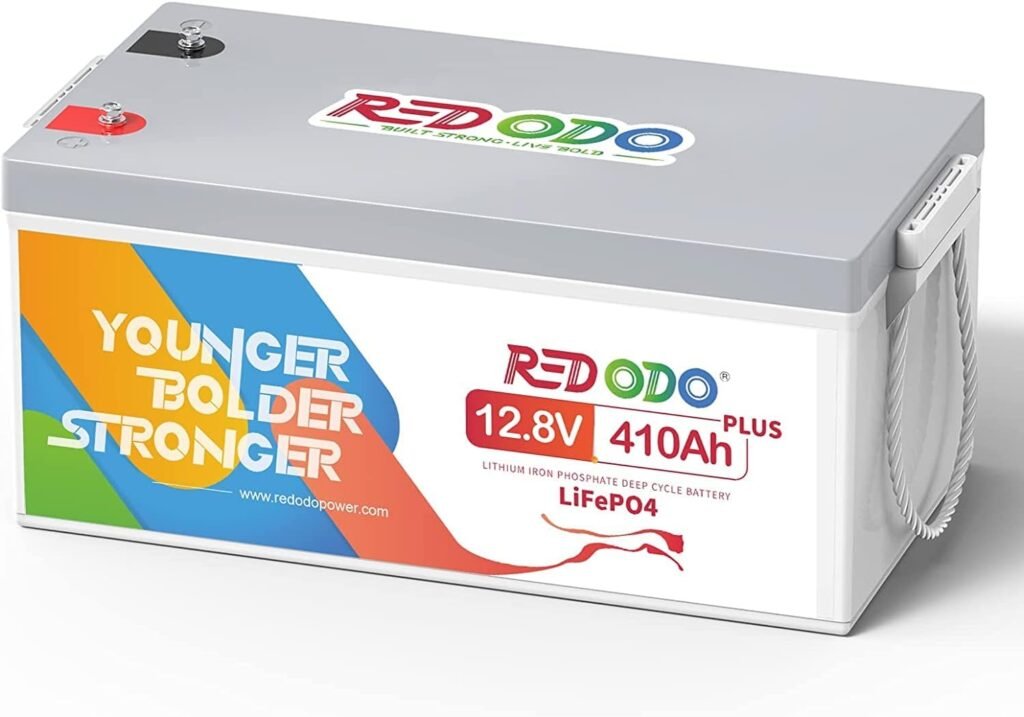
When we think about RV trips, cabins, boats, or home backup systems, we usually picture comfort and security, not flipping breakers and chasing down power problems. That’s where a serious battery solution like the Redodo 12V 410Ah LiFePO4 Battery (5248Wh) comes into play. We wanted to see whether this unit truly delivers the long runtime, high power, and peace of mind it promises.
So in this review, we’re going to walk through how it performs, what it’s really good at, what to be aware of, and who will get the most out of it.
Key Specifications at a Glance
Before we talk about real use cases, it helps to see the numbers. This battery is not just a small upgrade—it’s a major leap from traditional 12V AGM or smaller lithium packs.
Core Specs Breakdown
We like having the essentials side by side, so we pulled them into a simple table:
| Feature | Specification |
|---|---|
| Chemistry | LiFePO4 (Lithium Iron Phosphate) |
| Nominal Voltage | 12.8V |
| Capacity | 410Ah |
| Usable Energy | Approx. 5.248 kWh (5248Wh) |
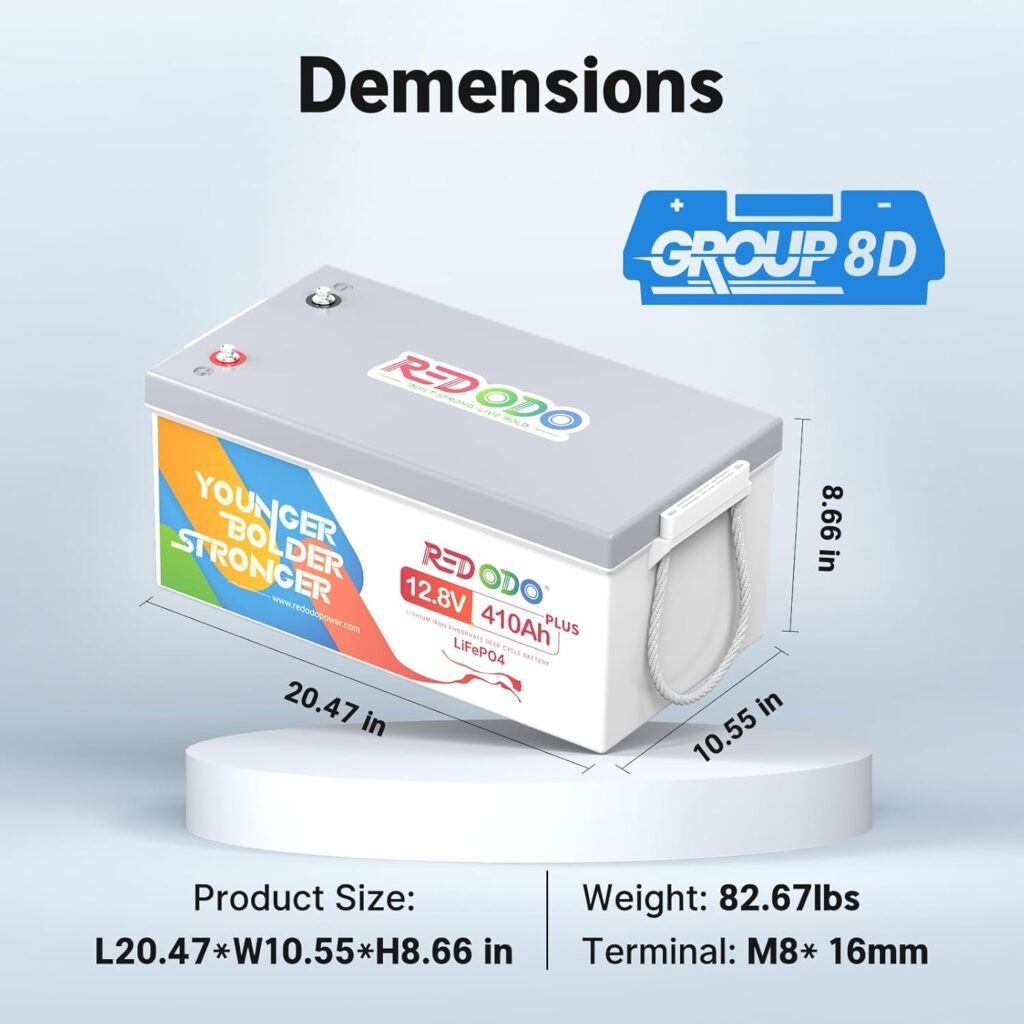
| Built‑in BMS | 250A Battery Management System |
| Max Continuous Output Power | 3200W |
| Cycle Life | 4000+ cycles (at recommended depth of discharge) |
| Estimated Lifetime | Up to 10 years (with proper use) |
| Weight | About 82.67 lbs (37.5 kg) |
| Expandability | Up to 16 units (4 in parallel, 4 in series) for ~83.968 kWh |
| Certifications | UL-1973 tested, FCC, CE, RoHS, UN38.3 |
| Recommended Applications | RVs, solar systems, marine, home backup, cabins |
| Warranty | 5 years + 24/7 expert support |
This data already tells us a lot: it’s a high-capacity, high-output 12V battery aimed at serious off-grid and backup setups, not just weekend gadget charging.
Real-World Energy: What 5.248kWh Actually Means for Us
When we see “5248Wh”, it can feel a bit abstract. What we really care about is: how long can we run our gear?
Powering Typical Devices for Hours, Not Minutes
Redodo states that one 12V 410Ah battery can keep a WiFi router (10W), security camera (20W), and a smart fridge (70W) running together for over 50 hours. That is a realistic and easy-to-picture scenario for off-grid cabins or RV stays.
To put this into perspective, here’s a quick runtime idea (approximate, assuming one fully charged battery and ideal conditions):
| Device / Load | Approx. Power Draw | Estimated Runtime on 5.248kWh |
|---|---|---|
| WiFi router | 10W | ~500 hours |
| LED lights (5 × 10W) | 50W | ~100+ hours |
| Smart fridge | 70W (avg) | ~70+ hours |
| Laptop (charging) | 60W | ~80+ hours |
| CPAP machine | 40W | ~120+ hours |
| Small TV | 80W | ~60+ hours |
| Mixed small loads (~150W total) | 150W | ~30+ hours |
| Portable AC or heater (1000W) | 1000W | ~5 hours |
| Electric stove (1800W use) | 1800W | ~2.5+ hours (active use) |
Obviously, we wouldn’t usually run any of these devices nonstop at full power for that long, but this gives us a sense of the energy reservoir we’re working with.
Plug‑and‑Play Convenience: One Battery Instead of Four
Many of us started with a bank of multiple 12V 100Ah batteries. It works, but it’s messy: more cabling, more points of failure, more confusion when diagnosing issues.
Why Replacing Four 100Ah Batteries with One Matters
Redodo’s 12V 410Ah LiFePO4 consolidates what would normally be four 12V 100Ah lithium batteries into a single unit with similar total energy (5.248kWh vs 5.12kWh). That has several big advantages for us:
- Less wiring: fewer parallel connections, fewer parallel balancing issues
- Reduced energy loss: fewer interconnect points where resistance and minor losses accumulate
- Simpler troubleshooting: one battery to check, one BMS to monitor
- Cleaner installation: fewer cables cluttering our battery compartment
If we’ve ever spent an afternoon crimping lugs and triple-checking wiring diagrams, we know how much simpler it is to deal with a single, high-capacity pack.
High Power Output: Why 3200W Matters Off‑Grid
Capacity is one part of the story. The other is how much power the battery can safely output at once.
Running High‑Demand Appliances Without Brownouts
Thanks to the built‑in 250A BMS, this Redodo battery can deliver up to 3200W of continuous power (at 12.8V). That means we can:
- Run an electric stove (around 1800W)
- Power microwaves, coffee makers, hair dryers, or space heaters (through an appropriately sized inverter)
- Start and run heavier tools or appliances without tripping protection circuits constantly
For a 12V battery, 3200W continuous is impressive. It allows our system to behave more like a small home grid than a fragile camping setup. As long as our inverter is properly sized, this battery can keep up with high-demand situations such as cooking, morning coffee runs, or short electric heating bursts.

Lightweight but Powerful: 82.67 lbs with 6.5× the Energy
We usually equate more energy with more weight, especially when we come from AGM or lead‑acid backgrounds. This battery breaks that expectation.
Comparing to Traditional 12V AGM Batteries
Redodo points out that this 12V 410Ah battery weighs about as much as 1.5× the weight of a 12V 100Ah AGM battery, but delivers around 6.5× the energy at a 1C rate. In practice, that gives us:
- A much more compact and lightweight energy source for our RV, boat, or cabin
- Easier handling during installation or maintenance
- The ability to free up space or reduce the number of batteries needed
Especially in boats and small RVs where every cubic inch counts, this kind of energy density is genuinely useful. We get more power while actually simplifying the physical layout.
Perfect for Upgrading Bulky AGM Systems
Many of us are still running large AGM banks. They work, but they’re heavy, not very energy-dense, and don’t enjoy being deeply discharged often.
Swapping 9 AGM Batteries for One LiFePO4
Redodo claims that to roughly match the energy of a single 410Ah LiFePO4, we’d need around nine 12V 100Ah AGM batteries. That’s an enormous difference:
- Space savings: at least 70% less space taken up by batteries
- Weight reduction: a huge cut in payload for our RV or strain on our boat
- Longer lifespan: LiFePO4 can handle more cycles, so we aren’t replacing batteries every few years
If we’re dealing with a bulky AGM system that eats storage space and adds hundreds of pounds to our rig, moving to a single high-capacity LiFePO4 like this is a substantial upgrade in both convenience and performance.
Lifespan and Cycles: 4000+ Cycles and 10-Year Lifetime
We don’t want to invest in a major battery upgrade just to replace it every few seasons. Lifespan matters just as much as immediate performance.
What 4000+ Cycles Really Means in Daily Use
This Redodo battery touts 4000+ cycles and a 10-year lifetime under proper use. To translate that:
- Using one full cycle per day, 4000 cycles is about 11 years
- In real usage, we rarely cycle from 100% to 0% every day, so effective life can be even longer
- Compared to AGM batteries that might realistically give us only a few hundred deep cycles, this is a massive improvement
The chemistry—LiFePO4—is inherently more stable and long-lived than typical lithium-ion or lead-acid, which helps explain the extended cycle life.
Safety First: Comprehensive BMS and Certifications
When we’re storing and using several kilowatt-hours of energy in a small space, safety is non-negotiable. Redodo addresses this on multiple fronts.
Battery Management System Protections
The integrated 250A BMS includes protections against:
- Over-charging
- Over-discharging
- Over-current
- Short circuits
- High-temperature conditions
This means if something is wired incorrectly, or a device suddenly draws too much power, or charging conditions go out of spec, the BMS steps in to protect both our battery and our system.
Testing and Certification
Beyond internal protections, the battery has been:
- Tested under UL-1973 standards
- Certified by FCC, CE, RoHS, and UN38.3
These certifications indicate that the battery isn’t just engineered for performance but also validated for safety and environmental compliance. That’s particularly reassuring if we’re planning an installation in a vehicle or home where codes and regulations may matter.
Versatility for RVs, Solar, Marine, and Home Backup
Not every battery is happy in every environment. Some struggle with vibration, others with varying charge patterns from solar. This one is designed to handle a broad range of scenarios.
Ideal Use Cases Where This Battery Shines
Here are some common setups where this Redodo battery fits especially well:
- Class A and large RVs: enough capacity to run fridges, inverters, fans, and entertainment systems for extended periods
- Off-grid cabins: store solar energy during the day and use it for lighting, refrigeration, and basic electronics at night
- Boats and marine systems: compact, high-power bank for navigation systems, lighting, pumps, and creature comforts
- Home backup: run critical devices like routers, small fridges, lights, medical equipment, and communications during grid outages
The combination of high capacity, strong power output, and safety protections gives us a battery that can effectively act as the heart of a wide variety of DC or inverter-based systems.
Expandable to 83.968kWh: Building Larger Systems
One battery is already substantial, but if we’re thinking about serious off-grid homes or extended backup, we may want more.
Scaling Up with 4P4S Configurations
Redodo allows this 12V 410Ah battery to be expanded up to 16 units, which can be wired as:
- Up to 4 in parallel
- Up to 4 in series
That configuration, 4P4S, delivers around 83.968kWh of total energy. To put that in context, that’s in the ballpark of a full home battery system capable of running essentials for days, depending on consumption.
With multiple units, we could:
- Build a 48V system with large capacity for higher-efficiency inverter use
- Design a large solar storage bank for cabins or off-grid homes
- Create robust backup power for home offices, remote workstations, or critical systems
We just need to follow Redodo’s wiring guidelines and make sure all batteries are matched and balanced properly during installation.
Installation: Practical Considerations and Tips
Even with a plug‑and‑play design, we still need to plan our system carefully. The battery is user-friendly, but power systems always deserve respect.
What We Need to Install It Properly
We should line up the right components before installation:
- Appropriate gauge cabling to handle up to 250A if we’re using the full output
- Properly sized inverter (if we’re converting to AC) that matches the 3200W potential and has correct low-voltage cutoffs for LiFePO4
- Compatible charger or solar charge controller that supports LiFePO4 charging profiles (voltage, absorption, float settings)
- Good ventilation in the battery compartment to manage any ambient heat, especially at high loads
While the battery is designed to be easy to use, the surrounding system design is crucial for performance and longevity.
Day‑to‑Day Experience: What It Feels Like to Use
Once we get past the numbers, what matters is whether our energy system feels effortless or constantly fragile.
Quiet, Consistent, and Predictable Power
With a battery like this, everyday usage becomes noticeably calmer:
- Our devices run more smoothly because voltage sag is reduced compared to lead-acid
- We can draw heavy loads briefly without feeling like we’re “hurting” the battery
- We don’t need to recharge at shallow depths as aggressively, thanks to healthy cycle life
For RVs and boats in particular, the difference between a sagging AGM system and a robust LiFePO4 pack is dramatic. Lights stay bright, inverters hold their output longer, and we spend less time worrying about our state of charge.
Comparing LiFePO4 to AGM in Real Use
Some of us may still be on the fence about whether switching chemistries is worth it. It helps to compare the experience more directly.
Everyday Differences We’ll Notice
Here are some key contrasts between a typical AGM setup and this LiFePO4 battery:
| Aspect | AGM Battery Bank | Redodo 12V 410Ah LiFePO4 |
|---|---|---|
| Usable capacity | ~50% of rated Ah without shortening life | 80–100% of rated Ah usable |
| Voltage under load | Noticeable drop at high loads | Stays more stable under load |
| Weight and volume | Heavy and bulky for same energy | Lighter and more compact |
| Cycle life | Hundreds of deep cycles | 4000+ cycles |
| Maintenance | Needs careful charging and avoidance of deep discharge | More forgiving and stable |
| Charging speed | Slower absorb stage, sensitive to overcharge | Faster and more efficient |
Switching to LiFePO4 is less about a small performance bump and more about transforming how we use and think about stored energy altogether.
Strengths of the Redodo 12V 410Ah LiFePO4 Battery
Every product has its sweet spots. This one has several.
What We Think It Does Exceptionally Well
Based on the specs and intended use, here’s where this battery really stands out:
- Massive usable capacity: 5.248kWh in a single 12V unit is substantial
- High continuous output: 3200W lets us power serious appliances through a proper inverter
- Space and weight efficiency: replaces multiple batteries, cuts down clutter and payload
- Long lifespan: 4000+ cycles and around a 10-year life under proper use
- Strong safety profile: robust BMS plus multiple certifications
- Scalability: can be the building block for very large systems up to nearly 84kWh
If we’re upgrading a serious RV or building a home solar battery bank, these strengths are exactly what we’re looking for.
Limitations and Things to Keep in Mind
No product is perfect for every situation. It’s helpful to be clear about where the constraints are.
What Might Be Challenges for Some Setups
A few points we should consider:
- Initial cost: LiFePO4 batteries are a bigger upfront investment than AGM, even though they win over the long term
- System compatibility: we need a LiFePO4-compatible charger and inverter for best results
- Weight still present: while lighter per kWh than AGM, 82.67 lbs is not “light” in an absolute sense; we still need to handle and mount it carefully
- 12V architecture: large systems might benefit from stepping up to 24V or 48V via series connections, which adds some design complexity
These aren’t deal-breakers, but they’re essential planning factors before we buy and install.
Who This Battery Is Best For
Not everyone needs a 410Ah LiFePO4. But for the right user, it’s a game changer.
Ideal Users and Scenarios
We’d say this battery is a great fit if we:
- Own a mid to large RV and want to run fridges, inverters, and appliances comfortably off-grid
- Operate a boat and need reliable, high-density energy with good safety and long life
- Have a cabin or off-grid tiny home with solar and want to store enough energy for multi‑day use
- Need home backup for critical circuits during outages, without dealing with loud generators all the time
- Are upgrading from multiple AGM batteries and want to dramatically simplify and modernize the system
If our use case is light—just a few small devices occasionally—this battery may be overkill. But for serious off-grid or backup scenarios, it hits a very practical sweet spot.
Support, Warranty, and Peace of Mind
When we invest in a large battery, we’re not just buying hardware; we’re buying support and future security as well.
Warranty and After‑Sales Experience
Redodo offers:
- A 5-year warranty on this LiFePO4 battery
- 24/7 expert support, which is invaluable if we’re designing or troubleshooting a system
Having responsive assistance can make the difference between a smooth installation and days of frustration. It’s also reassuring to know that issues years down the road are covered by a meaningful warranty period.
Practical Example Setups Using the Redodo 410Ah Battery
We often understand a product best by picturing what we’d actually do with it.
Example 1: RV Boondocking Setup
Imagine an RV with:
- A 3000W pure sine wave inverter
- 600–800W of rooftop solar
- DC loads: lights, water pump, fans, fridge
- AC loads: microwave, coffee maker, laptop chargers, TV
With a single 410Ah battery, we can genuinely operate like a small apartment for long weekends off-grid, as long as we’re mindful of high-wattage appliances and solar generation. We can cook, keep the fridge running, charge devices, and still have reserve capacity when the sun isn’t shining.
Example 2: Cabin Solar Storage
For a small off-grid cabin with:
- 1–2kW of solar
- LED lighting, small fridge, router, and occasional tool use
One Redodo 12V 410Ah battery can easily cover overnight use and cloudy days, particularly if loads remain moderate. We can expand later by adding more units in parallel or series if we decide to increase our solar array or load.
Example 3: Marine Comfort and Safety
On a boat with:
- Navigation electronics, radio, depth finder
- Bilge pumps, lights, fridge, water pump
- Occasional inverter use for AC devices
Having one compact but high-capacity LiFePO4 unit is a significant step up from heavy, maintenance‑intensive lead‑acid banks. The robust BMS and certifications add reassurance in a marine environment where reliability is critical.
Tips for Getting the Most Out of This Battery
Even with a well-designed product, how we treat it makes a big difference in long-term performance.
Best Practices for Longevity and Performance
We’d recommend:
- Using a LiFePO4‑compatible charger or charge controller with appropriate voltage settings
- Avoiding constant 100% to 0% cycles when possible, as partial cycles still give great usable life and reduce wear
- Keeping the battery within recommended temperature ranges, especially avoiding extreme heat
- Ensuring good cable sizing and secure connections so we don’t introduce unnecessary resistance or heating
- Periodically checking system settings (inverter low-voltage cutoffs, charge profiles, etc.) to keep everything tuned for LiFePO4
With these habits, we can realistically expect the battery to serve us reliably for close to a decade.
Our Overall Impression and Verdict
Putting everything together, the Redodo 12V 410Ah LiFePO4 Battery (5248Wh, 250A BMS, 3200W max output) stands out as a serious, high-capacity solution tailored for off-grid power users, RVers, boat owners, and homeowners wanting dependable backup.
We appreciate:
- The large usable energy in a single 12V package
- The ability to run high‑demand appliances through an appropriate inverter
- The space and weight savings compared to clunky AGM banks
- The long cycle life and strong safety features
- The option to scale up to nearly 84kWh in larger installations
As long as we pair it with the right supporting equipment (charger, inverter, cabling) and plan our system thoughtfully, this battery lets us move from “just getting by” on power to having a confident, quiet, and capable energy reserve we can rely on for years.
For anyone ready to upgrade a bulky lead-acid setup or build a future‑proof off-grid system, this Redodo 410Ah LiFePO4 battery is a compelling choice that balances performance, longevity, and practicality in a single robust unit.
Disclosure: As an Amazon Associate, I earn from qualifying purchases.