Have we ever sat staring at a dead lithium battery, wishing there were a faster, safer, and smarter way to bring it back to life?

What Is the VEVOR 12V 60A Lithium Battery Charger?
When we talk about serious lithium charging power for RVs, boats, and other off-grid setups, the VEVOR 12V 60A Lithium Battery Charger stands out as a heavy-duty, purpose-built solution. It is designed specifically for 12V LiFePO4 batteries and offers a robust 60A output with a charging voltage of 14.6V.
This charger is not a generic multi-chemistry unit. It is tailored for lithium iron phosphate (LiFePO4) batteries and optimized for fast, efficient, and safe charging cycles. For anyone running a 12V LiFePO4 system, this is a specialized tool rather than a “one-size-fits-all” compromise.
Key Specifications at a Glance
Having clear numbers helps us understand what a charger can actually do in the real world. The VEVOR 12V 60A charger packs plenty of performance in a relatively compact form.
Below is a summary of the main specs and features so we can see everything laid out clearly.
| Feature | Specification / Description |
|---|---|
| Product Name | VEVOR 12V 60A Lithium Battery Charger |
| Battery Type | 12V LiFePO4 (Lithium Iron Phosphate) only |
| Output Voltage | 14.6V DC |
| Output Current | Up to 60A |
| Recommended Battery Capacity | Ideal for medium to large LiFePO4 banks (e.g., 100Ah–300Ah) |
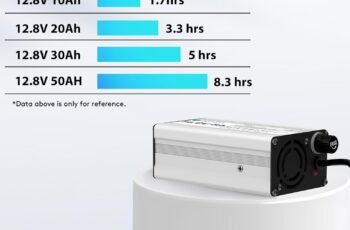
| Approx. Charge Time (150Ah) | About 3 hours from low to full (under ideal conditions) |
| Charging Stages | 4-Stage Intelligent: Precharge, CC, CV, T4 Full Stage |
| 0V Activation | Yes, can wake batteries in BMS protection (0V) mode |
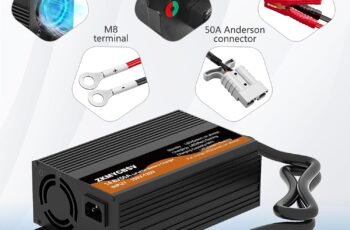
| Connector Type | Anderson connector with 1.4 ft 120A Anderson–M8 terminal adapter cable |
| Protections | Overheat, reverse polarity, short circuit, overvoltage |
| Cooling | Built-in cooling fan |
| Certifications | Tested to FCC standards |
| Use Cases | RVs, boats, golf carts, solar systems, lithium-powered equipment |
This table gives us a quick reference point. Right away, we can see that the charger is clearly aimed at serious 12V LiFePO4 systems rather than tiny portable packs or traditional lead-acid setups.
Compatibility: Designed Only for 12V LiFePO4 Batteries
Compatibility is the first thing we need to get right with any charger, and the VEVOR unit is very explicit about its target chemistry. It is made for 12V LiFePO4 batteries and should not be used on lead-acid, AGM, gel, or other chemistries.
LiFePO4 batteries require a different voltage profile and charging strategy compared with lead-acid. Using a charger that is not tuned for LiFePO4 risks damaging the battery bank or drastically shortening its lifespan. With this charger, we know the voltage and charging curve are optimized for that specific chemistry.
Why This Matters for Our Battery Health
Using a LiFePO4-specific charger like this one helps us protect the investment we have made in our battery bank. LiFePO4 batteries are not cheap, so aligning them with a proper charger is an easy way to extend service life and maintain capacity.
Instead of relying on a “universal” charger that tries to serve multiple chemistries, we get a charger whose entire logic and voltage control are tailored just for LiFePO4. That means better performance, safer operation, and more predictable behavior under different conditions.
Charging Performance: 60A Output and 14.6V Charging Voltage
Performance is where this charger shines. A 60A output is substantial for a 12V system, especially if we are charging a larger battery or a bank of parallel batteries. The 14.6V charging voltage is right in the sweet spot for LiFePO4, ensuring that our battery reaches full capacity safely and efficiently.
For example, VEVOR indicates that this charger can fully charge a 150Ah lithium battery in about 3 hours under ideal conditions. That kind of speed is a big advantage when we do not have unlimited generator or shore power time to spare.
What 60A Actually Means in Real Use
To put 60A into perspective, a 150Ah LiFePO4 battery charged at 60A, in a perfect world, would hit 100% from empty in roughly 2.5 hours (150Ah ÷ 60A). In real-world conditions, the charger shifts through stages, voltage rises, and current may taper, so 3 hours is a more realistic and practical expectation.
This makes the charger especially useful in these scenarios:
- When running a generator and wanting to minimize run time
- When charging battery banks overnight on limited shore power time
- When frequently cycling large LiFePO4 batteries in an RV or boat
With a strong 60A output, we can reduce our downtime and get our batteries back into service more quickly.
4-Stage Intelligent Charging Curve
The brains of this charger lie in its 4-stage intelligent charging curve. Rather than simply pushing current at a fixed rate, it monitors the battery’s condition and adjusts accordingly. This helps with safety, charging time, and battery longevity all at once.
The four stages are: Precharge, CC (Constant Current), CV (Constant Voltage), and T4 Battery Full Stage. Each stage serves a specific purpose and kicks in at the right part of the charge cycle.
Precharge Stage: Waking Low-Voltage Batteries
In the precharge stage, the charger detects a low-voltage or “sleeping” battery and starts charging gently. This is especially important for batteries whose BMS has gone into protection mode or that have been sitting at a low state of charge.
By gradually ramping up instead of slamming the battery with full current, we lower the risk of stress and heat buildup. This is also a part of how the charger supports its 0V activation feature, bringing batteries back from what seems like a “dead” state.
CC Stage: Fast and Efficient Bulk Charging
Once the battery is ready to accept a stronger charge, the charger moves into the Constant Current stage. Here, it delivers up to 60A to refill the majority of the battery’s capacity. This is the bulk charging stage where we see the biggest jump in state of charge over the shortest period.
This fast charging is ideal for off-grid setups, where we might have limited solar or generator hours. The charger focuses on pushing in as many amp-hours as possible while staying within safe parameters defined for LiFePO4.
CV Stage: Holding Voltage to Avoid Overcharge
As the battery approaches its full voltage, the charger transitions to the Constant Voltage stage. In this phase, it holds the voltage at around 14.6V and allows the current to taper down as the battery tops off.
This is how the charger fills those last few percent of capacity without overcharging the cells. If it continued at full 60A past a certain voltage, we would risk overheating and cell damage. By switching to CV, it protects both the battery and the charger.
T4 Battery Full Stage: Automatic Output Cut-Off
Once the battery is full, the charger enters the T4 Battery Full Stage. At this point, the output is cut off, which prevents unnecessary trickle or float that LiFePO4 batteries do not actually require in the same way lead-acid batteries do.
One detail worth noting is that the output remains off until a new battery is connected. This avoids repeatedly “poking” an already full battery with charge and aligns better with modern LiFePO4 charging philosophy. It treats a full battery as exactly that: full and ready to rest.
0V Activation: Recovering Batteries in BMS Protection Mode
The 0V secure activation function is one of the most attractive parts of this charger for many of us using lithium systems. Sometimes a LiFePO4 battery’s BMS will shut down and appear dead (0V) to protect the cells from over-discharge, short circuits, or other events.
In those situations, many chargers refuse to start charging because they do not see a valid voltage. With this VEVOR charger, the 0V activation capability means we can “wake” the battery back up without needing special tools or complicated manual workarounds.
Why 0V Activation Matters in Real Life
We might have had experiences like:
- Leaving lights or appliances running too long on a lithium bank
- Discovering a battery that has sat unused over a long offseason
- Running a system down in cold weather and triggering BMS protection
When the BMS cuts output, standard chargers see “no battery” and will not run. With 0V activation, this charger gently applies voltage in a controlled way to bring the BMS out of protection so normal charging can begin. This can mean the difference between a “dead” battery and a recoverable one.
Safety and Protection Features
Safety is not just a nice-to-have with high-current chargers; it is non-negotiable. The VEVOR LiFePO4 smart charger includes several key protections that guard both our batteries and our gear from damage and hazards.
We are dealing with up to 60A of current here, so having robust protections built into the unit gives us peace of mind when using it in RVs, boats, and garages.
Overheat Protection and Cooling Fan
High current naturally generates heat, and the charger accounts for that with overheat protection and a built-in cooling fan. The fan helps keep internal components at safe operating temperatures, especially during long bulk-charging sessions.
Should temperatures climb too high, the overheat protection kicks in and throttles or shuts down the charger to prevent damage. This lets us run high currents without having to monitor the unit constantly.
Reverse Polarity and Short Circuit Protection
Accidents happen. Reversing the positive and negative connections or accidentally shorting the output can be dangerous, especially at 60A. The VEVOR charger includes reverse polarity and output short circuit protections to mitigate these events.
Instead of catastrophic failure, blown fuses, or worse, the charger is designed to protect itself and our battery when cables are connected incorrectly. It still pays to be careful, of course, but knowing these protections exist adds another layer of security.
Overvoltage Protection and FCC Testing
The charger also includes overvoltage protection, which helps ensure that our batteries are not subjected to excessive voltage levels. This is crucial for LiFePO4 longevity and safety, since overvoltage can push cells beyond their safe limits.
Additionally, being tested to FCC standards means the charger meets certain benchmarks for electromagnetic interference and overall electrical safety. This is reassuring, especially when installing it in close proximity to sensitive electronics in RVs or boats.
Anderson Connector and Wiring Convenience
A strong charger is useless if it is a hassle to connect and disconnect frequently. The VEVOR charger comes with an upgraded Anderson connector system that makes life easier, especially when we work with modular battery setups or multiple packs.
The included 1.4 ft 120A Anderson–M8 terminal adapter cable provides a sturdy, plug-and-play connection without fragile clips or makeshift wiring. We gain both convenience and reliability in one go.
Why the Anderson Connector Is a Big Plus
Anderson connectors are widely used in high-current DC applications because they offer:
- Secure mechanical connection
- High current handling capability
- Simple, tool-free plugging and unplugging
For our use cases—RVs, boats, golf carts, solar systems—this style of connector fits right in. Instead of wrestling with clamps or dealing with loose contact points, we get a professional-grade interface that feels appropriate for a 60A charger.
Real-World Use Cases
The VEVOR 12V 60A Lithium Battery Charger is most at home in settings where we rely heavily on 12V LiFePO4 battery systems. Anywhere we need fast, dependable charging for deep-cycle lithium batteries, this charger can play a key role.
Let us look at some of the primary environments where it fits naturally.
RVs and Camper Vans
For RV owners running LiFePO4 house batteries, this charger can be the main workhorse behind the scenes. Whether we are plugged into shore power at a campground or running a generator off-grid, having 60A available means our batteries recover quickly between uses.
We might:
- Top off a 200Ah or 300Ah bank overnight
- Recharge the bank during a short generator session after cloudy days
- Use the 0V activation feature if our BMS shuts down from deep discharge
In a mobile lifestyle, reducing power anxiety and downtime makes a big difference.
Boats and Marine Applications
Boats often operate in power-constrained environments, relying on alternators, shore power, and sometimes solar. LiFePO4 batteries are becoming more common on vessels, and a dedicated charger like this fits right into that ecosystem.
We can use this charger:
- At the dock on shore power to recharge the house bank
- As a backup or supplemental charger alongside alternator output
- To maintain dedicated LiFePO4 trolling or accessory batteries between trips
Marine environments demand reliable gear, and a robust 60A lithium charger with appropriate protections helps give us confidence offshore.
Solar and Off-Grid Systems
Even in stationary off-grid setups, such as cabins or workshops, this charger can play an important role. It serves as a bridge between AC power sources (like generators or grid power when available) and our 12V LiFePO4 battery bank.
When sunlight is low or panels are temporarily insufficient, we can:
- Use this charger to quickly restore battery levels from a generator
- Back up a solar charge controller that cannot provide as much current
- Recover deeply discharged battery banks after extended bad weather
Because the charger is AC-DC, it integrates easily whenever we have access to mains or generator AC output.
Golf Carts and Other Electric Vehicles (12V Systems)
For golf carts or other small EVs that run 12V LiFePO4 configurations, fast charging can be a game changer for daily usability. Instead of leaving batteries on slow chargers for many hours, we can use the 60A capacity to get them ready faster.
Of course, we must confirm that our specific battery setup is 12V LiFePO4 and that the wiring and BMS can handle 60A charging current, but if so, this charger can make turnarounds between uses much quicker.
Ease of Use and User Experience
A smart charger should be powerful but also straightforward. The VEVOR unit focuses on plug-and-play convenience while still giving us indicators and protections that make day-to-day use less stressful.
Most of what we do as users comes down to connecting the Anderson plug correctly and letting the charger handle the rest with its automated stages.
LED Indicator and Status Feedback
The charger includes an LED indicator that helps show charging status at a glance. While this is not as elaborate as a full LCD screen with detailed readouts, it still lets us know whether the charger is:
- Actively charging
- In a standby or full state
- Encountering a fault condition
For many of us, quick visual feedback is enough when combined with other system monitors we may already be using, such as battery monitors or RV control panels.
Plug-and-Play Operation
Because it uses an Anderson connector and a smart charging algorithm, we do not need to fiddle with manual charging profiles or complicated programming. We simply connect the charger, ensure AC power is available, and let the unit manage the stages on its own.
This simplicity is particularly nice in environments where multiple people use the same equipment. Anyone can plug it in without having to be a battery expert.
Pros and Cons of the VEVOR 12V 60A Lithium Battery Charger
Summarizing the strengths and tradeoffs gives a clearer picture of whether this charger fits our specific needs. No product is perfect for everyone, but knowing where it shines and where it is limited helps us decide.
Advantages
From what we can see, these are the primary benefits of this VEVOR charger:
-
High 60A Output
Great for rapidly charging medium and large 12V LiFePO4 batteries, cutting down generator or shore power time. -
LiFePO4-Specific Charging Profile
The 14.6V output and 4-stage curve are tuned specifically for lithium iron phosphate, which is excellent for battery health. -
0V Activation Capability
Being able to wake BMS-protected or seemingly “dead” batteries without extra tools is extremely useful in real-world situations. -
Robust Safety Features
Overheat, reverse polarity, short circuit, and overvoltage protection combined with a cooling fan and FCC testing add layers of safety. -
Anderson Connector with High-Current Adapter
The included 120A Anderson–M8 cable provides a neat and professional plug-and-play solution, avoiding messy connections. -
Suitable for Multiple Use Cases
Works well in RVs, boats, golf carts, and off-grid solar systems, wherever 12V LiFePO4 banks are used.
Limitations
We should also consider where this charger may not fit everyone’s needs:
-
Not Compatible with Lead-Acid or Other Chemistries
If we run AGM, gel, or flooded lead-acid systems, this charger is not suitable. It is strictly for 12V LiFePO4. -
Single Voltage System (12V Only)
Those with 24V, 36V, or 48V LiFePO4 setups would need a different model. This unit is focused purely on 12V systems. -
Relatively High Current May Be Overkill for Very Small Batteries
Small LiFePO4 packs (e.g., under 50Ah) might not need or want 60A charging. We would need to ensure the battery’s recommended charge rate supports this level. -
Limited On-Device Display Information
Using basic LED indicators instead of a multi-function screen means we lean more on separate battery monitors if we want detailed data.
Installation and Setup Considerations
While the charger is largely plug-and-play, there are still some practical considerations when we install it in a vehicle, boat, or building. Planning ahead improves both safety and convenience.
We want to think about location, ventilation, cabling, and how it integrates with the rest of our electrical system.
Mounting Location and Ventilation
Because the charger includes a cooling fan and can generate heat at high loads, we should:
- Mount it in a dry, protected area away from direct splashes or water exposure
- Provide adequate airflow around vents so the fan can do its job
- Avoid sealing it in a completely closed compartment without ventilation
In RVs and boats, a well-ventilated cabinet or technical bay often works well, as long as heat can escape and the charger remains accessible.
Cable Sizing and Connection Quality
Even though the charger includes a 1.4 ft Anderson–M8 adapter, we still need to ensure the cables between the battery and the M8 terminals are appropriately sized for 60A and the length of the run. Undersized cables can lead to voltage drop and heat.
We also want solid, properly crimped or bolted connections at all terminals. Loose or corroded joints can cause resistance, leading to inefficient charging and potential overheating.
Integrating with Existing Power Systems
Some of us may already have solar charge controllers, DC-DC chargers, or alternator charging in our systems. Adding the VEVOR charger means thinking about how it fits into that ecosystem.
For example, we might:
- Use it only when on shore power or generator, while solar handles daytime charging
- Ensure there is proper coordination or isolation if multiple chargers can operate simultaneously
- Confirm the BMS settings on our batteries align with the voltage and current this charger provides
With a little planning, the VEVOR unit can seamlessly slot into an existing system as our high-powered AC charger.
Battery Sizing and Charge Rate Guidelines
To get the most from a 60A charger, it helps to match it with batteries that can accept that charge rate comfortably. While many LiFePO4 batteries can handle relatively high charge currents, each manufacturer has recommended maximum charge rates.
As a rough guideline, many LiFePO4 batteries support continuous charge rates of up to 0.5C to 1C (where C is the capacity). For example:
- A 100Ah battery might safely accept 50A to 100A
- A 150Ah battery might safely accept 75A to 150A
At 60A, this charger is well-suited for:
- 100Ah batteries that allow high charge rates
- 150Ah and 200Ah banks commonly used in RVs and boats
- Larger parallel banks where the total capacity is well above 100Ah
We always want to check the datasheet or manual for our specific batteries to confirm compatibility with a 60A charger.
How This Charger Compares Conceptually to Generic Units
While we may not be directly comparing it to specific competitor models here, we can still look at how this VEVOR charger stands against generic multifunction chargers.
Many low-cost chargers attempt to support multiple chemistries at lower amperage outputs. In contrast, this unit:
- Focuses solely on 12V LiFePO4, optimizing voltage and charging curves
- Delivers a high 60A output, which many generic chargers cannot match
- Includes 0V activation, a feature often missing from budget models
- Provides heavy-duty Anderson connectivity instead of simple clamps
This makes it more of a specialist’s tool for serious lithium setups rather than a universal all-rounder. If we are fully invested in 12V LiFePO4, that specialization is often exactly what we want.
Everyday Experience and Practical Impressions
Putting all the technical details aside, what matters is how the charger feels to use day in and day out. Our sense of reliability, speed, and confidence in the unit grows as we use it across different scenarios.
When we plug in, the behavior is predictable: the charger detects the battery, moves through the stages automatically, and safely turns off when the battery is full. The presence of protections and 0V activation means we are less stressed about edge cases and more comfortable pushing our system hard when necessary.
Noise and Operation
The built-in fan does introduce some level of operating noise, as we would expect with a 60A charger. In most setups—generator sheds, technical bays, or under-seat compartments—this is not a major concern, but it is something to be aware of if we place it in a very quiet living space.
The tradeoff is better cooling and more consistent performance at high current levels. For many of us, that is worth the moderate fan noise during heavy charging sessions.

Who This Charger Is Best For
Not everyone needs a 60A dedicated LiFePO4 charger, but for the right audience, this VEVOR model can be a highly effective tool.
It is especially well-suited for:
- RV users with 12V LiFePO4 house banks between roughly 100Ah and 400Ah
- Boat owners converting to or already using 12V LiFePO4 systems
- Off-grid cabin or workshop setups relying on LiFePO4 storage plus generator backup
- Users who frequently discharge their lithium bank and need rapid turnaround charging
- Anyone who wants 0V activation to recover BMS-protected “dead” batteries without extra gear
If our system is small, low-current, or based on lead-acid batteries, this charger would be overkill or incompatible. But for serious 12V LiFePO4 installations, it aligns very well with real needs.
Our Overall Impression and Final Thoughts
When we bring everything together, the “VEVOR 12V 60A Lithium Battery Charger, 14.6V, AC-DC LiFePO4 Smart Charger, with Anderson Connector, LED Indicator, 0V Activation, for Lithium LiFePO4 Deep Cycle Rechargeable Batteries of Boat, RV” positions itself as a robust, focused solution for modern lithium-powered setups.
We appreciate that it:
- Puts LiFePO4 requirements front and center instead of trying to work with every battery type
- Offers a strong 60A output and a smart 4-stage charging profile that respects battery health
- Adds 0V activation for those stressful moments when batteries fall into BMS protection
- Includes meaningful protections and solid connectors suitable for real-world, high-current use
For us, the biggest value lies in the combination of speed, safety, and lithium-specific intelligence. If our world revolves around 12V LiFePO4 batteries in an RV, boat, or off-grid system, this charger feels less like a simple accessory and more like a core component of the power ecosystem.
In short, when we need a powerful, reliable, and LiFePO4-tailored AC-DC charger, this VEVOR 12V 60A unit earns a strong place on our shortlist.
Disclosure: As an Amazon Associate, I earn from qualifying purchases.