Product Overview: Is This 12V 50A Lithium Battery Charger Worth Considering?
Charging a large LiFePO4 bank with a 20A unit can mean a long wait, so the central question is whether a 50A model earns its higher price. The KAISAL 12V 50A lithium battery charger is designed for nominal 12V or 12.8V LiFePO4 batteries and delivers 14.6V at up to 50A. At the listed $123.39 price, reduced from $135.99, it is currently in stock and presents its value through high output, three connector choices, and multiple protection functions.
We see the 12V 50A lithium battery charger as a specialist product rather than a universal battery charger. It is intended for LiFePO4 chemistry, not lead-acid, AGM, or gel batteries. The 50A maximum can substantially shorten charging time for a suitably sized battery, but it may be excessive for a small pack or a battery-management system with a lower charge-current limit.
For shoppers comparing high-output lithium equipment in 2026, the 12V 50A lithium battery charger deserves consideration if rapid AC charging is the priority. We assess its advertised three-stage operation, 0V wake-up feature, cooling, connectors, safety claims, customer-feedback evidence, alternative chargers, and practical suitability for RV, marine, solar, and off-grid work.
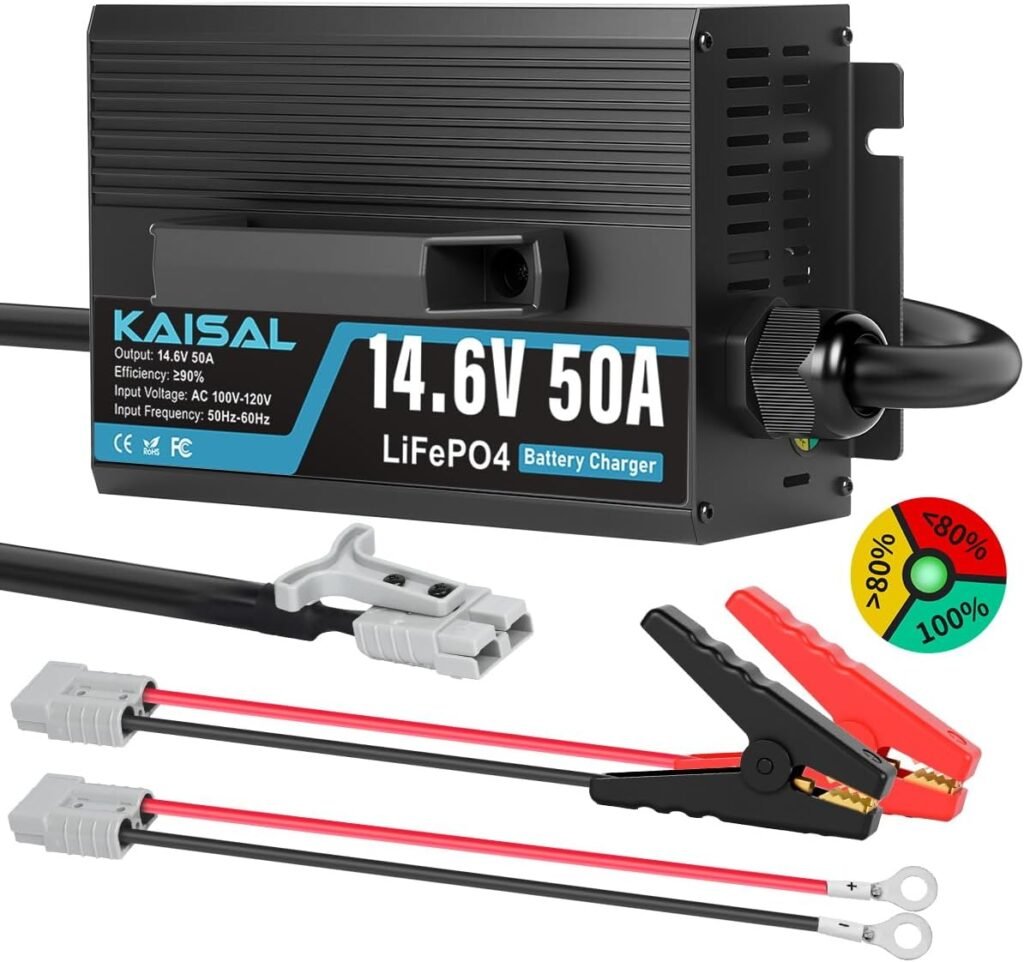

KAISAL 12V 50A Lithium Battery Charger Specifications
The core specification sheet makes the 12V 50A lithium battery charger a high-current AC charging device for 12V-class LiFePO4 batteries. The manufacturer lists these figures:
| Specification | Listed detail |
|---|---|
| Charging voltage | 14.6V |
| Maximum output | 50A |
| Rated input | 90–120V AC |
| Maximum stated efficiency | Up to 94% |
| Cable length | 9 feet |
| Weight | 5.5 pounds |
| Service promise | 3 years |
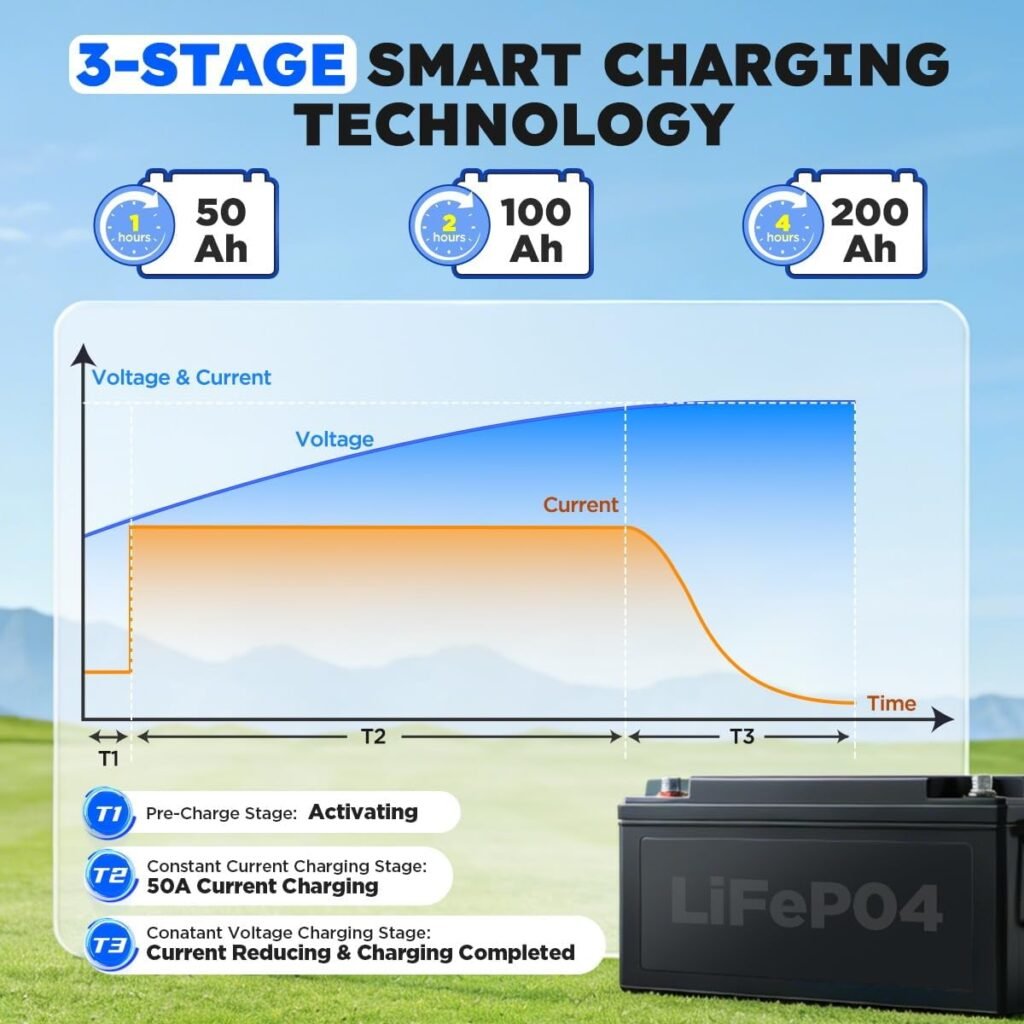
The 12V 50A lithium battery charger is specified for 12V nominal or 12.8V LiFePO4 batteries. KAISAL gives an example of a 12.8V 200Ah battery reaching full charge in about four hours under stated conditions, although real charging time varies with starting state, temperature, BMS limits, battery acceptance, and the slower final stage.
The 12V 50A lithium battery charger uses an aluminium-alloy housing and an eddy-current cooling fan. Those design choices are relevant when current is high for an extended period, but the listed 94% efficiency and certifications—FCC, ETL, CE, and RoHS—are manufacturer claims rather than measurements we have independently verified. Before relying on them, check the markings on the physical charger and packaging. Hands-on testing should confirm output current, temperature, fan behaviour, cable voltage drop, and actual charge duration.
Charging Performance and Three-Stage Operation
The advertised three-stage intelligent charging process is intended to provide stronger current while the battery is low, then reduce output as the cells approach full charge. That approach is normal for lithium charging: a charger cannot necessarily maintain its maximum rating throughout the entire cycle without risking overcharge or exceeding the battery-management system’s limits.
In simple terms, 50A represents a potentially substantial charge rate. A 100Ah battery could theoretically receive a 0.5C rate, while a 200Ah battery would receive approximately 0.25C. The 12V 50A lithium battery charger should only be allowed to operate at those levels when the battery maker specifies that the pack and BMS can accept them.
The stated efficiency of up to 94% suggests that some input energy becomes heat and conversion loss. Wiring quality, input voltage, battery temperature, state of charge, and current taper all affect real results. The claim of roughly four hours for a 200Ah battery is ideal arithmetic around the advertised output; the final 80%–100% portion can take longer.
Before the first full cycle, we recommend this sequence:
- Confirm that the battery is LiFePO4 and check its permitted charge current.
- Read the BMS specification, including any low-temperature or charging cutoff limits.
- Use suitable cables, terminals, and connectors rated for the intended current.
- Connect the battery before applying AC power.
- Monitor the battery, charger, and connections for temperature during charging.
For 20Ah or 50Ah batteries, the 12V 50A lithium battery charger may be too aggressive if the manufacturer specifies a lower limit. Fast charging is not automatically better for longevity; the battery’s recommended rate takes priority over the charger’s maximum.
0V Wake-Up, Indicators, and Protection System
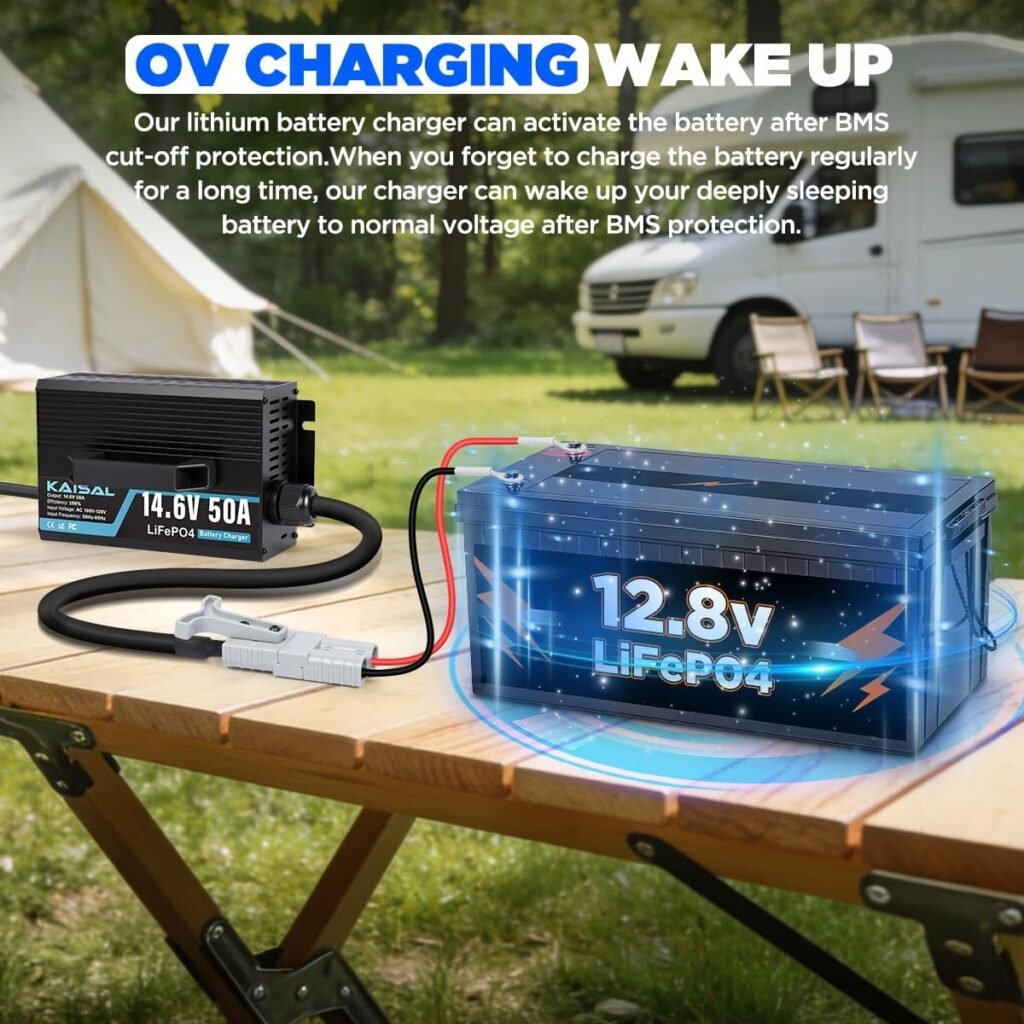
The advertised 0V wake-up mode is intended for a LiFePO4 battery whose BMS has disconnected the pack after low-voltage protection or prolonged storage. The 12V 50A lithium battery charger may attempt to restore enough voltage for the BMS to reconnect, but wake-up is not the same as repairing damaged cells or reversing unsafe battery conditions.
A battery reading 0V should be inspected before charging. We would stop immediately if there is swelling, unusual heat, physical damage, leakage, or an abnormal odour. The charger’s green light indicates standby or 0V wake-up mode; flashing red indicates normal charging from 0% to 80%; flashing yellow indicates the lower-current 80%–99% stage; and green indicates full charge.
KAISAL lists eight protections: overvoltage, overcurrent, overheating, no-load, short circuit, reverse connection, overcharge, and timed charging. It also states that the unit stops after hours continuously. These are useful safeguards, but they should not justify leaving an unknown or damaged battery unattended. Automatic fault recovery should be treated cautiously: correct the underlying problem rather than repeatedly cycling power.
For first use, verify chemistry and polarity, select the connector that matches the battery, observe the initial indicator state, and watch for abnormal heat or smell. If either the charger or battery behaves unexpectedly, disconnect AC power and investigate before trying again. The 12V 50A lithium battery charger is safest when its protective functions supplement careful supervision rather than replace it.

Connectors, Cable Length, Cooling, and Everyday Usability
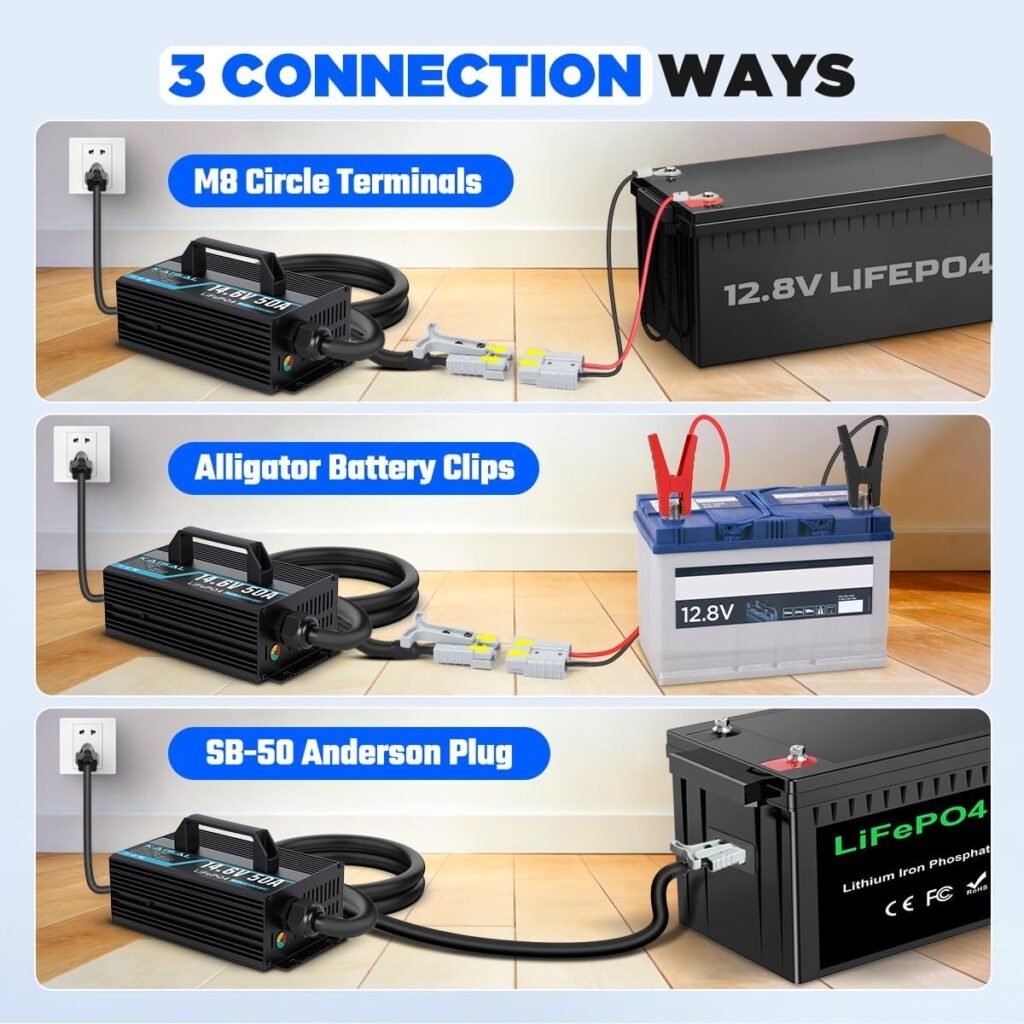
Connection flexibility is one of the more practical features of the 12V 50A lithium battery charger. It includes an SB-50 Anderson plug, M8 terminal connectors, and alligator clips. Anderson plugs suit batteries already fitted with a compatible port, M8 terminals are better for a more permanent installation, and clips are convenient for occasional charging where exposed battery posts are accessible.
Leaving M8 terminals attached can reduce repeated removal and reconnection, which is helpful in an RV or workshop. They still need correct polarity, secure hardware, clean contact surfaces, and protection against accidental contact. Alligator clips are convenient, but they require a firm connection throughout a high-current session and are less suitable as a permanent installation.
The 9-foot lead gives us more freedom to position the charger away from the battery. Route it away from heat, water, moving parts, sharp edges, and walkways. The 5.5-pound weight is manageable for camping, RV travel, marine storage, or a workshop, though it is not an ultra-light accessory.
The aluminium-alloy shell and cooling fan are intended to move heat away during sustained output. Place the charger on a dry, stable, ventilated surface, avoid covering it, and leave the air inlets and outlets clear. Before every high-current charge, inspect the lead, connector housings, clips, and terminals. Fan noise may be noticeable in a quiet cabin; the listing does not provide a measured decibel rating. Keep the 12V 50A lithium battery charger dry and check connectors regularly.
Where This Charger Fits: RV, Marine, Solar, and Off-Grid Applications
For an RV or van with a larger LiFePO4 house bank, the 12V 50A lithium battery charger can reduce downtime between trips or generator-powered charging sessions. Its usefulness rises with battery capacity and frequency of use; a suitably configured 200Ah bank can take much better advantage of high current than a small recreational battery.
Marine and boat owners need to treat it as an AC-powered charger for an indoor or protected location. The 12V 50A lithium battery charger should not be exposed to spray, standing water, condensation, or saltwater contamination. Trolling-motor and electric-yacht applications are possible only when the pack is a compatible 12V or 12.8V LiFePO4 system and its BMS accepts the charging current.
In a solar or off-grid installation, this unit can serve as an AC backup charger. It does not replace a solar charge controller, inverter, battery disconnect, or correctly sized DC wiring. The 90–120V AC input range also matters: verify that the available mains supply falls within that range before purchase.
We would assess application fit in this order: identify battery capacity, confirm chemistry and nominal voltage, check the maximum permitted charge current, verify AC availability, select the connector, and plan dry ventilation. The 12V 50A lithium battery charger is most compelling for medium-to-large 12V LiFePO4 banks, not every 12V installation.
What Customers Are Saying About the 12V 50A Lithium Battery Charger
The supplied product information does not include a current star rating or review count, so we cannot responsibly quote a numerical rating or claim that a particular number of buyers reported a pattern. That limits confidence in any assessment of long-term reliability. A short listing description also cannot establish whether the 3-year service promise has been tested through extended independent use.
Customer reviews should be separated into measurable evidence and impressions. Statements such as “charges quickly,” “runs cool,” or “works as expected” are useful first impressions but are much stronger when paired with battery capacity, starting voltage, charge time, ambient temperature, and a photograph of the setup. The 12V 50A lithium battery charger’s 9-foot lead, connector flexibility, indicator simplicity, compact form, and successful recovery after BMS cutoff are the themes we would look for in detailed buyer accounts.
We would also watch for complaints about fan noise, connector fit, cable heating, premature shutdown, confusing indicator behaviour, or incompatibility with batteries that restrict charge current. Conflicting feedback often reflects different chemistry, capacity, BMS settings, input voltage, connector choice, or charging procedures rather than a single universal result.
When reading the listing’s reviews, prioritise detailed entries with photos, named battery specifications, measured times, and repeated-use reports over short star-only ratings. In particular, check whether reviewers describe long-term operation or only a successful first charge. The 12V 50A lithium battery charger’s claimed features are promising, but the available data here does not prove durability.
How It Compares With Other 12V LiFePO4 Chargers
The KAISAL 12V 50A lithium battery charger stands apart from lower-current options such as the LiTime 14.6V 20A LiFePO4 Battery Charger and the Power Queen 14.6V 20A LiFePO4 Battery Charger. Both named alternatives are useful comparison points because a 20A design may be more appropriate for smaller batteries or packs with conservative charge limits. We do not have current competitor prices, ratings, or complete connector specifications here, so we will not declare a universal winner.
On paper, 50A can provide 2.5 times the current of 20A. That does not guarantee a 2.5-times shorter charge: battery acceptance, BMS limits, tapering near full charge, temperature, wiring, and starting state all change the result. The 12V 50A lithium battery charger is more suited to larger banks and frequent turnaround, whereas a 20A alternative may be safer and more economical when maximum speed is unnecessary.
We would compare the KAISAL, LiTime, and Power Queen by checking included connectors, lead length, cooling design, certification markings, service terms, wake-up behaviour, and verified customer feedback. Portability matters too, particularly when the charger is stored in an RV or carried to a workshop.
The 12V 50A lithium battery charger becomes the stronger candidate when the battery’s BMS permits 50A, rapid AC recovery matters, and three connection methods are useful. A 20A model deserves preference for a smaller pack, occasional charging, or a battery whose documentation sets a lower maximum current.
Who Should Buy This 12V 50A Lithium Battery Charger?
The best-fit buyer has a 12V or 12.8V LiFePO4 battery bank whose manufacturer permits charging at up to 50A and who regularly needs faster AC charging. The 12V 50A lithium battery charger makes practical sense for RV owners, marine users with protected charging spaces, off-grid operators, trolling-motor owners, solar users needing backup AC input, and workshop users maintaining compatible lithium batteries.
Three connector options are useful for households or fleets that use different battery connection styles. An Anderson-equipped battery can connect directly, an M8 installation can remain attached, and clips can support occasional access. That flexibility is valuable only when the connectors are correctly fitted and the battery terminals are appropriate for the current.
Poor-fit scenarios are just as clear: lead-acid owners, 24V or 48V system users, batteries with low charge-current limits, exposed outdoor locations, and small batteries that could be stressed by 50A. Before purchasing, we would check:
- LiFePO4 chemistry and 12V-class nominal voltage.
- Battery capacity and maximum permitted charge current.
- BMS wake-up behaviour and low-temperature limits.
- Connector compatibility and available 90–120V AC input.
- Ventilation, dry storage, and protected placement.
The stated 3-year product service adds value, but we would retain the purchase record and confirm the process for non-human-damage claims. Compatibility comes first; charging speed comes second. A 12V 50A lithium battery charger is sensible only when the battery documentation supports it.
Price, Availability, and Overall Value
The listed price is $123.39, compared with an original price of $135.99, and the product is currently shown as in stock. Marketplace prices and availability can change, so we would verify the final checkout total, return terms, current rating, and certification markings before placing an order.
At that price, the 12V 50A lithium battery charger is selling high-current capability rather than simple occasional charging. The value package includes the advertised up-to-94% efficiency, 0V wake-up, three connector choices, 9-foot lead, eight protection functions, cooling fan, and 3-year service promise. Those features matter more for a medium-to-large bank that is regularly recharged from AC than for a battery that normally accepts only 10A or 20A.
The practical calculation is time saved. Compared with a 20A charger, 50A can theoretically supply 2.5 times the current, but the real difference depends on how much current the battery accepts and how long charging tapers near full. We would compare the $123.39 purchase cost with the value of shorter generator runs, less waiting, or faster turnaround—not with the headline amperage alone.
Overall, the 12V 50A lithium battery charger appears most worthwhile for compatible medium-to-large LiFePO4 banks that need rapid AC charging and flexible connections. Buyers with small batteries or strict BMS limits should choose a lower-current model instead.
Pros and Cons
Pros
- High 50A maximum output for compatible medium-to-large LiFePO4 banks
- Three connection options: SB-50 Anderson plug, M8 terminals, and alligator clips
- Advertised 0V wake-up function for certain BMS-disconnected batteries
- Eight listed protection functions plus a 15-hour automatic stop
- 9-foot cable and aluminium-alloy housing with cooling fan
- Stated 3-year product service
Cons
- Not suitable for lead-acid, AGM, gel, 24V, or 48V battery systems
- 50A may exceed the permitted charging current of smaller batteries
- The listing does not provide a current rating or review count here for independent customer-feedback assessment
- Fan noise, long-term durability, and real-world efficiency are not independently established
- 0V wake-up cannot repair damaged cells or make an unsafe battery safe
Final Verdict
Key Takeaways
- The charger is designed specifically for 12V or 12.8V LiFePO4 batteries and provides up to 50A at 14.6V.
- Its high output is best matched with medium-to-large battery banks whose BMS permits a 50A charge rate.
- 0V wake-up and eight advertised protections add useful safeguards, but they do not replace battery inspection or supervision.
- The three connectors and 9-foot lead improve installation flexibility for RV, marine, solar, and workshop use.
- At $123.39, its value is strongest when faster AC charging saves meaningful time compared with a 20A charger.
Frequently Asked Questions
How many amps does it take to charge a 100Ah LiFePO4 battery?
The correct current depends on the battery manufacturer’s specification and BMS. This charger can provide up to 50A, which equals a theoretical 0.5C rate for a 100Ah battery, but the battery may permit less and should never be charged above its stated limit.
What are the disadvantages of LiFePO4 batteries?
LiFePO4 batteries typically require compatible charging equipment and battery-management protection, and they can cost more initially than some lead-acid options. Low-temperature charging may also be restricted by the BMS, while damaged or deeply discharged packs require careful inspection before attempting recovery.
What is the best way to charge a 100Ah lithium battery?
Use a charger specifically designed for the battery’s chemistry and nominal voltage, then follow the battery maker’s maximum-current instructions. Confirm polarity, use correctly rated wiring and connectors, provide ventilation, and monitor the first complete charge rather than relying only on the charger’s maximum rating.
How long does it take to fully charge a 100Ah battery?
The time depends on the charger’s actual current, the battery’s starting state, BMS limits, temperature, and tapering near full charge. At a constant theoretical 50A, 100Ah would take about two hours, but a real full cycle can take longer because current normally reduces as the battery approaches full.
Disclosure: As an Amazon Associate, I earn from qualifying purchases.