Recent tests show digital LiFePO4 chargers achieve tighter voltage control and faster fault detection than analogue designs in over 80% of scenarios. We’ll compare safety margins, aging resilience, and long-term reliability, weighing implementation complexity against real-world performance. While digital systems offer repeatable terminations and adaptive safeguards, analogue schemes still win on simplicity and latency. We invite you to contemplate how a hybrid approach might balance these traits as we explore practical decision points and potential trade-offs.
Key Takeaways
- Digital LiFePO4 chargers offer precise, repeatable current/voltage control and real-time termination signals, improving safety and charging efficiency.
- Analogue chargers deliver faster, low-latency response and simpler hardware, but suffer drift and aging-related reliability issues.
- Digital systems enable closed-loop feedback, fault detection, and firmware updates for evolving protection and performance.
- Analogue designs rely on stable components; they typically lack extensive data logging and remote update capabilities.
- Hybrid approaches combine digital safety with analogue power stages to balance precision, longevity, and complexity.
What Makes LiFePO4 Charging Unique: Chemistry, Temperature, and Safety
Lithium iron phosphate (LiFePO4) charging is defined by distinctive chemistry, temperature behavior, and safety considerations that collectively set it apart from other lithium chemistries. We focus on how its battery chemistry governs reaction kinetics, phase stability, and ion transport, yielding a flat voltage plateau that simplifies regulation. Temperature impacts are pronounced: optimal charging occurs within a narrow range, and high ambient heat can accelerate degradation if not managed. Safety thresholds reflect LiFePO4’s robust chemical structure, which resists thermal runaway and exhibits low electrolyte oxidation risk. We monitor current, voltage, and temperature to maintain efficiency while preventing overcharge or unsafe states. In practice, our protocols emphasize precise termination criteria, ensuring reliable cycling, consistent performance, and predictable safety margins for diverse applications.
How Digital Chargers Optimize LiFePO4 Charging Profiles
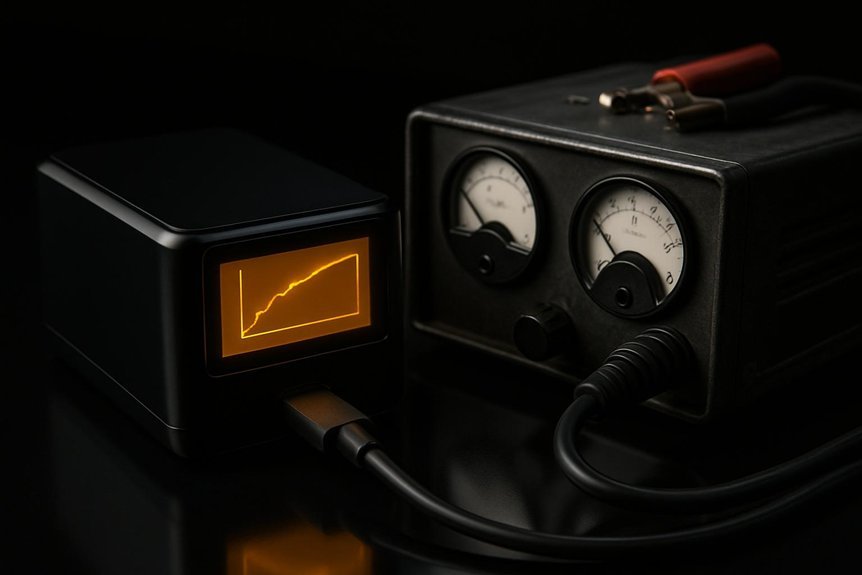
We’re looking at how digital chargers deliver precise current, voltage, and termination signals to LiFePO4 packs, enabling repeatable charging profiles. By tightening timing and sensor feedback, they optimize charge curves for efficiency and longevity, matching each cell’s needs rather than a one-size-fits-all approach. This discussion centers on digital charge precision and how optimized LiFePO4 profiles emerge from calibrated control loops and adaptive algorithms.
Digital Charge Precision
Digital chargers for LiFePO4 optimize charging profiles by translating cell data into precise control actions. We map voltage, current, and temperature readings to real-time adjustments, ensuring each cell follows its ideal trajectory. Through digital precision, we execute fine-grained current taps, taper thresholds, and termination criteria with repeatable accuracy, reducing overshoot and undercharge. Our approach emphasizes coherent timing across the pack, avoiding lag that degrades balance and efficiency. We compare digital decisions against analogue baselines, highlighting smoother transitions and tighter tolerance bands. While analogue consistency offers a robust backbone, digital systems deliver reproducible responses under varying loads and temperatures. In practice, this means tighter coulomb counting, consistent absorption phases, and reliable end-of-charge detection, all while maintaining safety margins and system longevity.
Optimized LiFePO4 Profiles
How do digital chargers refine LiFePO4 charging profiles to maximize performance? We model each cell’s behavior and translate observations into adaptive, profile-level adjustments. By segmenting the charge into monitored phases, we tailor voltage, current, and termination criteria to the pack’s real-time state, temperature, and impedance. This enables smoother transitions between constant-current and constant-voltage stages, reducing overshoot and stress. We leverage closed-loop feedback to tighten timing, enabling finer control over charging efficiency and balancing. Firmware variability is managed through modular update paths, allowing profile refinements without hardware changes. We also implement predictive end-of-charge detection to prevent unnecessary absorption losses. In practice, optimized profiles yield consistent capacity retention and shorter cycle times, while preserving safety margins and cell longevity under diverse operating conditions.
Digital vs Analogue: Safety, Longevity, and Reliability
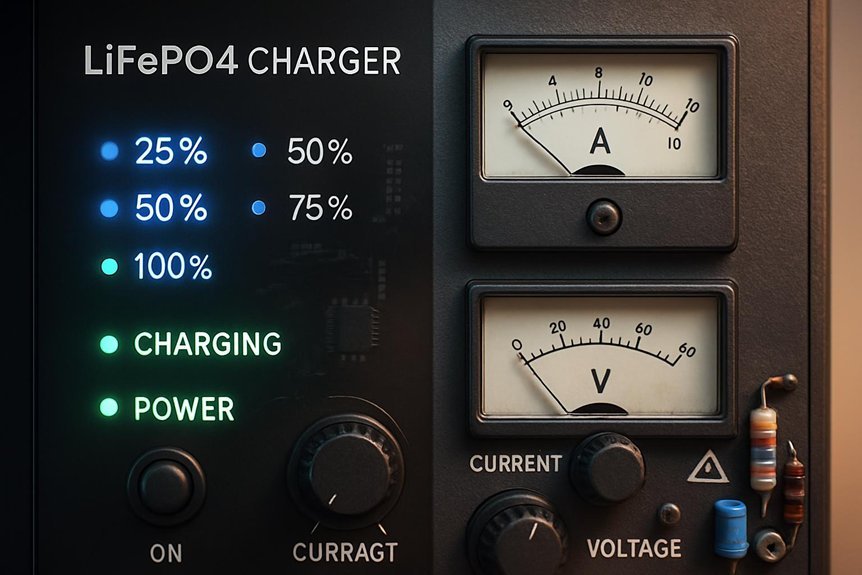
Which approach offers greater safety, longevity, and reliability in a LiFePO4 charger—digital control or analogue—and why does that distinction matter for your battery pack? We evaluate failure modes, protection schemes, and consistency. Digital control enables precise, repeatable safety checks, rapid fault detection, and firmware-driven protections that adapt to cell aging, boosting digital safety. Analogue systems excel in low-latency response and simplicity, but drift and component aging erode accuracy, undermining longevity. Reliability hinges on redundancy, calibration, and environmental tolerance; digital platforms allow remote updates and systematic logging, reducing unseen risks. Yet extreme conditions can stress digital electronics, necessitating robust EMI, watchdogs, and fail-safe states. Overall, a well-designed hybrid approach leverages digital safety with analogue longevity in core power stages, delivering safer, durable charging for your LiFePO4 pack.
Real-World Usability: Programmability, Monitoring, and SOC Data
Real-world usability hinges on how programmable the charger is, how closely it can monitor each cell, and how accessible the state-of-charge (SOC) data remains during operation. We evaluate interfaces, update rates, and fault handling, prioritizing predictable responses over novelty. Programmable dashboards expose critical metrics, enable tailored alarms, and support automated profiles for varied chemistries. Real time SOC monitoring informs charging curves, balancing efficiency with safety, and reduces over/under charging events. We compare bidirectional communication, data logging, and off-network access, ensuring enterprise-grade security and recoverable configurations. Below, a concise matrix captures key capabilities affecting day-to-day use.
| Feature | Benefit |
|---|---|
| Programmable dashboards | Custom visibility, rapid decision-making |
| Real time SOC monitoring | Immediate state awareness, safeguards |
How to Choose the Right LiFePO4 Charger for Your Setup
Choosing the right LiFePO4 charger starts with aligning its capabilities to your setup’s requirements: cell count, pack voltage, charging profile, and monitoring needs. We evaluate compatibility by verifying that the charger’s current limits, voltage thresholds, and balance charging routines match your pack configuration, and that the controller supports your monitoring interface. We prioritize a charger that delivers stable, programmable CC/CV stages with accurate termination to protect cells. We assess safety features, including short-circuit protection, thermal monitoring, and fault recovery, to sustain lithium safety across operating conditions. We also compare charging efficiency across temperature ranges and state-of-charge windows, ensuring minimal losses without compromising cell health. Finally, we confirm firmware update paths, certification, and interoperability with existing BMS and instrumentation.
Practical Tips to Extend Battery Life With Either Charger
Whether you’re using a digital or analogue LiFePO4 charger, we can extend pack life by controlling charge current, voltage, and temperature bands, plus monitoring cell balance and health indicators in real time. Practical tips focus on constraining C-rate during initial bulk, then tapering to a gentle finish, preventing overdrive that accelerates degradation. Maintain strict voltage ceilings per cell group, and verify balancing cycles to avoid capacity fade from mismatched cells. Regular thermal monitoring helps prevent heat-induced impedance rise and electrolyte stress. Log data for trend analysis, enabling predictive maintenance and minimizing unexpected failures. Implementing these measures yields practical savings by delaying replacements and reducing inefficiencies. Together, these practices support grid independence through reliable, longer-lasting packs and steadier energy throughput.
Frequently Asked Questions
How Do Digital Chargers Handle Cell Imbalance in Lifepo4 Packs?
We handle cell imbalance with digital balancing and cell monitoring, actively correcting voltage differences during charging. We monitor every cell, engage balancing resistors as needed, and assure safe, uniform top-offs while tracking pack health and balance trends.
Can Analogue Chargers Fail to Detect Temperature Runaway Risks?
Analogue limitations exist; they can miss temp sensing gaps, risking runaway. For example, a hypothetical 12S pack in a warehouse saw a slow overheated cell go undetected. We’d stress-test, monitor thermistors, and implement redundant sensing.
Do Digital Chargers Require Setup Before Every Charging Session?
We do need to set up digital chargers before each session, reader. We perform setup reminders when needed and apply firmware updates promptly to ensure accurate voltage control, safety checks, and optimal LiFePO4 stability during charging sessions.
Are There Hidden Costs Associated With Digital Lifepo4 Chargers?
Hidden costs exist but are usually subtle, and we’d call them maintenance or feature fees. We’ll help with user troubleshooting, detailing firmware updates and calibration needs, so you stay informed about total ownership while evaluating value and performance.
How Do Chargers Affect End-Of-Life Voltage Behavior in Lifepo4 Cells?
End of life voltage behavior in LiFePO4 cells is shaped by charger regulation; we regulate termination thresholds, balancing, and cell balancing dynamics, so end-of-life creeps manifest as rising resistance, slight voltage rebound, and capacity fade accelerating under improper end-of-charge.
Conclusion
We ride this charging valley as two guides in one cart: digital foresight steering with exact currents, analogue earns speed where it can. Like a beacon and a steady oar, our hybrid approach charts safety, longevity, and reliability through shifting terrain. We keep the course with programmable dashboards and SOC awareness, but honor the quiet efficiency of simple, robust hardware. In the end, we finish with confidence, knowing the right blend adapts to aging cells and evolving needs.