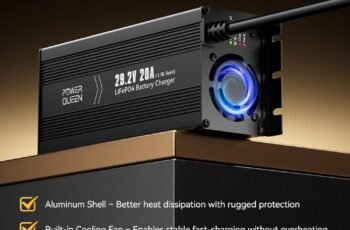
DC House 12V 10A Charger Review: Quick Overview
Can one $59.99 charger safely handle both 12V lead-acid and 12V LiFePO4 batteries? The DC House 12V 10A charger is designed to do exactly that, adding battery activation, winter charging, pulse repair, LCD monitoring, and three connection methods to the usual charging function. It is currently in stock at $59.99, reduced from the listed original price of $64.99.
Based on the supplied specifications, the DC House 12V 10A charger looks most useful for households managing several types of equipment: RVs, cars, lawn mowers, motorcycles, trucks, seasonal vehicles, and backup equipment. Its broad feature set is appealing, but some buying questions remain unanswered, especially around certification, warranty coverage, cable construction, and independently measured performance.
Our review examines charging versatility, 0V LiFePO4 activation, cold-weather maintenance below 14°F, lead-acid pulse repair, connector choices, LCD information, and value in 2026. The early assessment is straightforward: the specifications suggest a flexible all-in-one charger, while the missing technical details mean shoppers should confirm compatibility before treating it as a universal solution.
- Best apparent strength: one unit supports two 12V battery chemistries and several charging tasks.
- Main qualification: the supplied material does not include a current star rating, review count, laboratory results, warranty, or formal certification details.

Product Specifications and What You Get
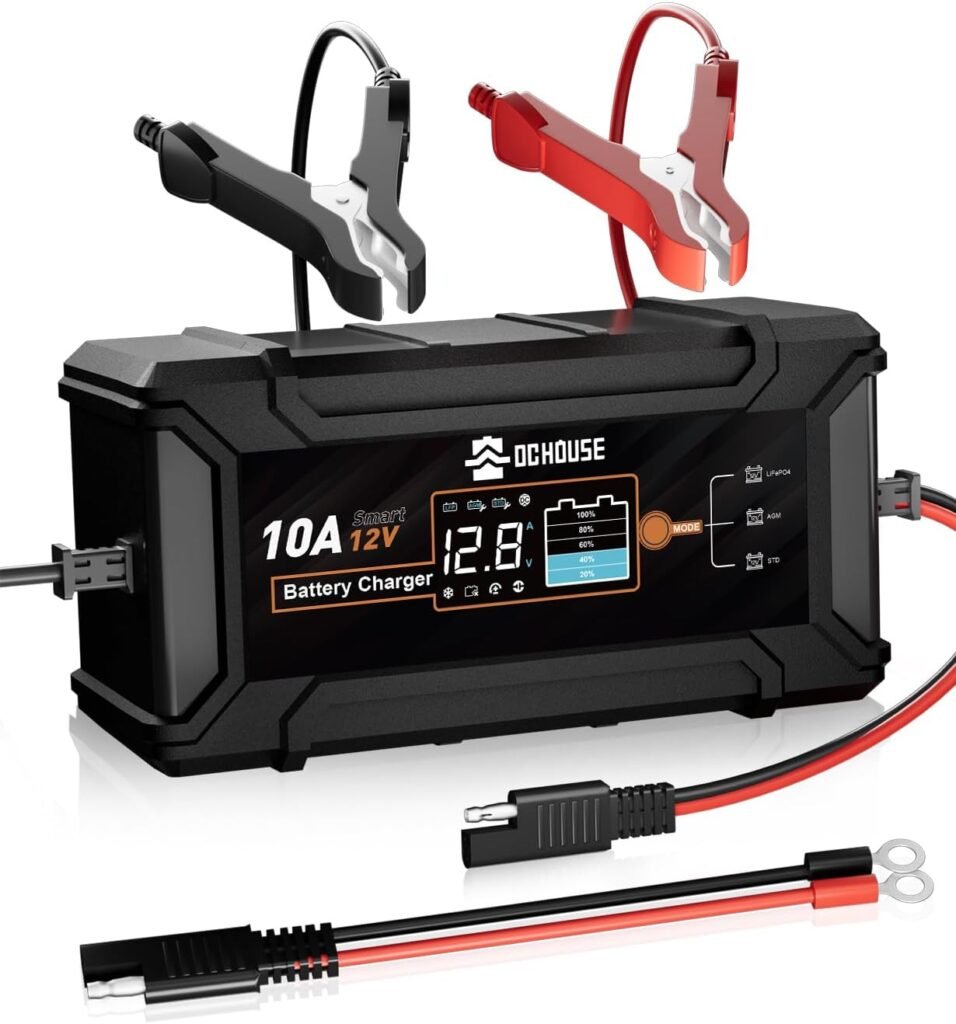
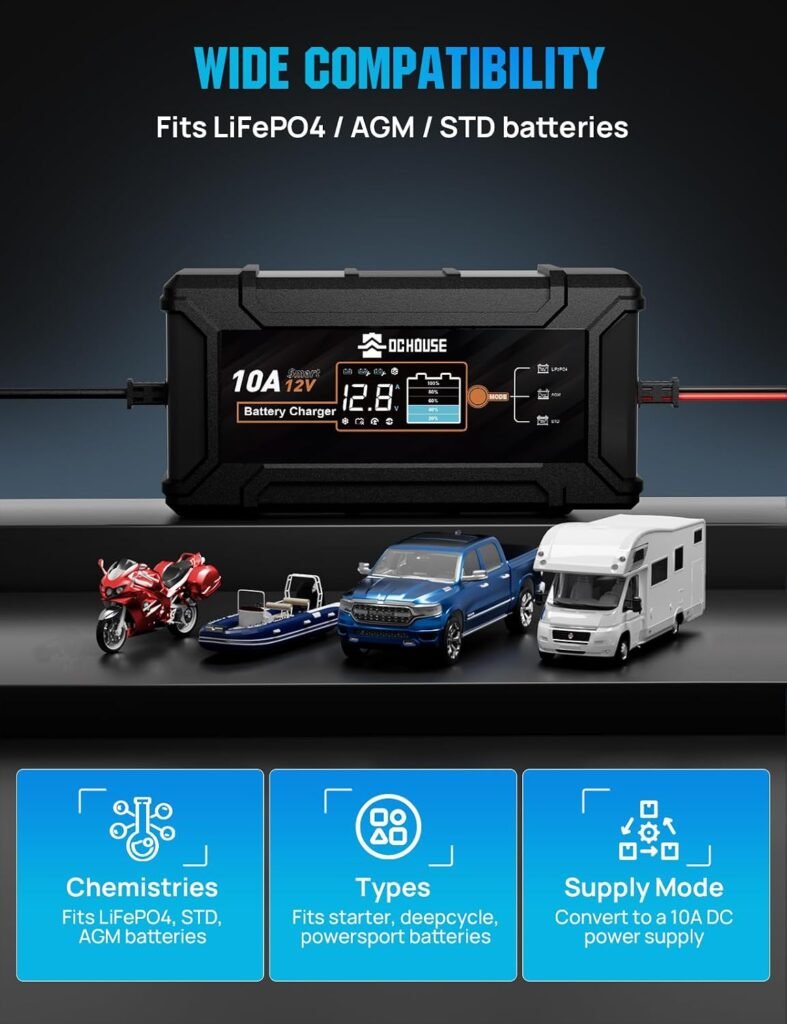
The core specification is a 12V charger rated at 10A, with support for both lead-acid and LiFePO4 batteries. That combination makes the DC House 12V 10A charger more versatile than a unit restricted to one chemistry, provided the battery is genuinely a compatible 12V model and the correct charging mode is selected.
| Specification | Supplied detail |
|---|---|
| Output compatibility | 12V batteries |
| Charging capacity | 10A |
| Battery chemistries | Lead-acid and LiFePO4 |
| Current price | $59.99 |
| Connection options | Copper lug terminals, alligator clips, and SAE connector |
Battery chemistry selection matters because lead-acid and lithium iron phosphate batteries use different charging behaviour and protection systems. A lead-acid setting should not automatically be assumed suitable for LiFePO4, and the battery label or manufacturer documentation should be checked first.
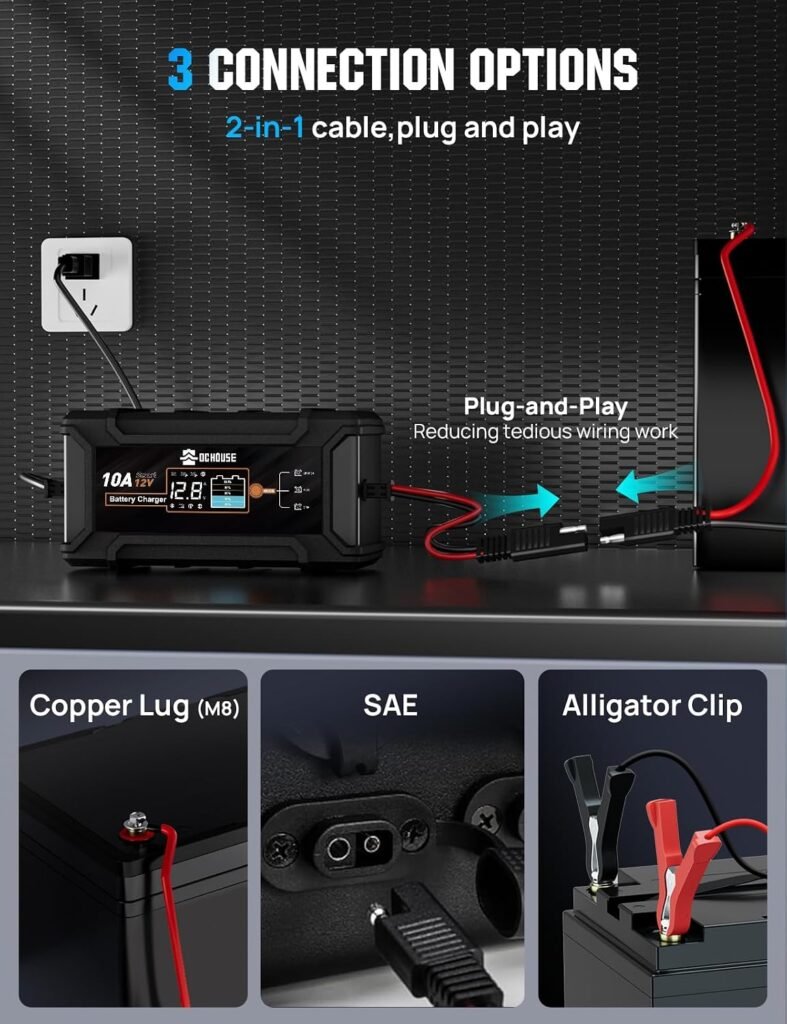
The package description identifies copper lug terminals for a more fixed connection, alligator clips for temporary charging, and an SAE connector for compatible pre-wired systems. A 2-in-1 DC cable arrangement is intended to make switching between connection styles easier. However, the supplied information does not state physical dimensions, weight, cable lengths, input-voltage range, warranty details, or formal safety certifications. Those omissions are worth verifying before purchase in 2026. The DC House 12V 10A charger should therefore be judged from its listed functions, not from specifications that have not been provided.
DC House 12V 10A Charger Key Features Explained
A 10A output can be more practical for medium and larger 12V batteries than a low-amperage maintainer, especially when a battery needs more than simple storage maintenance. Charging time still depends on battery capacity, state of discharge, temperature, battery age, and whether the battery is accepting current normally. We should not interpret the 10A figure as a guaranteed charging speed.
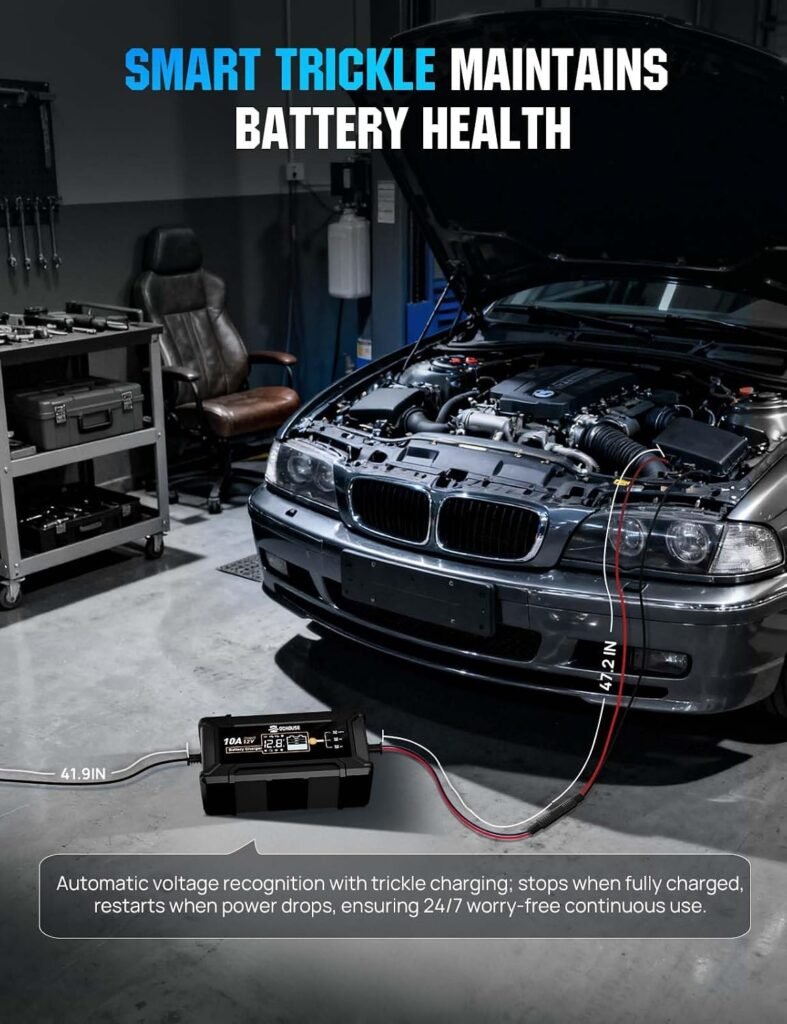
The DC House 12V 10A charger is described as automatic. Its intended sequence is normal charging, a lower-current trickle or maintenance phase, full-charge detection, and automatic stopping or maintenance behaviour to reduce the risk of continued overcharging. That is useful for stored vehicles, although users should still follow the battery maker’s instructions rather than leaving any charger connected indefinitely without checking the setup.
The LCD is designed to show charging voltage, charging current, battery percentage, operating status, and alerts. Those readings can help us spot a loose connection, a battery that is not accepting charge, or a maintenance cycle that has finished. For example, a displayed current that remains unexpectedly low may justify checking polarity, terminals, and battery condition before assuming the charger has failed.
These are manufacturer-listed functions, not independently verified test results supplied with the brief. The DC House 12V 10A charger may perform as described, but the available material does not establish its accuracy, charging-profile precision, or long-term durability through laboratory testing.

0V Dead Battery Activation for LiFePO4 Batteries
Deeply discharged LiFePO4 batteries can appear unavailable to an ordinary charger when their battery management system, or BMS, enters a protection lock. The claimed 0V activation function is intended to awaken a battery in that condition and restore it to a normal voltage range so regular charging can begin.
Before trying the DC House 12V 10A charger in this mode, we would use a cautious sequence:
- Confirm that the battery is a 12V LiFePO4 model, not another lithium chemistry or a lead-acid battery.
- Inspect the case and terminals for swelling, cracks, leaks, scorching, corrosion, or other physical damage.
- Disconnect vehicle loads and accessories so the battery is isolated during the initial attempt.
- Select the connector that matches the battery installation, checking polarity before energising the charger.
- Start the process in a suitable, monitored area and watch the LCD for voltage, current, status, and alerts.
Activation is not proof that a damaged, swollen, overheated, or internally failed battery is safe to use. If the battery becomes hot, emits an unusual smell, or behaves unpredictably, stop immediately and follow the battery manufacturer’s safety guidance.
The supplied information does not confirm the minimum activation voltage, activation duration, activation current limits, or whether every BMS design is supported. The DC House 12V 10A charger therefore offers a potentially useful recovery feature, but we should treat it as a claimed function rather than a guarantee that every locked-out battery can be revived.
Winter Battery Maintenance Below 14°F
The product description advertises safe and efficient operation below 14°F, supported by an intelligent pre-charging mode that begins with reduced current before normal charging. Cold temperatures make battery maintenance harder because available performance can fall and equipment may sit unused for long periods. A charger that can begin gently is relevant to stored cars, motorcycles, lawn mowers, RVs, and other seasonal equipment.
For winter use, we would first clean and inspect the battery terminals, then place the equipment and charger in a dry, ventilated area. Connect the charger according to the battery instructions, verify that the LCD shows the expected charging status, and check the setup periodically rather than assuming a cold-weather connection is trouble-free.
The DC House 12V 10A charger may be a convenient option for a seasonal vehicle owner who wants both charging and low-current maintenance from one device. Still, the advertised temperature capability should not override battery-specific limits. LiFePO4 batteries in particular must be charged within the temperature range specified by their maker; we should not rely on the charger’s below-14°F claim alone to make cold lithium charging safe.
The description does not provide independent cold-chamber test results, so the temperature statement remains a listed product claim. In practice, the battery’s own temperature, installation location, ventilation, and condition all matter. The DC House 12V 10A charger is best considered a cold-weather maintenance aid, not permission to ignore the battery manufacturer’s winter instructions.
Pulse Repair Mode for Lead-Acid Batteries
Lead-acid batteries can lose usable capacity when sulfation builds on the plates or when acid concentration becomes uneven through stratification. In plain terms, these conditions can make a battery appear charged while reducing the energy it can deliver under load. The charger description claims a pulse repair cycle for damaged, stratified, and sulfated lead-acid batteries.
The stated repair period is two hours, after which the charger automatically switches to standard charging. We would treat that as a defined operating sequence rather than proof of a particular capacity gain. Battery age, previous abuse, electrolyte condition, and internal damage determine whether any recovery is possible.
To assess the feature sensibly, record the battery’s resting voltage before connecting the DC House 12V 10A charger. Run the repair cycle in a suitable location, allow the automatic transition to complete, and then test whether the battery holds charge and performs under the intended load. Avoid judging success solely by a temporarily higher voltage immediately after charging.
Repair mode cannot substitute for replacing a battery with a shorted cell, cracked case, severe corrosion, or other physical damage. The description’s claims about restoring capacity and extending service life should be tested against the individual battery rather than treated as guaranteed outcomes. The DC House 12V 10A charger gives owners a recovery option, but it cannot reverse every form of lead-acid failure.
Connectors, Installation, and LCD Monitoring
The three connection methods target different installations. Copper lug terminals make the most sense for a more permanent connection, alligator clips suit temporary charging, and the SAE connector is useful when compatible wiring is already installed on a vehicle or battery system. The 2-in-1 DC cable design is intended to reduce repeated rewiring when switching between these arrangements.
For setup, we would use this sequence:
- Turn the charger off and keep it disconnected from power.
- Connect the positive lead to the positive battery terminal.
- Connect the negative lead, or the appropriate ground point where the installation requires one.
- Confirm polarity and ensure the connectors are firmly seated.
- Power the charger and select the correct chemistry if the unit requires a mode choice.
The DC House 12V 10A charger LCD can then be used to check voltage, current, battery percentage, charging status, and alerts. A sudden change in displayed current or an unexpected status message can prompt us to stop and inspect the connection before continuing.
Several installation details are not supplied: connector weather resistance, fuse protection, cable gauge, and enclosure rating. Those points matter for outdoor, vehicle-mounted, or semi-permanent use. The DC House 12V 10A charger has practical connection flexibility on paper, but buyers should not assume that every connector or the charger enclosure is weatherproof without confirmation.
What Customers Are Saying About the DC House Charger
The supplied product brief does not include the current Amazon star rating or review count, so we cannot honestly report a figure such as 4.5 out of stars or describe a review volume as established fact. We also do not have a verified set of buyer comments to quantify. That limitation matters: customer experience is especially useful for features such as 0V activation, LCD accuracy, connector quality, and long-term reliability, yet none of those patterns can be confirmed from the information provided.
At publication time, we would examine detailed buyer reports under several themes: ease of connecting the lugs, clips, or SAE lead; LCD readability; results with lead-acid batteries; LiFePO4 activation from a known starting voltage; winter maintenance; the two-hour repair cycle; and reliability after repeated use. Reviews that identify battery chemistry, starting condition, charging duration, and measurable results deserve more weight than short comments saying only that the charger worked.
Negative reports would also need careful separation. Inaccurate percentage readings could affect monitoring, poor connectors could undermine safe installation, unclear instructions could lead to an incorrect chemistry selection, overheating could create a safety concern, failed activation could reveal BMS limitations, and unexpected shutdowns could make unattended maintenance unsuitable. An isolated anecdote should not outweigh a repeated, well-documented pattern.
Before buying the DC House 12V 10A charger, we recommend checking recent, detailed reviews from owners using the same battery chemistry. Claims about revived batteries deserve caution because a short-lived voltage increase is not the same as restored capacity. This section should be updated if the displayed rating, review volume, price, or availability changes. Until those figures are supplied, the DC House 12V 10A charger must be assessed primarily from its stated specifications rather than customer-review evidence.
DC House 12V 10A Charger Compared With Alternatives
The NOCO GENIUS10 belongs to the same broad 12V charger category, but a fair comparison must be model-specific. We would verify the exact GENIUS10 version’s supported battery chemistries, output rating, repair or recovery functions, display information, connector design, price, and warranty before publication. The same caution applies to Battery Tender 10A models, because features and specifications can vary between models rather than transferring automatically across a product family.
On the information supplied here, the DC House 12V 10A charger stands out for combining lead-acid and LiFePO4 support with claimed 0V LiFePO4 activation, pulse repair, winter pre-charging, an LCD, and three connector types. That package may appeal to an owner who wants one charger for mixed equipment instead of separate charging and maintenance devices.
A NOCO model may be preferable when the shopper values more extensively documented support, a clearly stated warranty, certification information, or independently discussed field performance. A Battery Tender 10A model may be the better fit for someone seeking a simpler, maintenance-focused product or a convenient permanent-installation arrangement. Those are potential selection factors, not claims that either alternative is superior in every specification.
Before choosing the DC House 12V 10A charger, compare the competing model’s exact chemistry coverage, repair mode, monitoring method, connector design, price in the same currency, warranty, and intended use. The DC House model’s feature list is broad, but better-documented support can matter more than a longer list of advertised functions for a high-value battery installation.
Who Should Buy This Charger?
The best-fit shopper is someone maintaining both 12V lead-acid and 12V LiFePO4 batteries and wanting one device for vehicles and equipment. That could include an RV owner, a household with a car and lawn mower, a motorcycle owner, or someone storing seasonal machinery and backup equipment. The combination of ordinary charging, low-current maintenance, and recovery-oriented functions gives this audience a clear reason to consider it.
The DC House 12V 10A charger also suits people who prefer visible charging information instead of a basic indicator light. Voltage, current, percentage, status, and alerts can be useful when diagnosing a battery that has been sitting unused, although the supplied information does not establish how accurate those readings are.
Seasonal vehicle owners may appreciate the advertised reduced-current pre-charging mode for cold-weather maintenance. We would proceed more carefully if we needed a charger for any voltage other than 12V, documented waterproofing, permanent outdoor installation, or confirmed compatibility with a particular LiFePO4 BMS.
Our pre-purchase check would be:
- Confirm the battery’s chemistry and nominal voltage.
- Check that the charger’s 10A capacity suits the battery and intended charging routine.
- Choose between lug, clip, and SAE connection requirements.
- Assess whether the installation environment needs weather resistance or a stated enclosure rating.
- Compare warranty, certifications, support, display functions, and recovery features against alternatives.
The DC House 12V 10A charger is a stronger candidate when mixed chemistry support and monitoring matter more than documented installation credentials.
Price, Value, and Buying Decision
At $59.99, currently reduced from the listed $64.99 price and shown as in stock, the charger presents a value case based on the number of functions included. We should not treat the $64.99 figure as proof of savings; the meaningful question is whether the current price is justified by the charger’s compatibility and the features the buyer will actually use.
The DC House 12V 10A charger combines 10A charging, support for lead-acid and LiFePO4 batteries, low-current maintenance, claimed 0V activation, pulse repair, LCD monitoring, and three connector styles. Someone who needs several of those functions could find one unit more practical than buying separate devices. Someone who only needs a basic maintainer may gain little from the added recovery features.
The unknowns temper that value assessment. Supplied information does not confirm warranty coverage, formal certifications, exact charging profiles, cable specifications, weather resistance, or independently measured performance. We would compare alternatives first if warranty strength, brand support, documented safety information, or established field testing is the main priority.
Our decision path is simple: consider it if we need both compatible battery chemistries plus monitoring or recovery functions; compare NOCO GENIUS10 and the relevant Battery Tender 10A model if support and documentation matter most; avoid it if the battery is not a compatible 12V type. Overall, the DC House 12V 10A charger is a potentially versatile $59.99 option for mixed 12V maintenance, but its final value depends on confirming the missing details and matching its claims to the reader’s actual battery needs.
Pros and Cons
Pros
- Supports both 12V lead-acid and 12V LiFePO4 battery chemistries.
- Listed 10A output is suitable for more than basic low-amperage maintenance.
- Includes claimed 0V LiFePO4 activation and pulse repair for lead-acid batteries.
- LCD reports voltage, current, battery percentage, status, and alerts.
- Offers copper lug terminals, alligator clips, and an SAE connector.
Cons
- The supplied information does not include a current star rating or review count.
- Warranty coverage, formal safety certifications, cable specifications, and weather-resistance details are not provided.
- The minimum voltage, duration, and BMS compatibility for 0V activation are unspecified.
- Claimed repair and recovery results are not independently verified.
- It is designed for 12V batteries, so it is unsuitable for other nominal battery voltages.
Final Verdict
Key Takeaways
- Supports compatible 12V lead-acid and 12V LiFePO4 batteries with a listed 10A charging capacity.
- Adds claimed 0V LiFePO4 activation, two-hour lead-acid pulse repair, winter pre-charging, low-current maintenance, and LCD monitoring.
- Three connection options are supplied: copper lug terminals, alligator clips, and an SAE connector.
- The current price is $59.99, but warranty, certification, cable, weather-resistance, and independent performance details are not supplied.
- Customer rating and review count were not provided, so buyers should inspect current detailed reviews before making a final decision.
Frequently Asked Questions
Can this charger be used with both lead-acid and LiFePO4 batteries?
Yes. The supplied product description lists compatibility with 12V lead-acid and 12V LiFePO4 batteries. Confirm the battery’s chemistry and nominal voltage before connecting it, and use the appropriate charging mode if the charger requires one.
What does 0V activation do for a LiFePO4 battery?
It is intended to awaken a deeply discharged LiFePO4 battery whose BMS has entered protection lock, allowing normal charging to begin. The supplied information does not confirm the minimum activation voltage, duration, current limit, or compatibility with every BMS design.
Can it maintain a battery during winter?
The product description claims operation below 14°F and describes an intelligent pre-charging mode that starts with reduced current. LiFePO4 batteries must still be charged within the temperature limits specified by their battery manufacturer.
Does pulse repair guarantee that a lead-acid battery will be restored?
No. The listed two-hour repair cycle is intended for sulfated, stratified, or damaged lead-acid batteries, then switches to standard charging. It cannot be relied on to fix a shorted cell, cracked case, or severely failed battery.
Disclosure: As an Amazon Associate, I earn from qualifying purchases.