Power Queen 24V LiFePO4 Battery Charger: Quick Overview
Is a dedicated 20A charger for a 24V battery bank a practical upgrade over charging two 12V batteries separately? For owners of compatible lithium iron phosphate packs, the answer may be yes. This 24V LiFePO4 battery charger combines a 29.2V charging output, automatic CC/CV charging, and a 0V activation mode intended to wake a battery whose BMS has disconnected it after low-voltage protection.
Power Queen lists the charger at $98.99, reduced from $109.99, and the product is currently in stock. It is aimed at people running 24V battery banks in RVs, boats, solar-storage systems, mobility equipment, workshops, and off-grid installations with access to mains electricity.
On paper, the 20A output and 0V activation feature are the main reasons to consider this 24V LiFePO4 battery charger. Neither feature makes it universal, though: the battery chemistry, voltage, charge-current rating, connector, polarity, and BMS must all match. We assess the charger using the supplied specifications, available customer-feedback information, competing options, and practical buying considerations for 2026.
Our early view is positive but conditional. This could be a convenient dedicated charger for a correctly configured 24V LiFePO4 pack, while buyers with 12V batteries, lead-acid systems, or a genuinely failed battery should look elsewhere. The central question is therefore not simply whether the 24V LiFePO4 battery charger works, but whether it suits the battery system already in front of us.
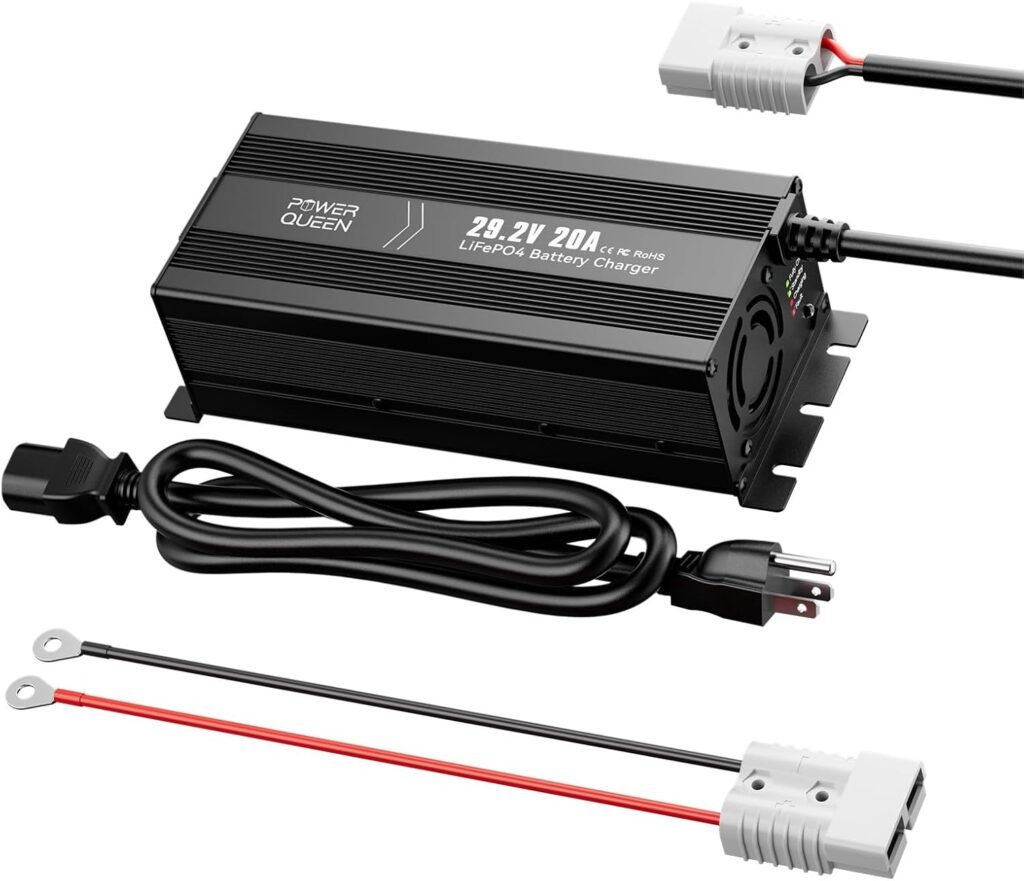

24V LiFePO4 Battery Charger Specifications and Compatibility
The electrical specification is straightforward, but matching it correctly is essential. The charger accepts 100V–240V AC input and provides a nominal 29.2V output at a rated 20A, with a stated output range of 19A–21A. Its charging method is two-stage constant-current/constant-voltage, commonly abbreviated CC/CV.
| Specification | Listed detail |
|---|---|
| Input voltage | 100V–240V |
| Charging output | 29.2V |
| Rated current | 20A |
| Stated current range | 19A–21A |
| Charging method | CC/CV |
| Connection | Anderson connector |
A 24V LiFePO4 pack normally has a nominal voltage of 25.6V because eight 3.2V cells are connected in series. The higher 29.2V figure is the target charging voltage for that eight-cell arrangement, so this 24V LiFePO4 battery charger is not intended for an arbitrary battery labelled “24V.”
We should use it only with LiFePO4 chemistry, not lead-acid, AGM, gel, or lithium-ion batteries that require different charging profiles. A compatible BMS remains necessary to monitor cells and provide protective cutoffs; the charger does not replace that circuitry.
- Identify the battery chemistry.
- Confirm its nominal and maximum charge voltage.
- Check the manufacturer’s recommended charge current.
- Inspect the Anderson connector, cable condition, polarity, and pack configuration.
That sequence is the minimum compatibility check before connecting this 24V LiFePO4 battery charger.
Key Features of the 24V LiFePO4 Battery Charger
The charger uses a two-stage CC/CV process suited to an eight-cell LiFePO4 pack. During the constant-current phase, it supplies substantial current to raise the battery voltage. Once the pack approaches the target, the charger holds the voltage while current tapers, allowing the battery to fill without continuously forcing the full rated output.
Its automatic operation means we shouldn’t need to manually change between the main charging stage and the finishing stage. That makes this 24V LiFePO4 battery charger more convenient for a dedicated battery bank than a basic power supply, provided the pack has the correct internal protection and charging limits.
The most unusual feature is the 0V activation or pre-charge mode. If a BMS has disconnected a battery after low-voltage protection, the charger may provide the initial input needed to wake the pack and allow normal charging to begin. This is a recovery attempt, not a repair function. It cannot fix damaged cells, a failed BMS, reversed wiring, or a battery that is unsafe to charge.
Power Queen states voltage stability of approximately ±0.2V, with an approximate operating range of 29V to 29.4V. Consistent voltage is useful during a lithium charging cycle, although it does not remove the need for correct setup. An LED provides charging-status and diagnostic feedback; we should consult the included instructions for the exact meaning of each light state.
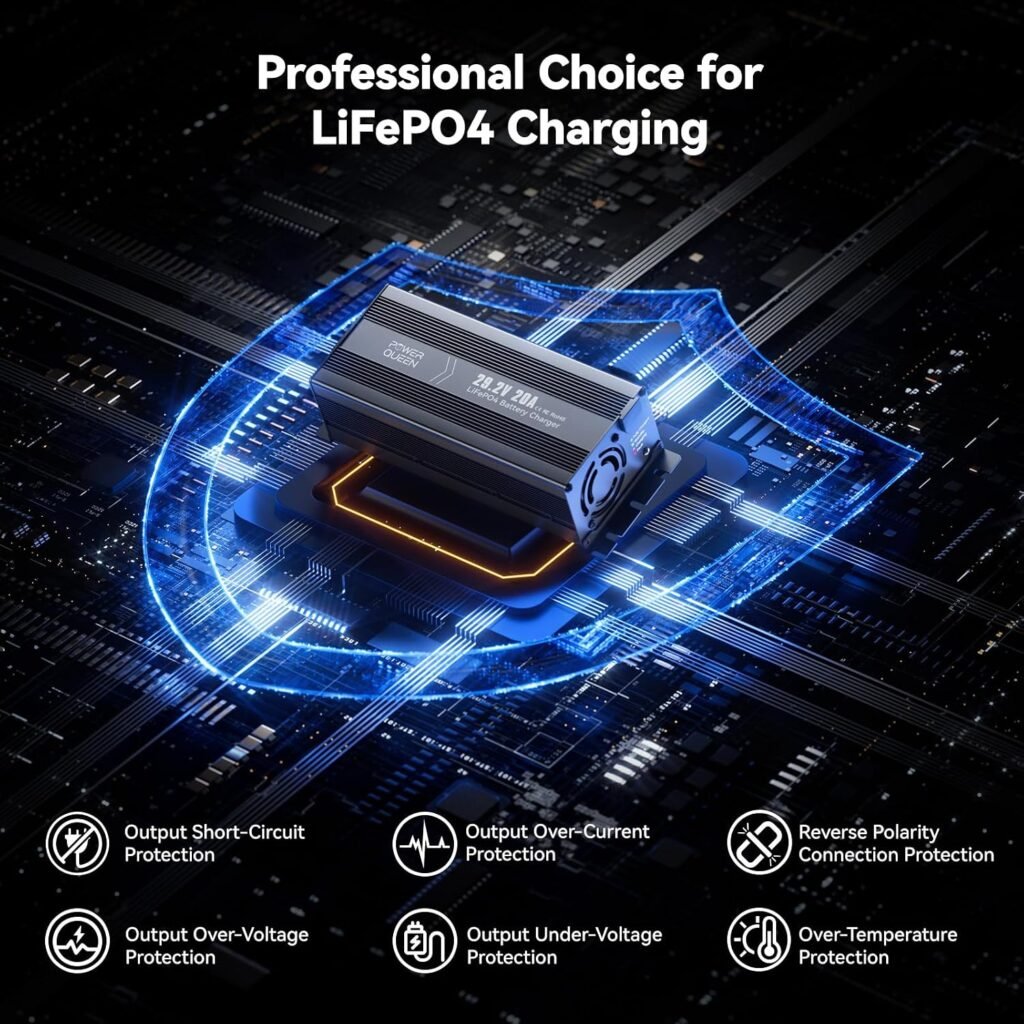
Protection is listed against over-temperature, output short circuit, output over-voltage, and reverse polarity. Those safeguards are valuable, but this 24V LiFePO4 battery charger still requires correct wiring and a suitable battery.
Charging Speed: What 20A Means for a 24V 100Ah Battery
Power Queen gives an approximate example of five hours to charge a 24V 100Ah battery pack. That estimate assumes suitable conditions and a battery able to accept the charger’s output. Starting state, temperature, charging losses, and the BMS can all alter the elapsed time.
The simple calculation is capacity divided by current: 100Ah ÷ 20A equals five hours in an idealized constant-current scenario. Real charging normally takes longer because the current tapers during the constant-voltage stage. The manufacturer contrasts this with a 12V 20A charger charging two 12V batteries separately, estimating more than five hours for each, or over ten hours combined.
That comparison explains the convenience of this 24V LiFePO4 battery charger, but it doesn’t mean every 24V battery is suitable for 20A. Some smaller packs have a lower maximum charge-current rating, and their BMS may reduce or stop charging when that limit is reached.
For a sensible first test, we would:
- Record the battery’s starting state and temperature.
- Confirm the battery is approved for the charger’s current.
- Connect the battery and monitor the LED and casing temperature.
- Record the time until charging finishes or the indicator changes state.
- Compare that result with the battery maker’s expected range.
A 30A alternative may suit a larger bank or a user prioritising shorter recharge periods, but only when the battery, BMS, cables, connector, and AC supply support the higher current. For moderate systems, the 20A rating of this 24V LiFePO4 battery charger offers a more conservative balance.
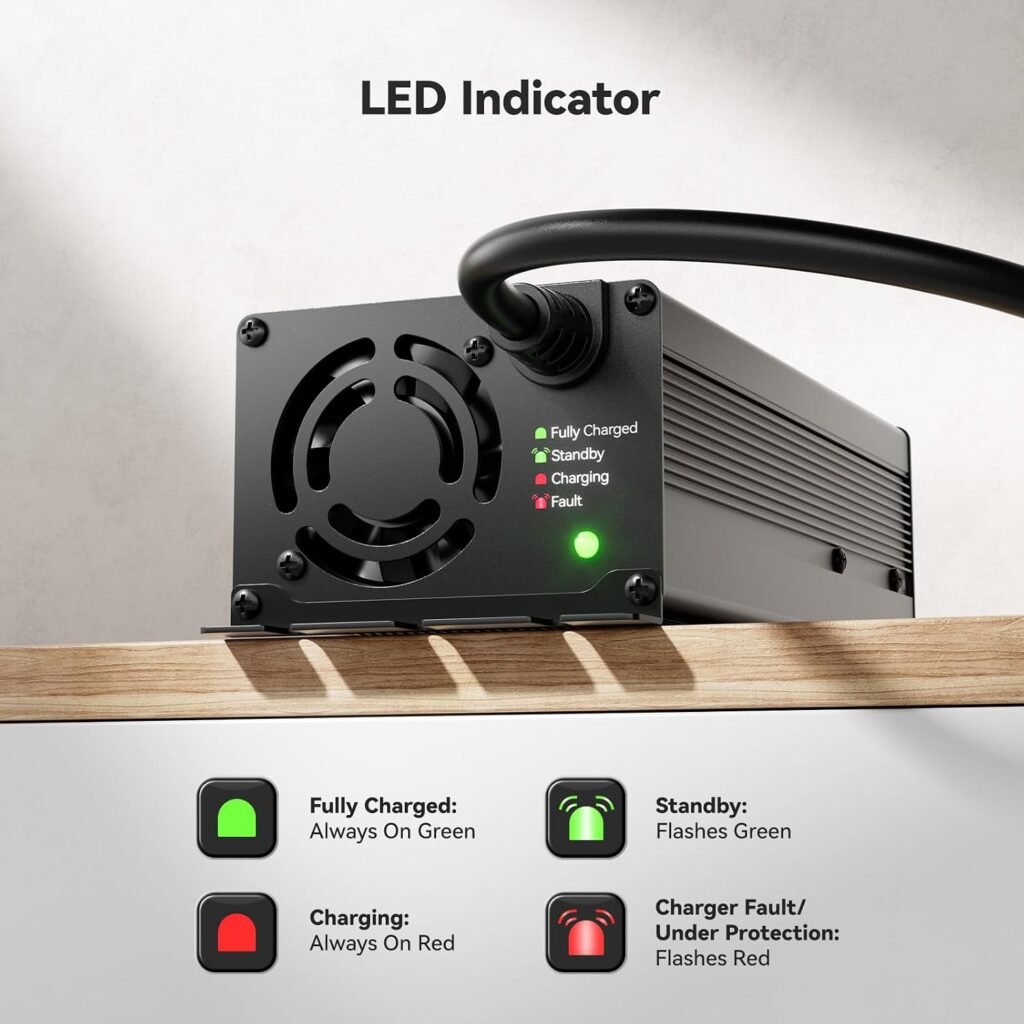

Using the Power Queen Charger Safely
We would begin by placing the charger in a dry, ventilated location away from moisture and conductive debris. Before applying power, inspect the cable insulation and Anderson connector for damage, confirm polarity, and make sure the connector is fully seated. If the battery system has a power-isolation procedure, follow it before connecting anything.
- Switch off the battery system if the manufacturer requires it.
- Connect the charger to the battery pack using the correct Anderson connector.
- Check that the connection is firm and polarity is correct.
- Connect the charger’s AC input only after the battery connection is secure.
- Stay nearby during the first cycle and monitor for abnormal heat, smell, noise, or fault indications.
This sequence reduces the chance of energising an incomplete connection. The protections in this 24V LiFePO4 battery charger—including over-temperature, short-circuit, over-voltage, and reverse-polarity safeguards—reduce risk but do not make incorrect wiring harmless.
Never charge a battery that is frozen, swollen, visibly damaged, wet, or unusually hot. If the charger reports a fault or the battery remains at 0V, disconnect the AC supply, inspect the wiring and connector, and check whether the BMS has isolated the pack. We should contact the battery manufacturer or a qualified technician rather than repeatedly forcing activation.
Storage also matters. Keep this 24V LiFePO4 battery charger protected from water, metal fragments, and other conductive material, and allow adequate ventilation whenever it is operating.
What Customers Are Saying About the Power Queen 24V Charger
The supplied product information does not include a current star rating or review count, so we cannot responsibly quote a satisfaction percentage or present an unsupported number of buyers. That limitation matters: customer feedback should be checked at the time of purchase, especially for a charger whose success depends heavily on the connected battery.
When assessing reviews for this 24V LiFePO4 battery charger, we would separate practical observations into clear groups. Useful positive reports would describe a straightforward Anderson-connector setup, an LED that makes charging status easy to follow, normal charging of a 25.6V pack, or a successful wake-up after a BMS protection shutdown.
Other comments deserve separate treatment. Build quality, operating noise, cable length, connector fit, heat during use, and durability after multiple cycles are not the same as charging performance. Critical reviews may mention a deeply protected battery that stayed inactive, unclear LED meanings, warmth during operation, or compatibility problems caused by incorrect wiring.
We would judge reliability by looking for repeated patterns rather than isolated praise or criticism. Reviews that identify the battery’s chemistry, 25.6V nominal voltage, capacity, and starting condition are more useful than vague comments such as “works great.” Verified-use details also carry more weight when several buyers describe similar results.
Before buying, check recent feedback for mentions of 24V 25.6V packs, 100Ah charging times, Anderson connectors, 0V wake-up results, and performance after multiple cycles. Positive reports can support the convenience of this 24V LiFePO4 battery charger, but they cannot guarantee that every 0V battery is recoverable.
Power Queen 24V Charger Compared With Alternatives
The closest higher-current comparison is the Dumfume 24V 30A LiFePO4 Battery Charger. Its 30A rating could reduce charging time for a suitably rated battery, but the extra current is useful only when the BMS, wiring, connector, battery cells, and power source are all approved for it. More current is not automatically better for a smaller pack.
Power Queen’s 20A design takes a more moderate approach. This 24V LiFePO4 battery charger lists a 29.2V output, automatic CC/CV charging, 0V activation, 100V–240V input, LED feedback, and four stated protection categories. The Dumfume model and other alternatives may differ in connector style, waterproofing, current capacity, indicator system, warranty, and protection details, so the labels should be compared rather than assumed equivalent.
A typical 12V 20A LiFePO4 charger is not a substitute for a 24V charger delivering 29.2V. It may be appropriate for a single 12V battery, but a 24V bank made from two 12V batteries could require separate charging according to the battery maker’s instructions.
Our decision rule is simple: choose the Power Queen for a compatible 24V LiFePO4 pack and moderate charging speed. Consider the Dumfume 30A option only when the battery explicitly supports the higher current. Choose a 12V model only for a 12V system. Comparing final voltage, chemistry support, current, connector, protections, warranty, and recent buyer feedback will tell us more than the name alone. The right 24V LiFePO4 battery charger is the one that matches the complete system.
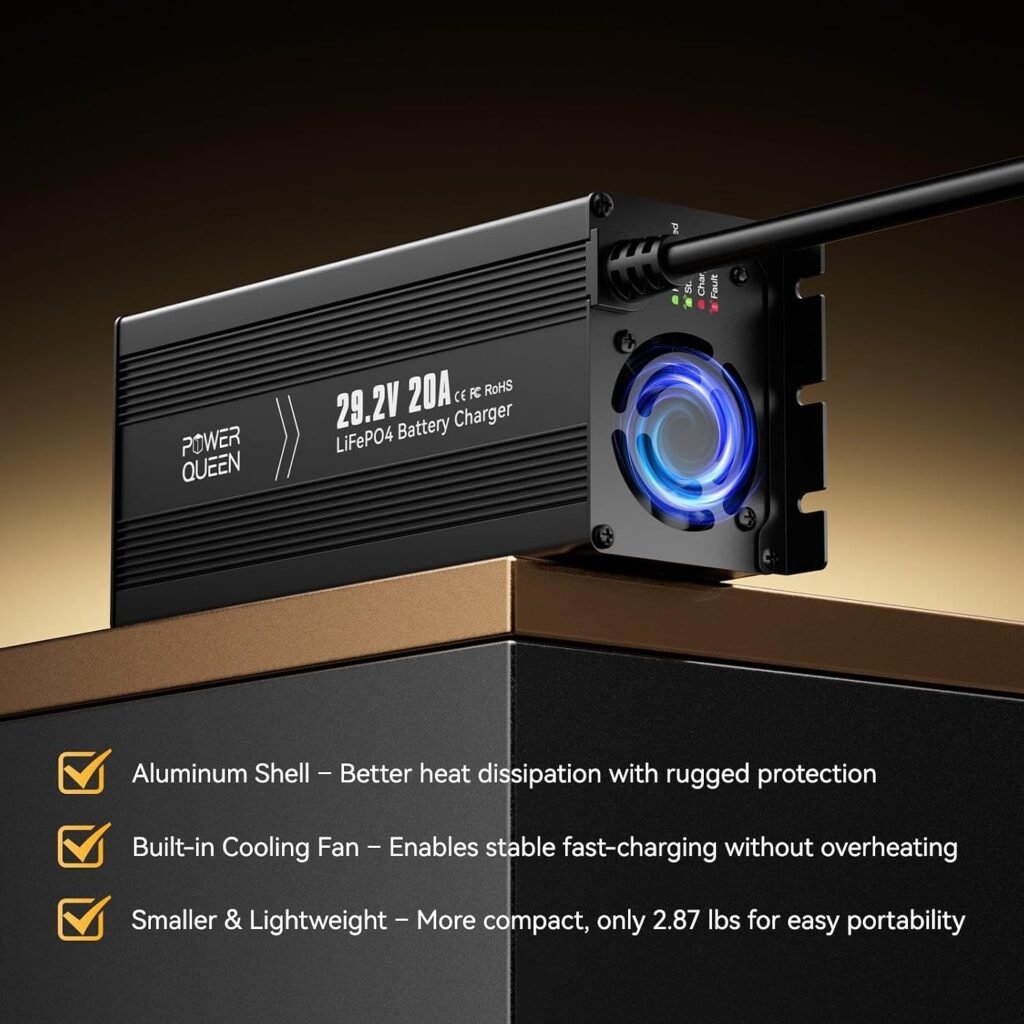
Who Should Buy This 24V LiFePO4 Battery Charger?
This charger makes the most sense for owners of a 24V LiFePO4 battery pack who want a dedicated mains charger rather than a device designed to handle several unrelated chemistries. RV and marine battery banks, solar-storage systems, workshop equipment, mobility applications, and off-grid setups can all be reasonable use cases when a stable AC supply is available.
The 0V activation feature may appeal to users whose BMS occasionally disconnects the battery after low-voltage protection. It can provide a convenient restart attempt, but this 24V LiFePO4 battery charger should not be treated as a battery-repair tool. If the pack has damaged cells or a defective BMS, professional diagnosis remains the safer route.
We would consider it a poor fit for a 12V system, lead-acid battery, pack with a lower permitted charging current, or battery lacking a compatible connector. Outdoor users should also check whether their installation needs certified waterproof equipment instead of a mains charger intended for a protected, ventilated location.
Our pre-purchase checklist is short but decisive: read the battery label and manual, confirm chemistry and nominal voltage, verify the maximum charge voltage, compare the recommended current with 20A, check connector polarity, plan a dry physical location, and review the seller’s return and warranty terms. Buyers balancing speed and compatibility may find the rating sensible; owners of very large banks who need the shortest possible recharge may need a higher-current design. In either case, the 24V LiFePO4 battery charger must match the battery before it matches the budget.
Is the Power Queen 24V 20A Charger Good Value at $98.99?
At the listed price of $98.99, this charger is $11.00 below its stated original price of $109.99. We should treat that reduction as the current listed difference rather than assume it is permanent. The product is shown as in stock, but availability and pricing can change.
What are we paying for? The package of features includes a dedicated 29.2V LiFePO4 charging profile, automatic CC/CV operation, a 0V activation mode, LED status feedback, 100V–240V input support, and protection against over-temperature, output short circuit, output over-voltage, and reverse polarity.
The value case is about setup convenience as much as purchase price. Charging one correctly configured 24V pack directly can avoid dismantling a bank or charging two 12V batteries separately. That advantage is meaningful for RV, marine, workshop, and solar users who regularly need a dependable mains charging routine.
The main risk is mismatch. This 24V LiFePO4 battery charger has little practical value if the battery is lead-acid, uses a different voltage, cannot accept 20A, has incompatible wiring, or remains at 0V because of a failed BMS. Before ordering, we would read the battery label and manual, compare its permitted current with the charger output, examine recent reviews, and confirm the return policy.
Our buying position is measured: at $98.99, it may be worthwhile for a compatible 24V LiFePO4 system that benefits from direct, automatic charging. It is not a universal charger or a guaranteed solution for a failed 0V battery. For the right pack, though, this 24V LiFePO4 battery charger offers a sensible feature mix without requiring separate 12V charging.
Pros and Cons
Pros
- Dedicated 29.2V CC/CV profile for compatible 24V LiFePO4 packs
- 20A output with a stated 19A–21A operating range
- 0V activation mode may wake a BMS-protected battery
- 100V–240V input supports a broad mains-voltage range
- Listed protections include over-temperature, short circuit, over-voltage, and reverse polarity
Cons
- Compatibility is limited to suitable 24V LiFePO4 battery systems
- The 0V activation feature cannot repair damaged cells or a failed BMS
- A 20A output may be slower than a 30A charger for suitably rated large banks
- Anderson connector type and polarity must match the battery pack
- The supplied information does not include a current star rating or review count
Final Verdict
Key Takeaways
- The charger is designed for 24V LiFePO4 packs with a 25.6V nominal voltage and 29.2V charging target.
- Its 20A output and stated 0V activation mode are the main practical attractions.
- Compatibility checks must include chemistry, voltage, charge current, BMS, connector, and polarity.
- Power Queen lists the price at $98.99, reduced from $109.99, with the product currently in stock.
- It is a dedicated charger, not a universal solution for 12V, lead-acid, or damaged batteries.
Frequently Asked Questions
How many amps does it take to charge a 100Ah LiFePO4 battery?
The required current depends on the battery maker’s specification and BMS rating. This charger supplies 20A, with a stated operating range of 19A–21A, but a 100Ah battery should only be charged at that rate if its documentation permits it.
What is the best way to charge a 100Ah lithium battery?
Use a charger designed for the battery’s chemistry, nominal voltage, maximum charge voltage, and permitted current. For an eight-cell 24V LiFePO4 pack, a charger with a 29.2V CC/CV profile and a compatible BMS is appropriate; verify the connector and polarity before use.
Is there a 12V 100Ah LiFePO4 battery charger available?
Yes, dedicated 12V LiFePO4 chargers are available, but they are designed for a different voltage range than this 24V charger. A 12V model should be used with a 12V battery system rather than substituted for a 29.2V charger on a 24V pack.
How long does it take to charge a 100Ah LiFePO4 battery?
At 20A, the ideal arithmetic is about five hours for 100Ah, although the constant-voltage stage, starting state, temperature, losses, and BMS behavior can make the real time longer. Power Queen gives roughly five hours as an example for a 24V 100Ah pack under suitable conditions.
Disclosure: As an Amazon Associate, I earn from qualifying purchases.

 LiFePO4 Battery Charger with Multi Safety Protections,0V Activation Function)