VEVOR Smart Battery Charger Overview:
A charger that spans 6V to 72V is unusual enough; adding a 16A maximum output and LiFePO4 support makes this a very different proposition from a basic car maintainer. The VEVOR smart battery charger is aimed at households and workshops managing more than one type of battery-powered equipment, rather than someone who only tops up a single 12V car battery.
At $81.90 and currently listed as in stock, its main appeal is consolidation. One unit can potentially serve cars, motorcycles, boats, RVs, golf carts, forklifts, lawn equipment, ride-on vehicles, electric pruners, ATVs, and small yachts, provided the battery chemistry and total nominal voltage are supported. That could be more economical than buying separate chargers for ordinary automotive batteries, high-voltage golf-cart packs, and lithium equipment.
Our assessment focuses on charging flexibility, controls, safety systems, display usefulness, customer-feedback evidence, alternatives, and suitability for different buyers. The VEVOR smart battery charger looks attractive for mixed fleets and higher-voltage equipment, but it may be unnecessary complexity for an owner with one conventional 12V battery. Its value depends less on the headline amperage than on how many of its supported modes and voltage settings we would actually use.


Key Specifications and Battery Compatibility
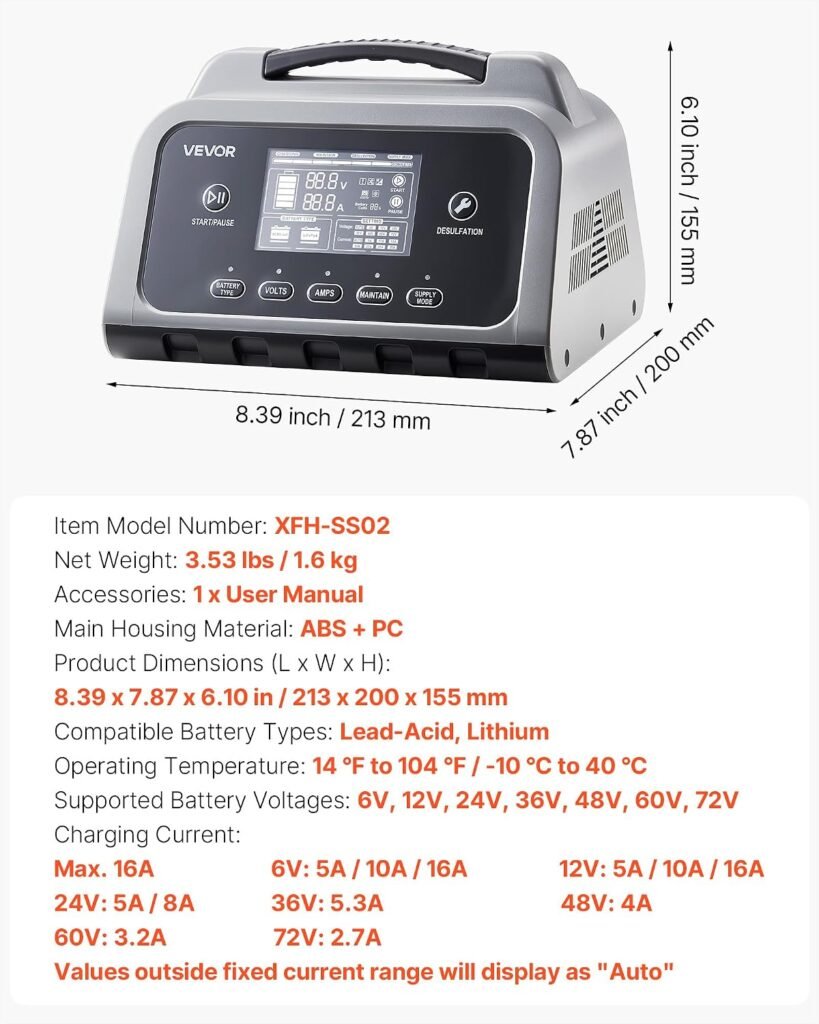
The charger supports 6V, 12V, 24V, 36V, 48V, 60V, and 72V lead-acid systems. The listed battery types include Wet, Gel, MF, CA, EFB, AGM, Calcium, and related lead-acid designs. That range covers standard starting batteries as well as several deep-cycle and start-stop applications, although the battery maker’s charging instructions remain the final authority.
For lithium use, the VEVOR smart battery charger is specifically listed for 12V, 24V, 36V, 48V, 60V, and 72V LiFePO4 batteries. LiFePO4 should not be treated as a generic label for every lithium chemistry; lithium-ion, lithium-polymer, and other formulations are not specifically identified in the supplied product information.
Output reaches 16A, with adjustable voltage and current controls. Adjustable output matters because a small motorcycle battery, a large leisure bank, and a high-voltage equipment pack don’t necessarily tolerate the same charging rate. Professional Mode is intended for non-standard batteries and experienced users who know the correct voltage and current limits. Before connecting the VEVOR smart battery charger, read the battery label, identify its chemistry and nominal voltage, and select the matching setting rather than guessing.
How the VEVOR Smart Battery Charger Works
The four operating modes give this unit a broader role than a simple power supply. Charging Mode uses seven-stage smart charging, progressively managing the process instead of applying the full current continuously. Maintain Mode supplies low-current upkeep for batteries stored in cars, boats, motorcycles, RVs, and seasonal machinery.
Desulfation Mode is aimed at some aging lead-acid batteries where sulfation has reduced usable performance. It may assist a recoverable battery, but it cannot repair cracked cases, damaged plates, internal shorts, or a battery that has genuinely failed. Force Mode is designed to activate batteries below 1V, a situation that deserves extra caution because extreme discharge can indicate internal damage or an unsafe battery.
To use the VEVOR smart battery charger, first inspect the case, terminals, and cables. With charger power disconnected, connect the leads correctly, choose the chemistry and voltage, select the operating mode, and verify the displayed settings before starting. Watch the first cycle rather than leaving an unfamiliar battery unattended immediately. The same cautious sequence applies when using the VEVOR smart battery charger on equipment with an unusual battery arrangement.
LCD Display, Controls, and Everyday Usability
A 3.1-inch LCD screen provides live information rather than leaving us to infer what the charger is doing. The display shows the selected charging mode, voltage, current, battery level, and battery status. Those readings are useful when a battery appears weak, when we want to see current taper as charging progresses, or when we need to confirm that a 24V or higher setting was selected correctly.
The VEVOR smart battery charger also uses independent buttons for operation and adjustment. That should be easier to understand than a single multifunction dial, particularly when switching between maintenance, ordinary charging, and recovery functions. Still, “beginner-friendly” does not mean foolproof: users must understand nominal voltage and chemistry before pressing start.
We would check the screen shortly after charging begins, then again near completion. A falling current can be a normal sign of charge management, while an unexpected voltage, error indication, or persistently high current deserves investigation. The screen adds practical diagnostic value, but it is not a substitute for a battery tester or the manufacturer’s charging specifications.
For anyone using the VEVOR smart battery charger on several machines, recording the displayed readings during the first cycle can also make later troubleshooting easier. That is a sensible habit when moving between batteries of different capacities.

Safety Protections and Charging Reliability
The listed protection systems cover overcurrent, short circuit, reverse polarity, overheat, low temperature, and overvoltage conditions. Thermal compensation is also specified, with the charger automatically adjusting current and voltage as conditions change. These are useful safeguards for a multi-purpose unit because charging demands can vary considerably between battery types and environments.
Protection features reduce operating risk, but they do not make a damaged battery safe. We should stop immediately if a battery is swollen, leaking, cracked, unusually hot, or producing an abnormal smell. Lead-acid charging should take place in a ventilated area, and connections should remain dry and secure. Low-temperature protection is helpful, but it does not override a battery maker’s minimum charging temperature.
Our basic routine with the VEVOR smart battery charger would be straightforward:
- Confirm positive and negative polarity before connecting.
- Keep clamps, terminals, and hands dry.
- Use the correct chemistry and voltage mode.
- Leave ventilation openings uncovered.
- Disconnect charger power before removing the clamps.
Following that routine matters more than assuming the VEVOR smart battery charger can identify every unsafe condition on its own.
Using It for Cars, Boats, Motorcycles, RVs, and Equipment
The wide voltage range is most useful in a household or workshop with several battery-powered vehicles and machines. For a car or motorcycle that sits unused, Maintain Mode can help preserve charge during storage. AGM support is relevant to compatible start-stop automotive batteries, though the vehicle battery label should confirm the required charging profile.
Boats and RVs can make a multi-voltage charger especially useful because leisure equipment may have separate starting, service, or higher-voltage banks. The listing also names golf carts, forklifts, lawn mowers, ride-on vehicles, electric pruners, ATVs, and small yachts. For these applications, the pack’s total nominal voltage must match the charger setting; selecting a setting based on one individual cell or module would be unsafe.
Before using the VEVOR smart battery charger, we would check six points: the battery label, chemistry, total voltage, capacity, connector arrangement, and charging instructions. The VEVOR smart battery charger may suit a mixed equipment lineup, but capacity and onboard charging requirements can vary greatly, particularly on boats and RVs. A charger that fits the voltage may still be inappropriate if the battery manufacturer limits current or requires a dedicated battery-management system.
Charging a 100Ah LiFePO4 Battery: What to Expect
For a 100Ah LiFePO4 battery, a 16A setting represents approximately 0.16C: 16A divided by 100Ah. That is a useful way to describe the rate, not a guarantee that every battery permits it. The battery manual may specify a lower maximum charge current, and that limit takes priority over the charger’s available output.
With the VEVOR smart battery charger, expected charging time depends on starting state, selected current, temperature, charge tapering, and the battery-management system’s balancing behaviour. A substantially depleted battery may approach several hours at 16A, but the final portion can take longer as current reduces. Capacity alone cannot provide an exact time estimate.
For a practical setup, confirm that the pack is a 12V LiFePO4 battery, check its permitted current, select the dedicated LiFePO4 mode, and monitor voltage and current on the LCD. Use the lithium charging profile rather than a lead-acid desulfation setting. We would not use Force Mode or Desulfation Mode on lithium batteries unless the battery manufacturer explicitly approves that procedure. The same rule applies when using the VEVOR smart battery charger with a larger LiFePO4 pack at 24V or above.

What Customers Are Saying About the VEVOR Smart Battery Charger
The supplied product information does not include a verified star rating, review count, or a searchable set of individual buyer comments, so we cannot responsibly claim that customers consistently praise or criticize particular behaviours. That limitation matters: reports about 16A charging speed, long-term reliability, cable length, heat, screen visibility, or switching between battery types require actual review evidence rather than assumption.
Based on the published design, the features most likely to attract buyers are the seven selectable voltage levels, LiFePO4 compatibility, readable live readings, and four operating modes. The features most likely to create learning friction are Professional Mode, adjustable output, and Force Mode below 1V. A buyer charging a golf-cart pack or RV bank may value that flexibility more than someone seeking a simple 12V maintainer.
When verified reviews become available, we would separate first-use impressions from longer-term reports and look for repeated patterns across golf carts, boats, RVs, and workshop equipment. Several independent complaints about incorrect readings or overheating would deserve more weight than one isolated report that may reflect a mismatched battery or defective unit. At $81.90, the broader capability needs to work reliably to justify the premium over a basic 12V charger.
For now, our view of the VEVOR smart battery charger rests on its documented specifications rather than an invented consensus. Shoppers should inspect current buyer feedback before ordering, particularly if their battery is specialized. The VEVOR smart battery charger is promising on paper, but customer evidence is incomplete in the information provided for this review.
VEVOR Smart Battery Charger vs. Alternatives
The VEVOR Smart Battery Charger is designed around breadth: 6V through 72V systems, lead-acid types, specified LiFePO4 support, adjustable output, and recovery and maintenance modes. The NOCO GENIUSPRO50 is a much higher-output workshop-class alternative intended for users who prioritise substantial charging power and a specialist-brand ecosystem. It may be better for demanding professional workloads, while VEVOR is more focused on voltage variety at a lower entry price.
The Schumacher SC1325 is a more conventional automotive-oriented alternative. Its appeal is simpler car and 12V/6V battery use rather than the VEVOR’s unusually broad 6V–72V coverage. We should compare exact model specifications because output class, supported lithium chemistry, display information, protection features, warranty terms, and controls can differ between versions.
Maximum amperage alone doesn’t decide which charger is better. The VEVOR smart battery charger is the stronger choice when one unit must serve lead-acid and LiFePO4 batteries across several voltage systems. A simple maintainer may make more sense for occasional 12V car charging, while NOCO or Schumacher may appeal to buyers who prefer an established specialist brand or need a specific higher-current workshop charger. Check current prices and exact specifications at checkout, since promotions and model details change.
The VEVOR smart battery charger therefore competes through versatility rather than a claim of being the best tool for every charging job.
Who Should Buy This Charger?
The best match is an owner with multiple vehicles or machines using different battery voltages, especially where both lead-acid and LiFePO4 batteries are present. DIY mechanics, small workshops, RV owners, boat owners, golf-cart users, and people maintaining seasonal equipment could all make practical use of Charging, Maintain, Desulfation, and Force modes.
The VEVOR smart battery charger should suit technically confident users better than complete beginners. Professional Mode and adjustable voltage and current create useful flexibility, but incorrect settings can damage a battery or create a safety hazard. Anyone uncomfortable reading battery labels or charging instructions may be better served by a simpler charger with fewer manual choices.
Our purchase decision framework is built around three questions:
- How many voltage systems do we genuinely need to charge?
- Which chemistries are involved: lead-acid, LiFePO4, or both?
- Will we use maintenance or recovery modes, or only occasional standard charging?
If the answers point to one 12V car battery and rare use, the VEVOR smart battery charger may offer more capability than necessary. If the answers include a 48V golf cart, a 12V car, and stored RV equipment, its broader design becomes much easier to justify.

Value Assessment
At $81.90, the VEVOR Smart Battery Charger offers a compelling specification package for mixed-voltage ownership. The documented combination includes 16A output, seven-stage charging, several lead-acid types, LiFePO4 compatibility, seven selectable voltage levels, four modes, a 3.1-inch LCD, thermal compensation, and multiple electrical protections.
The possible saving is not simply the purchase price. Replacing several dedicated chargers with one unit could reduce equipment clutter and make seasonal battery care easier. Maintain Mode adds ownership value for stored vehicles, while live voltage and current readings can help us understand whether a battery is accepting charge normally. Recovery functions may extend the life of some aging lead-acid batteries, but they should never be treated as a replacement for a battery that is physically damaged or fully failed.
The VEVOR smart battery charger offers conditional value for a single-vehicle owner and strong consideration for a mixed-voltage owner. We would be comfortable recommending it to shoppers who can verify their battery requirements and will use its breadth. The VEVOR smart battery charger deserves more cautious consideration for specialised lithium setups: confirm the exact LiFePO4 chemistry, pack voltage, current limit, connector arrangement, and manufacturer-approved charging process before purchase.
Key Takeaways
Our overall assessment: this is a versatile charger whose value rises sharply when a household or workshop owns batteries across several voltage systems.
- The 6V–72V range and 16A maximum output are broader than those of a typical 12V maintainer.
- Support is specified for multiple lead-acid types and LiFePO4, but not for every lithium chemistry.
- Charging, Maintain, Desulfation, and Force modes cover ordinary charging, storage, lead-acid recovery, and deeply discharged batteries.
- The LCD provides useful voltage, current, mode, level, and status information, although correct setup still requires battery knowledge.
- At $81.90, it is most convincing for mixed fleets; single-12V-battery owners may get better value from a simpler alternative.
Because verified rating and review-count information was not supplied, we would check current customer feedback and the exact battery manual before committing. Used within its documented limits, the charger has a persuasive flexibility advantage for shoppers.
Pros and Cons
Pros
- Broad 6V–72V compatibility for multiple equipment types
- Supports listed lead-acid batteries and 12V–72V LiFePO4 systems
- 16A maximum output with adjustable voltage and current
- Four operating modes, including maintenance and lead-acid desulfation
- 3.1-inch LCD shows live voltage, current, mode, level, and status
- Listed protections include reverse polarity, overcurrent, short circuit, overheat, low temperature, and overvoltage
Cons
- May be unnecessarily complex for owners with only one standard 12V battery
- Professional and Force Modes require confident battery selection
- LiFePO4 support should not be assumed to cover other lithium chemistries
- Recovery modes cannot repair physically damaged or failed batteries
- Verified rating and review-count evidence was not included in the supplied product data
Final Verdict
Key Takeaways
- The charger’s main advantage is support for 6V, 12V, 24V, 36V, 48V, 60V, and 72V systems at up to 16A.
- It supports listed lead-acid types and LiFePO4 batteries, but buyers must distinguish LiFePO4 from other lithium chemistries.
- Charging, Maintain, Desulfation, and Force modes provide more flexibility than a basic automotive maintainer.
- The 3.1-inch LCD and protection features add useful control, but the adjustable settings require careful battery matching.
- At $81.90, it is best suited to mixed-voltage owners rather than someone who only needs occasional 12V charging.
Frequently Asked Questions
How many amps does it take to charge a 100Ah LiFePO4 battery?
A 16A setting is approximately 0.16C for a 100Ah battery. The correct current depends on the battery manufacturer’s permitted charging rate, so check the manual before using the charger’s maximum output.
What is the best way to charge a 100Ah lithium battery?
Use a charger with a charging profile specifically approved for the battery’s chemistry and voltage. For a 100Ah LiFePO4 battery, select the dedicated LiFePO4 mode, follow the stated current limit, and monitor the voltage and current during the first cycle.
Is there a 12V 100Ah LiFePO4 battery charger available?
Yes. This charger is listed as supporting 12V LiFePO4 batteries and provides adjustable output up to 16A. Confirm that the battery is specifically LiFePO4 and that its permitted charging current matches the selected setting.
How long does it take to charge a 100Ah LiFePO4 battery?
At a theoretical constant 16A, a fully depleted 100Ah battery would take about 6.25 hours, but real charging takes longer or varies because of starting state, current tapering, temperature, and balancing behaviour. The battery’s charging limits and the selected current should determine the actual process.
Disclosure: As an Amazon Associate, I earn from qualifying purchases.