?Are we considering the Y&H 3200W Hybrid Solar Inverter DC24V to AC230V for our RV or home backup system and want a thorough, practical review before committing?

Quick verdict
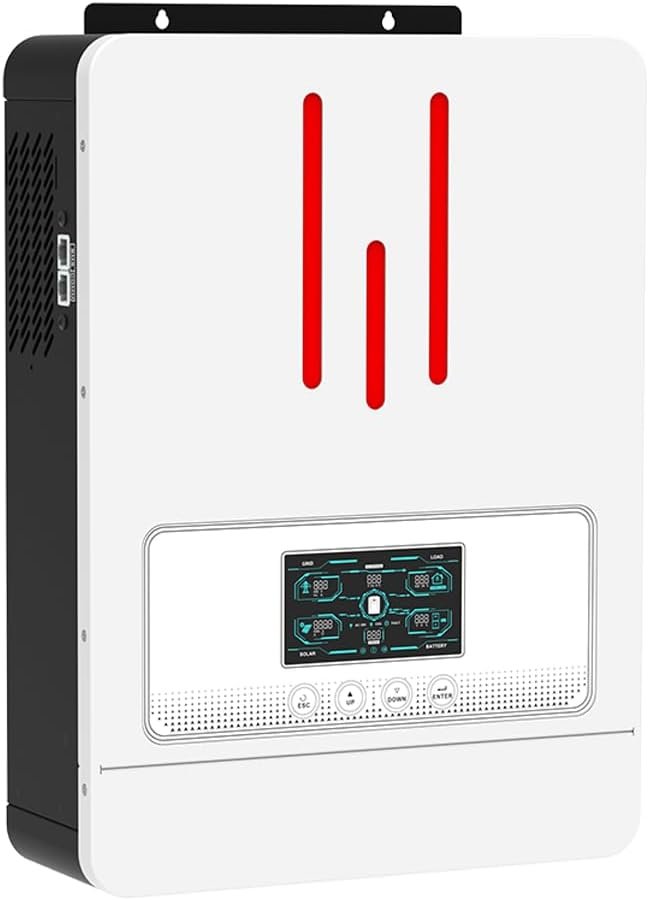
We find the Y&H 3200W Hybrid Solar Inverter to be a compelling all-in-one option for 24V systems that prioritize daytime solar use, flexible charging modes, and a compact hybrid design. Its built-in 80A MPPT charger, pure sine wave output, and battery-free startup option reduce system complexity and cost for the right use cases. At the same time, we think buyers should be aware of limitations like single-phase 230V output (no 110/120V), BMS compatibility caveats, and trade-offs inherent to battery-less operation.
Key specifications
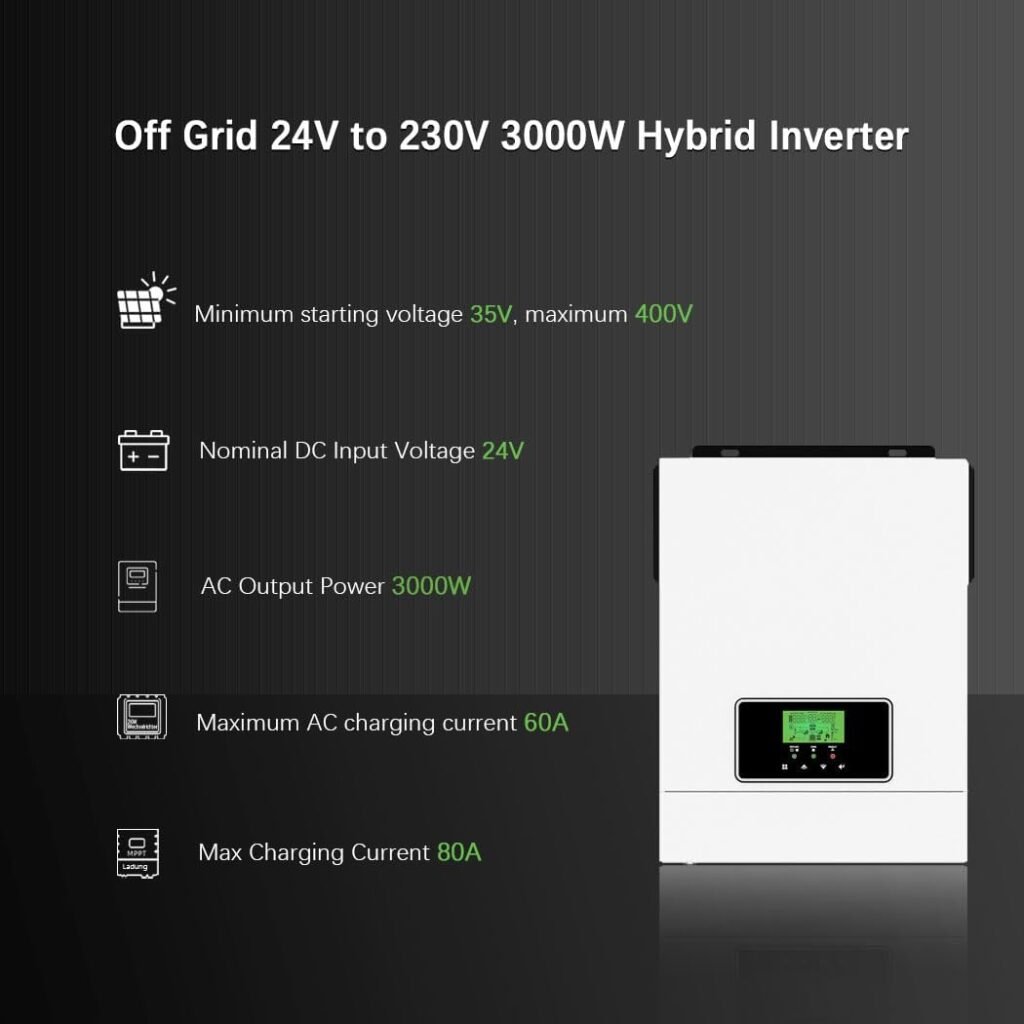
We summarize the most relevant technical specs so we can make a clear decision quickly. The table below breaks down the headline details and the values we should verify against our planned installation.
| Feature | Specification |
|---|---|
| Product name | Y&H 3200W Hybrid Solar Inverter DC24V to AC230V |
| Inverter type | Pure sine wave, off-grid / hybrid inverter |
| Continuous output | 3000W (nominal), 3200VA nameplate |
| Surge capacity | 6000W |
| DC input | 24V nominal |
| MPPT charge controller | Built-in 80A MPPT |
| Max PV input power | 3000W |
| PV input voltage range | 55–450V DC (starting voltage >60V) |
| Max PV open-circuit voltage (VOC) | 450V DC |
| Max charge current | 80A |
| Output voltage | AC 220/230/240V single-phase (hot leg 230V output) |
| Output frequency | 50/60Hz nominal |
| Output modes | Solar First, SBU Priority |
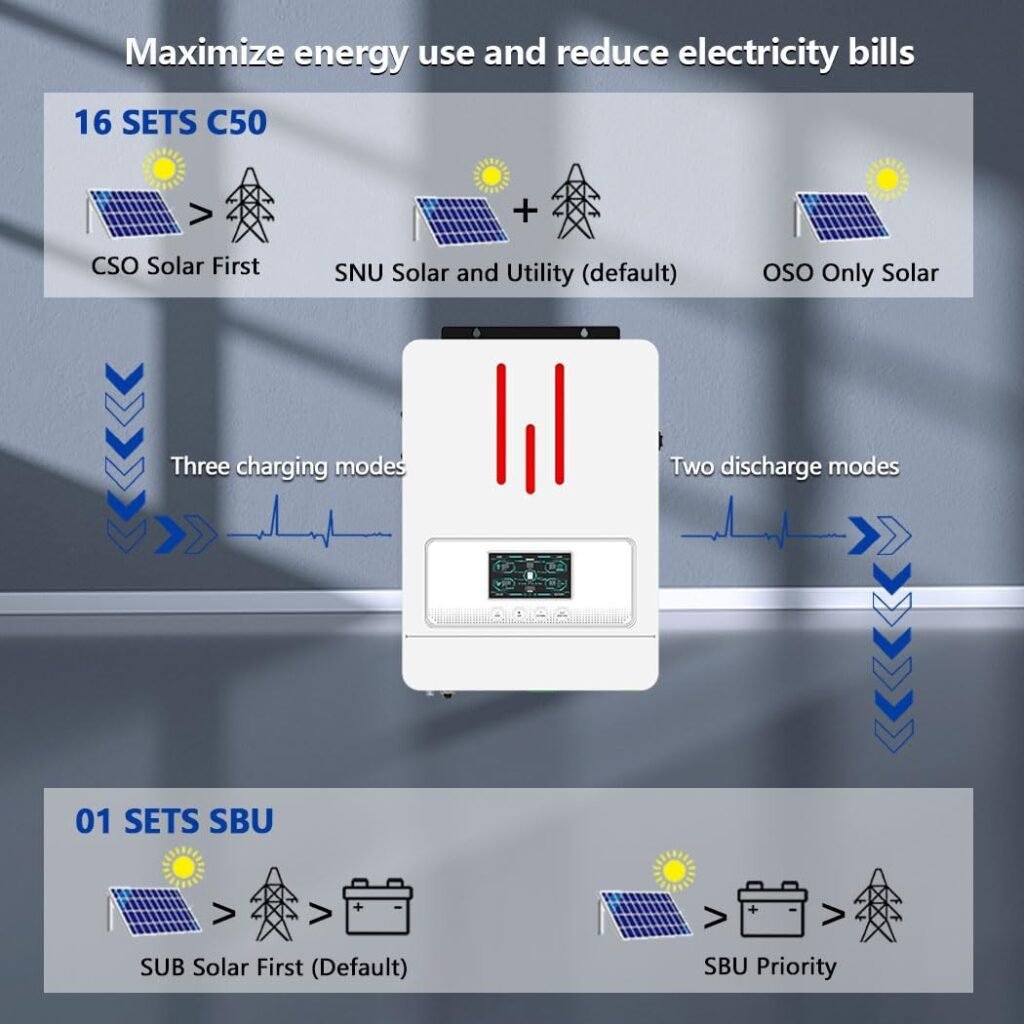
| Charging modes | Only Solar, Solar First, Mains & Solar hybrid |
| UPS transfer time | 4 ms |
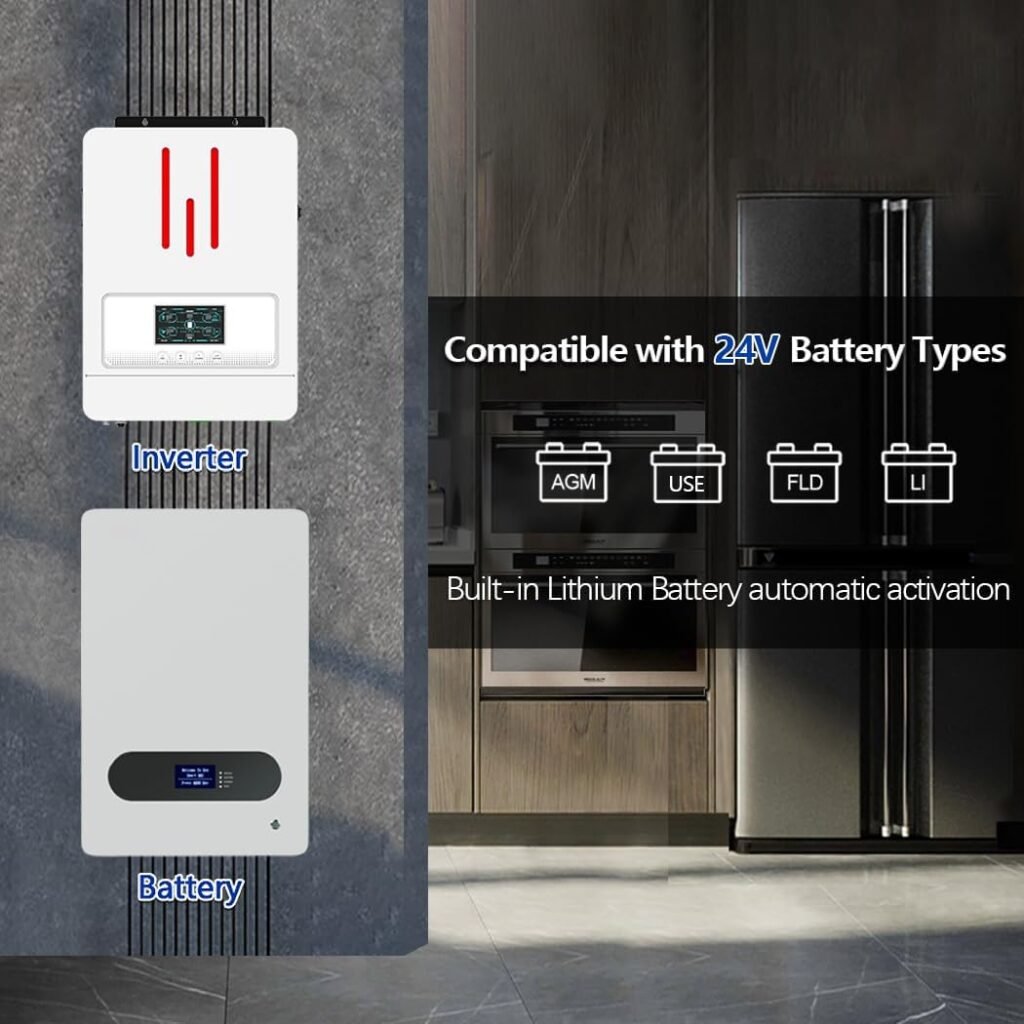
| Battery compatibility | 24V Lead-Acid (sealed/AGM/gel/flooded) and Lithium (LiFePO4) |
| BMS interface | RS485, LiFePO4 BMS support (BMS compatible with PYLON/PACE) |
| Battery-less capability | Yes (battery-free startup supported) |
| Notes | Not compatible with 110/120V split-phase systems; step-down converter required for 110/120V loads |

What we like
We appreciate several design choices that balance functionality and cost. The all-in-one form factor with a robust 80A MPPT and pure sine wave inverter simplifies installations, and battery-free startup can significantly reduce upfront costs for daytime-heavy systems. The 4 ms UPS transfer and 6000W surge capacity give confidence for many motor loads and refrigerators.
We also like that the inverter has flexible charging and output priority settings, which allow us to tune behavior for our daily usage patterns. The BMS RS485 integration for supported batteries is helpful for monitoring and safety when we pair with compatible LiFePO4 packs.
What we don’t like (limitations)
We want to be upfront about limitations that could be dealbreakers for some of our applications. The inverter is strictly single-phase 230V and cannot natively supply 110/120V devices. In the US or other 120V regions, we would need a separate step-down converter for 110/120V appliances, which adds cost and wiring complexity.
We also note that the BMS compatibility is limited (explicitly compatible with PYLON/PACE), so if we plan to use other intelligent BMS systems, we should verify communication compatibility. Finally, battery-free operation removes nighttime resilience — without a battery, we are entirely dependent on PV or grid/generator when solar output drops.
In-depth features
Power output and waveform
We see that the inverter provides a pure sine wave output with a continuous rating of roughly 3000W and a surge capacity of 6000W. That pure sine waveform is important for sensitive electronics, modern appliances, and variable-speed motors. The high surge rating helps start compressors and pumps, but we still recommend verifying individual appliance starting currents against the inverter’s surge capability to avoid overload trips.
We also note the product name lists 3200W but the detailed spec reports 3000W continuous. For sizing and expectations, we prefer to treat the sustained output as ~3000W and the nameplate 3200VA as a nominal figure.
MPPT solar charger and solar-first / battery-free operation
The built-in 80A MPPT charge controller is a major advantage when we want a simplified system. Its maximum PV input power is 3000W, with an input voltage window of 55–450V DC and a max VOC of 450V — this gives us design flexibility in stringing panels and configuring the array voltage.
Battery-less startup is attractive when our peak demand occurs in daytime and we want to avoid battery purchase/maintenance costs. We should remember battery-free operation is ideal only when solar generation matches load patterns reliably, or when we pair the inverter with grid/generator backup for periods without sun. The inverter supports three charging modes (Only Solar, Solar First, and Mains & Solar hybrid), so we can prioritize PV or combine it with AC when necessary.
Battery compatibility and BMS-RS485
We can use 24V lead-acid batteries (sealed, AGM, gel, flooded) or lithium batteries such as LiFePO4 with the inverter. The RS485 BMS interface provides a path to read battery voltage, current, temperature, SOC, and SOH, enabling safer charging and discharging behavior. Crucially, the product notes that BMS compatibility is limited to PYLON/PACE BMS units, so if we intend to use third-party LiFePO4 packs or an off-brand BMS, we should confirm compatibility or plan additional integration work.
We value that the BMS can signal the inverter to stop charging/discharging on abnormal conditions like over-temperature or overcurrent. That interlock reduces the risk of battery damage and enhances system safety when configured correctly.
UPS and transfer time
A 4 ms UPS transfer time is short enough for most sensitive electronics and prevents most devices from resetting on utility or generator outages. We consider this transfer nearly seamless for typical home and RV loads. However, when absolute zero-interruption is required for critical equipment (medical devices, industrial control systems), we should assess the entire system behavior and possibly add dedicated UPS gear.
We also appreciate the auto-restart function when AC recovers, which simplifies restart after outages.
Charging modes and hybrid operation
Having three charging modes gives us the flexibility to match behavior to our priorities. In Only Solar mode, the inverter charges the battery only from PV, which maximizes renewable use. Solar First prioritizes PV charging while still allowing auxiliary AC when PV is insufficient. Mains & Solar hybrid mode blends AC and PV charging to maintain battery SOC quickly when needed.
We like that the inverter can automatically switch between solar, grid, and generator inputs, and that it supports SBU or Solar First output prioritization. These options let us shape the system for zero-bill daytime operation, resilience, or battery health.
PV input and array sizing
Because the MPPT supports up to 3000W PV input and up to 450V input, we can design arrays with higher string voltage and fewer parallel strings. For a 24V battery-inverter system, keeping PV string voltage comfortably above the 60V starting threshold is important. We should ensure array voltage under STC and cold conditions remains below 450V VOC to protect the MPPT.
We recommend calculating panel strings to match the MPPT operating range and using proper fusing and disconnects on the DC side. The product suggests 16 AWG PV cable sizing for standard runs, but in longer runs or higher current scenarios we should upsize cables to reduce voltage drop and heat.
Efficiency and real-world performance
While exact inverter efficiency numbers aren’t listed in the provided spec, pure sine hybrid inverters in this class normally have decent peak efficiencies (often in the high 80s to low 90s percent). In real-world conditions we expect a small inverter standby draw and slightly reduced efficiency at partial loads. For the best overall system efficiency, we prefer to operate the inverter near its optimal load point and avoid running it for long stretches at extremely low loads without a battery or without using ECO modes if available.
We also expect the MPPT controller to achieve near-optimal energy harvest when arrays are sized and oriented correctly. In practice, shading, panel mismatch, and suboptimal orientation will reduce realized PV input, emphasizing the benefit of the hybrid charging options.
Installation and setup
Wiring and cable sizing
We recommend planning cable runs carefully. For 24V battery connections carrying up to 80A charge current and high inverter discharge currents, using appropriately sized battery cables (often AWG 2–4 or larger depending on distance and load) is essential to avoid voltage drop and heat. The MPPT suggests 16AWG for PV leads when within short runs and low current, but we will generally upsize to 10–12 AWG or larger for longer runs or higher current arrays. Always fuse the DC positive line close to the battery/bus to protect conductors.
We also prefer using a dedicated AC breaker and an isolation switch on the AC output. Proper grounding and earthing are necessary for safety and to reduce noise. When integrating with a generator or grid, we’ll ensure neutral/ground configuration complies with local electrical codes.
Battery installation and configuration
Even though the inverter supports battery-free startup, when we do install batteries we choose a well-matched 24V battery bank with appropriate capacity. For LiFePO4, we ensure the BMS supports RS485 communication if we want deep integration with the inverter. For lead-acid, we set charging voltages and absorption times to match battery manufacturer recommendations.
We will place batteries in ventilated, secure enclosures and use a battery management strategy that protects batteries from over-discharge. If using flooded lead-acid, we’ll follow regular maintenance schedules to top up electrolyte and check terminals.
BMS and communication setup
We appreciate that the inverter can read BMS signals via RS485. For reliable operation, we register the BMS type (PYLON/PACE noted as compatible) and confirm the BMS wiring and protocol. We will test the communication path and ensure the inverter respects BMS cutoffs. If our intended BMS is not listed as compatible, we’ll contact the battery or inverter vendor to confirm or request a firmware update.
We recommend validating the BMS-inverter protection workflow in a controlled environment so that we understand how the system stops charging/discharging on faults.
Generator and grid integration
Because the inverter accepts AC input from mains or a generator, we’ll configure priorities to suit our usage: Solar First for max PV use, or hybrid mode to ensure battery charging when PV isn’t enough. We will install appropriate transfer switches where local code requires separation between generator and grid connections. Auto-restart functions simplify recovery after grid outages, but we still prefer to test the sequence so we can understand timing and behavior.
Use cases and load examples
RV use
For RV applications, we appreciate the compact all-in-one design. The inverter’s surge capacity and 4 ms transfer time help start air conditioners and refrigerators commonly used in RVs. We prefer to run major loads during daylight on PV with battery-free mode when traveling in sunny regions, cutting down weight and maintenance costs.
We will, however, keep a small auxiliary battery or portable power pack if we anticipate nighttime or shaded camping. Also, since RVs often have 120V appliances, we must remember the inverter outputs 230V and would need a reliable converter for typical US RV equipment.
Zero-bill home backup strategy
We see this inverter as a strong candidate for a “zero-bill daytime” approach: run daytime loads directly from PV without a battery, and let the inverter switch to utility power when solar isn’t enough. This approach saves on battery cost but requires PV capacity to meet daytime demand and either grid/generator for evening or cloudy day power.
We advise calculating typical daytime loads (appliances, lighting, HVAC, pumps) and sizing PV so that the inverter can supply them reliably under average sun. For many households with daytime-focused demand (e.g., home offices, heat pumps on daytime schedules), this can be economical and effective.
Off-grid daytime setups
When our energy needs are concentrated in daylight hours (workshops, irrigation pumps, construction sites), the battery-free startup and strong MPPT input reduce system complexity and maintenance. We still recommend a small buffer battery for transient needs or as a UPS if continuous operation during brief cloud cover is required.
For fully off-grid 24/7 reliability, we prefer adding a battery bank sized for nighttime demand and ensuring BMS integration to protect the battery system.
Safety, maintenance, and troubleshooting
Common issues and fixes
We encounter a few recurring issues during setups and routine use. If the inverter trips on overload, we will check surge currents and reduce simultaneous start-up loads or add soft-start devices. If the MPPT shows low harvest, we check panel orientation, shading, wiring integrity, and ensure array voltage is within the MPPT operating window (above the 60V start).
If the inverter reports BMS communication errors, we verify RS485 terminations, wiring polarity, and BMS protocol compatibility. For persistent errors, a firmware update or vendor support may be required. Overvoltage warnings on PV input often stem from miscalculated VOC at cold temperatures; we will recompute worst-case VOC and reconfigure strings.
Routine maintenance
We recommend periodic inspections of all DC and AC connections, ensuring terminals are tight and corrosion-free. Clean PV panels periodically to maintain output. Check battery health: for lead-acid, monitor electrolyte and terminal condition; for LiFePO4, monitor BMS logs and cycle statistics.
We will also check inverter ventilation and keep it free from dust and debris to avoid derating under heavy use. Firmware updates and occasional reboots in controlled conditions can also keep the system operating smoothly.
Firmware, monitoring, and RS485 tips
We value remote monitoring and suggest configuring any available software or RS485-based monitoring tools that come with the inverter. Accurate SOC and SOH data from a compatible BMS greatly improve battery longevity and system reliability. We recommend logging a baseline of system behavior (PV harvest, inverter efficiency, battery cycles) to spot anomalies early.
If RS485 wiring seems to fail intermittently, we will check termination resistors and ensure twisted pair wiring is used for noise immunity. Labeling wires and keeping a simple wiring diagram with the installation makes future troubleshooting much easier.
Comparison with similar inverters
We compare the Y&H 3200W to other 3–4 kVA hybrid inverters in terms of integrated MPPT, battery-free operation, and BMS support. The key differentiators are the high MPPT voltage range up to 450V, 80A charge current, and the explicit support for battery-less startup. Many competitors require external MPPTs or do not offer battery-free startup as a robust option.
We also note that some competing models provide native split-phase or dual 120/240V outputs for U.S. customers, which this inverter does not. Therefore, if we need native 120V support, other models might be a better fit.
Practical tips before we buy
- Confirm voltage compatibility with our region and appliance set: the inverter outputs single-phase 230V and does not provide 110/120V natively. If we have 120V appliances, plan a step-down converter or select a different inverter.
- Verify BMS compatibility: if we plan to use LiFePO4 batteries, check that our specific BMS is compatible with RS485 protocols expected by the inverter (PYLON/PACE compatibility is indicated).
- Size the PV array carefully: keep total PV input below 3000W for the MPPT and ensure VOC under all conditions stays below 450V. Aim for array operating voltage above the 60V startup threshold.
- Plan wiring and fusing: use appropriate cable sizes for 24V battery currents, fuse near the battery, and include DC disconnects for safety.
- Consider surge and starting currents: the 6000W surge helps start motors but confirm inrush ratings of major appliances to prevent nuisance trips.
- Think through battery-free trade-offs: battery-free is cost-effective for daytime-heavy loads but leaves us without stored energy at night.
Frequently asked questions (FAQ)
Is this inverter suitable for US homes?
We believe it can be used in US homes only if all loads are 230/240V or if a reliable step-down transformer/converter is added for 110/120V appliances. The inverter is not compatible with 120V split-phase systems natively, so for typical US 120V equipment additional conversion is required.
Can we run the inverter without a battery?
Yes — the inverter supports battery-free startup and operation for daytime-focused systems. We recommend pairing it with grid or generator input to supplement solar when PV power is insufficient, or accepting a lack of nighttime power.
Which batteries work best with this inverter?
We prefer LiFePO4 for long cycle life and efficiency, but 24V lead-acid banks (sealed/AGM/gel/flooded) are also supported. For BMS-controlled LiFePO4, ensure RS485 BMS compatibility (PYLON/PACE). Proper configuration of charging parameters is important for battery longevity.
How many solar panels can we connect?
It depends on panel wattage and how we configure strings. The MPPT accepts up to 3000W PV input and 55–450V DC. For example, with 400W panels, up to ~7–8 panels maximum (7 panels × 400W = 2800W) could be used safely; we would tailor string voltage to the MPPT range.
Is the inverter good for starting compressors and motors?
Yes, the 6000W surge gives us a margin for starting many compressors and motors. However, inrush currents can vary greatly; we recommend measuring or consulting appliance specs and staging loads when necessary.
Final recommendation
We find the Y&H 3200W Hybrid Solar Inverter DC24V to AC230V to be a strong choice for users who want an integrated, flexible hybrid inverter for 24V systems, especially where daytime solar use is dominant or when simplification and cost reduction via battery-free operation are priorities. Its built-in 80A MPPT, pure sine wave output, robust surge rating, and configurable charge/output modes make it a practical all-in-one unit for RVs, workshops, and home daytime backup strategies.
We recommend it for:
- Owners with 230V appliance fleets or who can accommodate a step-down converter for 120V loads.
- Users who want an integrated MPPT without adding external charge controllers.
- Installations where daytime PV-driven loads will cover most demand and battery-free operation is acceptable.
- Systems that will pair with PYLON/PACE BMS-equipped LiFePO4 batteries for tighter battery management.
We advise caution or alternate choices for:
- Households that require native 120V/240V split-phase support.
- Installations that need guaranteed 24/7 off-grid power without batteries.
- Users planning to use third-party BMS systems without verifying compatibility.
If we decide to proceed, we’ll double-check PV string voltage calculations, confirm BMS compatibility, plan for proper cable sizing and protections, and test the system behavior under realistic loads. With careful planning, this inverter can be a practical center-piece of a cost-effective hybrid solar system.
Disclosure: As an Amazon Associate, I earn from qualifying purchases.