When it comes to maintaining solar-integrated LiFePO4 chargers, we need to focus on proper installation, effective charge management, and protecting the system from environmental damage. Using the right cables and grounding methods sets the foundation, while monitoring charge cycles prevents battery stress. Weatherproofing with high-IP enclosures safeguards the hardware. Yet, even with these measures, routine checks and careful handling are essential to maximize lifespan and performance. Let’s explore how to implement these best practices effectively.
Key Takeaways
- Ensure proper solar panel orientation, secure wiring, and fuse protection for safe and efficient charger installation.
- Monitor charge cycles within 20%-80% depth and maintain moderate charging rates to prolong battery life.
- Use weatherproof, UV-resistant enclosures with adequate IP ratings and ventilation to protect chargers from environmental damage.
- Regularly inspect and control moisture with sealed enclosures, desiccants, and conformal coatings to prevent corrosion and condensation.
- Follow manufacturer guidelines for safe handling, charging limits, and routine checks to avoid overcharging and physical damage.
How to Install Solar-Integrated LiFePO4 Chargers Correctly
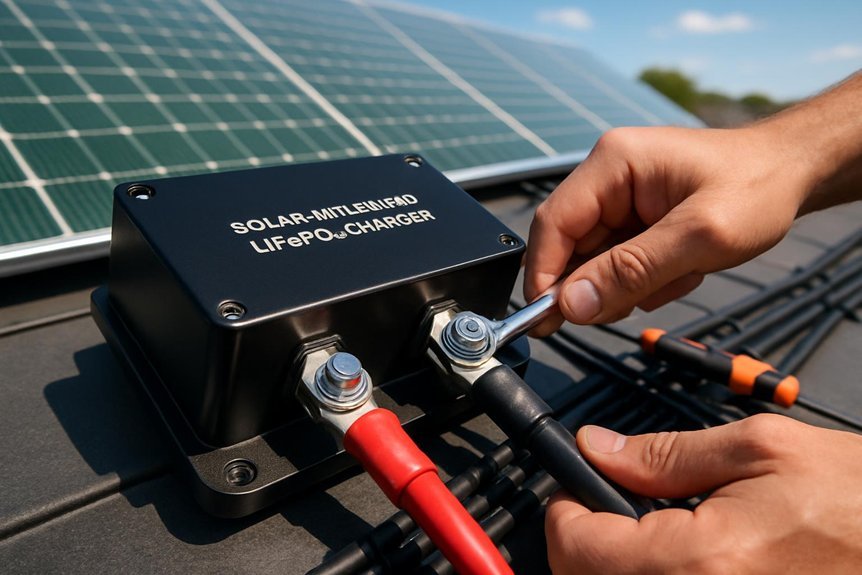
To install solar-integrated LiFePO4 chargers correctly, we need to follow a clear sequence of steps that guarantees both safety and optimal performance. First, we confirm ideal solar panel orientation to maximize energy capture—typically facing true south in the northern hemisphere with an angle matching the latitude. Next, we focus on wiring safety by using appropriately rated cables and secure, insulated connections to prevent shorts and voltage drops. It’s essential to incorporate proper fuse protection and grounding to mitigate electrical hazards. We also verify compatibility between the solar panel output and the charger’s input specifications to avoid overvoltage damage. By systematically addressing these technical factors, we set up a reliable, efficient charging system that leverages the strengths of LiFePO4 technology while maintaining operational safety and longevity.
Tips for Monitoring and Managing Charge Cycles
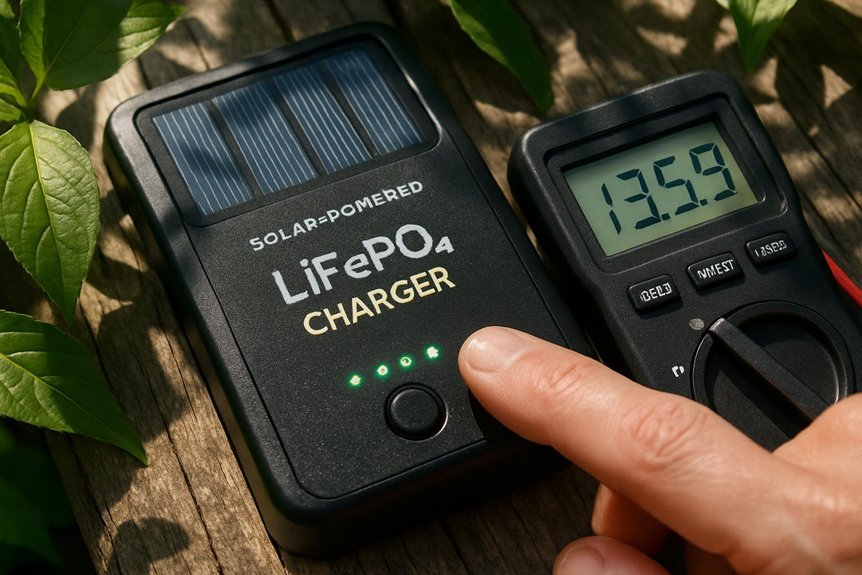
Although LiFePO4 batteries are known for their durability, actively monitoring and managing charge cycles is crucial to maximize their lifespan and performance. Effective charge cycle monitoring helps us prevent overcharging and deep discharging, both of which degrade battery health. Implementing robust battery management systems (BMS) guarantees balanced cell voltage and accurate state-of-charge readings.
| Charge Cycle Parameter | Recommended Practice |
|---|---|
| Cycle Depth | Keep between 20%-80% |
| Charge Rate | Use moderate C-rate |
| Temperature Range | Maintain 0°C to 45°C |
| Cycle Frequency | Avoid excessive cycling |
| BMS Calibration | Perform quarterly checks |
Protecting Your Lifepo4 Charger From Weather and Environmental Damage
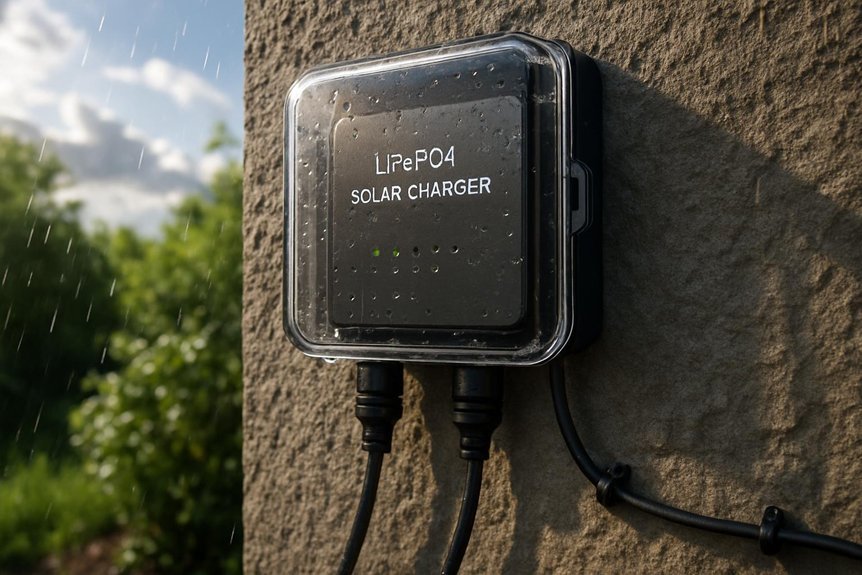
To guarantee the longevity and reliability of our LiFePO4 chargers, we need to focus on robust weatherproof enclosures that shield against rain, dust, and temperature extremes. Incorporating UV protection materials will prevent degradation from sunlight exposure, while effective moisture prevention methods like sealing and desiccants will keep internal components dry. Let’s explore these essential strategies to safeguard our chargers in harsh environmental conditions.
Weatherproof Enclosure Options
Because our LiFePO4 chargers often operate in varied outdoor environments, selecting the right weatherproof enclosure is crucial to confirm their longevity and performance. We prioritize enclosure materials that resist corrosion, moisture, and temperature fluctuations—such as polycarbonate, aluminum, or stainless steel. Each offers unique benefits; polycarbonate is lightweight and impact-resistant, while metals provide enhanced durability. Design considerations must include IP ratings to guarantee protection against dust and water ingress, ventilation to prevent overheating, and secure sealing to avoid environmental contaminants. Additionally, mounting options and ease of access for maintenance factor heavily into ideal enclosure selection. By integrating these technical elements, we effectively shield our chargers from harsh conditions, ensuring reliable operation and minimizing downtime in solar-integrated LiFePO4 systems.
UV Protection Techniques
When our LiFePO4 chargers face prolonged sun exposure, UV radiation can degrade enclosure materials and internal components, compromising performance and lifespan. To combat this, we recommend integrating UV shielding materials such as polycarbonate or UV-stabilized ABS plastics in the charger’s housing. These materials resist photodegradation and maintain structural integrity over time. Additionally, applying specialized solar panel coatings with UV-blocking properties on exposed surfaces further reduces radiation penetration, protecting sensitive electronics inside. These coatings not only enhance durability but also improve overall solar energy absorption efficiency. By combining UV shielding materials with effective solar panel coatings, we greatly extend the operational life of our solar-integrated LiFePO4 chargers. This proactive approach minimizes maintenance needs and guarantees consistent charger performance in harsh sunlight conditions.
Moisture Prevention Methods
Alongside protecting our LiFePO4 chargers from UV radiation, safeguarding them against moisture is equally important to maintain their reliability and longevity. We can achieve this by implementing effective moisture barriers, such as sealed enclosures with high-quality gaskets, to prevent water ingress during rain or humidity spikes. Additionally, applying conformal coatings on circuit boards adds an extra layer of defense against condensation. Incorporating humidity control solutions, like desiccant packets or silica gel within the enclosure, helps absorb residual moisture and stabilizes internal conditions. Regular inspections guarantee these barriers remain intact and functional. By combining moisture barriers with active humidity control, we effectively protect our solar-integrated LiFePO4 chargers from environmental damage, assuring consistent performance and extending their operational lifespan.
Routine Maintenance Tasks to Extend Battery Life
Although LiFePO4 batteries are known for their durability, regular maintenance is essential to maximize their lifespan and performance. Proper battery maintenance prevents capacity loss and guarantees consistent charging efficiency. To extend battery life effectively, we need to implement routine checks and care protocols:
- Inspect terminals and connectors for corrosion; clean as necessary.
- Verify charge and discharge parameters align with manufacturer specifications.
- Monitor battery temperature during operation to avoid overheating.
- Perform periodic full charge-discharge cycles to balance cell voltages.
- Store batteries at recommended charge levels and in controlled environments.
Troubleshooting Common Issues With Solar Lifepo4 Chargers
When we encounter charging inefficiency in solar LiFePO4 systems, we should first verify that the solar panels and charger are functioning within their specified parameters. Commonly, battery connection problems such as loose or corroded terminals can disrupt proper charging and must be inspected and corrected promptly. By systematically checking these areas, we can quickly identify and resolve the root causes of performance issues.
Charging Inefficiency Causes
Since solar-integrated LiFePO4 chargers depend heavily on variable environmental conditions, we often encounter charging inefficiencies that stem from factors like improper panel alignment, shading, or temperature fluctuations. Understanding these causes helps us optimize performance and extend battery life. Key contributors include:
- Temperature effects: High heat reduces charging efficiency and can trigger thermal protection modes.
- Shading impact: Partial shading drastically lowers power output by limiting sunlight exposure.
- Dirty or dusty panels: Accumulated debris blocks sunlight, decreasing panel efficacy.
- Incorrect tilt or orientation: Panels misaligned with the sun’s path reduce energy capture.
- Wiring losses: Voltage drops from suboptimal cable gauge or connections impair charging current.
Battery Connection Problems
Because reliable battery connections are critical for efficient charging, we must carefully troubleshoot common issues that arise with solar-integrated LiFePO4 chargers. Connection troubleshooting starts by consulting accurate wiring diagrams to verify all terminals are correctly connected and secure. Loose or corroded connections often cause voltage drops, leading to inefficient charging or system failure. We recommend inspecting connectors for oxidation and tightening all terminals to manufacturer specifications. Additionally, using a multimeter helps us identify continuity issues or unexpected resistance along cables. If wiring diagrams reveal parallel or series configurations, we guarantee proper polarity to prevent damaging the battery or charger. By methodically following this connection troubleshooting process, we maintain ideal electrical pathways, guaranteeing consistent charging performance and prolonging the lifespan of our LiFePO4 battery system.
Best Practices for Storing and Handling LiFePO4 Batteries
Proper storage and handling of LiFePO4 batteries greatly extend their lifespan and maintain peak performance. We must control storage conditions by keeping batteries in a cool, dry place to minimize temperature effects that accelerate capacity loss. Handling precautions are essential to avoid physical damage and internal short circuits. Maintaining moderate discharge rates and following recommended charging practices prevent stress that shortens battery lifespan. Implementing safety measures protects both users and equipment during storage and transport.
Key best practices include:
- Store batteries at 40-60% state of charge to reduce degradation
- Avoid exposure to temperatures above 45°C or below -20°C
- Handle batteries carefully to prevent punctures and impacts
- Use chargers designed for LiFePO4 chemistry with proper voltage/current limits
- Perform regular maintenance checks for swelling, corrosion, or damage
Frequently Asked Questions
Can Lifepo4 Chargers Be Used With Other Battery Chemistries?
We don’t recommend using LiFePO4 chargers with other battery chemistries due to LiFePO4 compatibility issues. However, some chargers offer versatility with adjustable settings—always verify specs to confirm safe, efficient charging across different battery types.
What Safety Certifications Should I Look for in a Lifepo4 Charger?
We understand over 70% of charger failures result from poor safety features. Let’s confirm your LiFePO4 charger meets charging standards like UL 2054 and IEC 62133, guaranteeing reliable protection and compliance for safe, efficient charging.
How Do Temperature Extremes Affect Lifepo4 Battery Charging Efficiency?
Temperature impact reduces charging cycles by slowing chemical reactions in LiFePO4 batteries during extremes. We recommend monitoring temperatures closely and adjusting charging parameters to optimize efficiency and prolong battery life under varying conditions.
Are There Specific Brands Recommended for Solar-Integrated Lifepo4 Chargers?
Steering brand comparisons feels like charting stars—we’ve found Victron and Renogy excel with charger features like MPPT efficiency and temperature compensation. Let’s focus on these for reliable, efficient solar-integrated LiFePO4 charging solutions.
Can Solar-Integrated Lifepo4 Chargers Be Expanded for Larger Battery Banks?
Yes, we can expand solar-integrated LiFePO4 chargers for larger battery capacity by paralleling compatible units or upgrading controllers. This guarantees ideal charging efficiency while preventing overcurrent issues, maintaining system balance and longevity.
Conclusion
Together, we can navigate the intricate dance of maintaining solar-integrated LiFePO4 chargers, ensuring they perform like a well-oiled machine. By installing correctly, managing charge cycles wisely, protecting against environmental challenges, and performing routine upkeep, we extend battery life and safeguard our investment. Let’s treat these systems not just as tools, but as the heart of our solar power setup, beating steadily and reliably through every sunrise and storm.