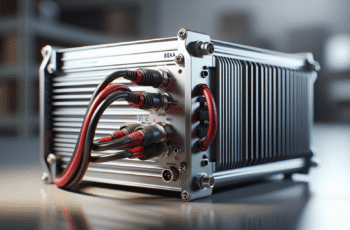
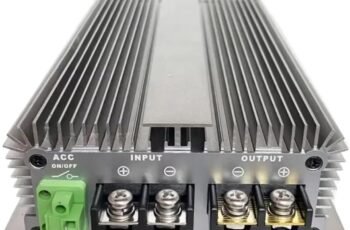
Renogy 20A Charger: Quick Overview for RV and Boat Owners
A deeply discharged LiFePO4 battery can look completely dead when its battery management system has disconnected the cells for protection. The Renogy 20A charger is designed for that particular frustration: it combines AC charging with a built-in BMS activation function intended to wake a compatible 12V lithium battery. At $119.99, compared with a listed original price of $189.99, it is aimed at RV and boat owners who want more than a basic indoor battery maintainer.
Our early view is positive, but conditional. This charger makes the most sense when you need a relatively high-current AC charger that can live in a damp environment, operate without a cooling fan, and support temporary or fixed wiring. It is less convincing for shoppers who need solar charging, app control, multiple battery banks, or support for several battery chemistries.
The listing shows only units remaining, which is a stock condition rather than evidence of quality or a reason to skip compatibility checks. In this review, we assess the charging claims, BMS recovery purpose, installation flexibility, safety systems, quiet operation, available customer-feedback evidence, and alternatives such as the NOCO GENIUSPRO25 and Victron Energy Blue Smart IP22 Charger.

Renogy 20A Charger Specifications and Included Equipment
The core specification is straightforward: this is a 20A AC-to-DC charger for 12V LiFePO4 batteries. The enclosure is rated IP67, the cooling system is fanless, and the input accepts 100-240V AC at either 50Hz or 60Hz. That combination gives it a useful mix of output capacity, environmental protection, and travel flexibility.
| Specification | Listed detail |
|---|---|
| Charging output | 20A |
| Battery compatibility | 12V LiFePO4 |
| AC input | 100-240V AC |
| Input frequency | 50/60Hz |
| Environmental rating | IP67 |
| Cooling | Fanless construction |
| Included equipment | 14AWG alligator-clip cable, ring-terminal cable, mounting bracket, and screws |
Two connection methods make the package more practical than a charger supplied with only one lead. The 14AWG alligator clips suit temporary charging or battery recovery, while the ring terminals provide a cleaner option for a permanent onboard installation. The bracket and screws are intended to secure the unit in a tight location inside an RV, boat, truck, or workshop setup.
The broad input range can accommodate compatible outlets in different regions, but it does not mean the supplied plug automatically fits every country. We would still check the plug type and obtain a suitable, safety-approved adapter where necessary.
How the Renogy 20A Charger Handles Deeply Discharged Batteries
The built-in BMS activation function is the feature that separates the Renogy 20A charger from a simple power supply. In plain English, it is designed to detect a 12V LiFePO4 battery whose BMS has placed the cells into sleep or protection mode after over-discharge or low-temperature conditions, then attempt to reactivate charging.
A conventional charger may fail to begin when the battery’s protection circuitry has disconnected the cells because it sees little or no usable battery voltage. BMS activation can address that specific situation, but it should not be treated as a repair function. A battery that is frozen, swollen, leaking, overheated, physically damaged, or otherwise unsafe should not be connected merely to test whether it will recover.
We would use the following sequence:
- Inspect the battery for swelling, cracks, leaks, unusual odor, or other damage.
- Confirm that it is a compatible 12V LiFePO4 battery and review its manufacturer’s charging instructions.
- Identify positive and negative terminals, then connect the correct cable polarity.
- Plug the charger into AC power and watch the LED indicator.
- Stop immediately if the battery becomes unusually hot or behaves abnormally.
When reading customer reports, we would look for the battery capacity, its condition before charging, the time needed to leave protection mode, and whether the light behavior was easy to understand. Those details are much more useful than a brief claim that a battery was simply “dead.”
20A Charging Performance for RVs, Boats, and Off-Grid Systems
A 20A output is a sensible middle ground for larger 12V deep-cycle lithium batteries. As an illustration, a nominal 100Ah battery would require about five hours in a theoretical calculation at 20A if the full rated capacity had to be replaced. Actual charging will take longer or shorter depending on the starting state of charge, battery temperature, charging efficiency, and the way the final charging stage tapers current.
That output suits several practical jobs: restoring an RV battery from shore power, charging a boat battery at the dock, preparing a backup battery in a workshop, or recovering an off-grid battery after storage. It is more substantial than a small maintenance charger, although the appropriate current still depends on the battery manufacturer’s limits and the size of the connected bank.
We would not confuse this unit with a solar charge controller, an alternator charger, or a DC-to-DC system. It requires AC input and converts that power for the battery. Before a permanent installation, check the battery manual for its recommended charging voltage and maximum current, particularly if multiple batteries are connected together.
The practical test is simple: estimate how much energy needs replacing, allow for charging losses and tapering, then decide whether a 20A rate fits your charging schedule. That approach is safer than promising an exact number of hours from the nominal amp-hour figure alone.
IP67 Waterproof Design and Fanless Heat Management
IP67 means the charger is designed for dust protection and temporary immersion under specified test conditions. For an RV, boat, truck, or outdoor workshop, that is a stronger environmental position than an indoor-only charger and should provide better resilience around rain and splashes when installed correctly.
IP67 does not mean we should deliberately submerge the unit, leave it underwater, or operate it with wet connectors and exposed wiring. The rating applies to the product under defined conditions; the complete installation also depends on cable entries, terminals, plug connections, and the way the charger is mounted.
The fanless construction is particularly appealing in sleeping areas, camper interiors, and cabins where a cooling fan would be distracting. There is no fan noise to manage, but silent operation does not remove the need for sensible heat management. The listing describes a heat-dissipating plastic shell, so we would provide clearance around the unit and avoid placing it in a sealed compartment that traps warmth during extended charging.
For installation, mount the charger securely in a dry, ventilated position, protect the cable connections from spray, and inspect them periodically for moisture or corrosion. A marine environment is demanding; the enclosure helps, but it cannot compensate for exposed terminals, standing water, or neglected wiring.


Safety Protections and LED Status Monitoring
The product listing identifies five protection layers: short-circuit, over-current, over-voltage, over-temperature, and reverse-polarity protection. Each addresses a different risk. Short-circuit protection responds to an unintended low-resistance path, over-current protection limits excessive demand, over-voltage protection helps control abnormal voltage, over-temperature protection responds to excessive heat, and reverse-polarity protection is intended to reduce the consequences of connecting positive and negative incorrectly.
These safeguards are useful, but they are not a substitute for careful installation. Before applying power, we would complete this checklist:
- Confirm the battery chemistry and voltage.
- Check positive and negative connections visually and by labeling.
- Inspect cable insulation and terminals for damage.
- Secure the battery so it cannot move or pull on the cables.
- Use an AC outlet and plug arrangement suitable for the installation.
The LED indicator is intended to show charging or an abnormal condition. We would consult the supplied instructions for the exact light patterns rather than guessing from color alone, especially if the charger appears not to start. The available product information does not provide a complete status-code table, so buyers should not assume that every unusual blink has the same meaning.
Stop charging if the battery smells abnormal, leaks, becomes unusually hot, or shows physical damage. Protective electronics reduce risk; they cannot make an unsafe battery safe.
Installation Options: Temporary Charging or Permanent Mounting
The included alligator clips are the convenient choice for occasional charging. They let us connect the charger when a battery needs recovery, then remove the equipment without creating a permanent wiring project. For an onboard RV or boat installation, the ring-terminal cable is the tidier and more secure option because it is designed to remain attached to the battery terminals.
Our preferred installation plan would be:
- Choose a dry, ventilated mounting location away from moving parts, hot surfaces, sharp edges, and standing water.
- Disconnect AC power before handling the battery cables.
- Identify the battery’s positive and negative terminals.
- Attach the selected cable set with the correct polarity.
- Secure the charger using the included bracket and screws.
- Route and protect the cables, then reconnect AC power.
- Confirm the LED status before leaving the installation unattended.
Clip connections are best for a workshop bench or occasional battery recovery. Ring terminals make more sense for a dedicated shore-power charging station that will remain in the vehicle or boat. The package includes mounting hardware, but the buyer may still need site-specific cable protection, fusing, adapters, or professional installation based on the vehicle and battery manufacturer’s instructions.
We would also keep the wiring away from chafe points and moving mechanisms, secure loose cable runs, and protect connections from spray. Those details determine whether a good charger becomes a dependable installation.
What Customers Are Saying About the Renogy 20A Charger
The supplied listing and review material do not include a verified star rating, review count, failure rate, or enough individual customer comments to claim a reliable pattern of praise or criticism. We therefore won’t invent statements about buyers reviving batteries, charging times, waterproof performance, or long-term durability. At publication, the current Amazon star rating and review count should be inserted only after checking the live listing.
That limitation matters because the most useful reports would distinguish a battery in ordinary low-charge condition from one whose BMS has entered protection mode. We would give greater weight to detailed accounts that identify battery capacity, starting voltage or condition, ambient temperature, cable type, connection method, recovery time, and final outcome.
Potentially helpful feedback to look for includes successful BMS recovery, quiet operation in a cabin, compact mounting, and practical use of both cable sets. Conversely, repeated reports of confusing LED behavior, short cables, heat during prolonged charging, weak connectors, poor mounting hardware, or batteries remaining in protection mode would deserve closer attention. An isolated complaint may reflect wiring, battery condition, temperature, or setup rather than a product-wide fault.
Our buying advice is to read the newest detailed reviews first, then compare them with the manufacturer’s stated specifications. One-line ratings rarely explain whether the charger or the battery was the real source of a disappointing result.
Renogy 20A Charger Compared With Alternatives
The NOCO GENIUSPRO25 is a useful comparison for shoppers considering a similar high-output AC charger. The Renogy model is specifically positioned around 12V LiFePO4 charging, built-in BMS activation, silent fanless operation, and IP67 outdoor protection. The NOCO alternative may appeal more to buyers who prioritize its own battery-chemistry support, portable charger format, or a different connection approach. We would verify the exact chemistry modes and environmental requirements for the individual setup before choosing.
The Victron Energy Blue Smart IP22 Charger represents a different priority. It is associated with a connected smart-charger ecosystem and is often considered by owners who want monitoring and configuration features. The Renogy unit instead emphasizes built-in recovery capability and a weather-resistant enclosure for outdoor or marine positioning. Buyers should compare the required charging current, app or telemetry needs, mounting environment, and cable arrangement rather than treating either product as universally better.
For a compatible 12V LiFePO4 battery, the Renogy 20A charger is the stronger fit when the shopping list specifically includes AC charging, BMS activation, quiet operation, and a waterproof enclosure. A competitor may be preferable when the priority is app monitoring, broader chemistry support, lower-current charging, or a more established configuration ecosystem.
We would make the comparison in that order: battery compatibility first, charging method second, environmental placement third, and convenience features last. That prevents an attractive feature list from hiding a basic mismatch.

Who Should Buy This 20A LiFePO4 Battery Charger?
The best match is an RV owner, boater, truck user, off-grid operator, or workshop user with a compatible 12V LiFePO4 battery. It is especially relevant to people who have experienced a BMS shutdown and want a charger designed to attempt reactivation rather than a basic unit that may not recognize a protected battery.
We also see a good fit for buyers who value quiet charging in a sleeping area or cabin more than app-based monitoring. The two connection options support both occasional recovery and a more permanent onboard arrangement, so the product can adapt as a small charging setup develops.
We would look elsewhere if the main requirement is solar input, alternator charging, support for different battery chemistries, a higher-output multi-bank system, or detailed remote telemetry. This is an AC charger for a specific battery type, not an all-purpose power-management hub.
Our decision sequence is simple:
- Confirm the battery is 12V LiFePO4.
- Estimate whether a 20A charging rate meets the recovery schedule.
- Choose temporary clips or fixed ring-terminal wiring.
- Check whether the installation will face rain, splashes, or marine moisture.
- Compare the $119.99 price with the features you will actually use.
If BMS recovery and weather resistance are central requirements, this product belongs on the shortlist. If they are not, a simpler or more configurable charger may offer better value.
Is the Renogy 20A Charger Good Value at $119.99?
At $119.99, the Renogy 20A charger sits at a price that can make sense for a purpose-built installation. The listing shows an original price of $189.99, but we should treat that reference price as a comparison point rather than guaranteed savings or a promotion that will remain available. The displayed availability of units is also a stock message, not proof of performance.
Value comes from combining several useful elements in one package: 20A output, BMS activation, IP67 protection, fanless operation, five listed protection systems, two cable sets, and mounting hardware. Someone replacing a basic charger may avoid buying separate connection and mounting accessories, while an RV or boat owner may value not having to troubleshoot repeated protection-mode failures.
There are still unanswered questions in the supplied listing. It does not specify the warranty duration, exact charging-voltage profile, cable lengths, level of LED detail, or verified long-term reliability. Those omissions don’t automatically disqualify the unit, but they should temper any assumption that the charger is fully documented for every installation.
Our recommendation: this is a strong candidate at $119.99 for compatible 12V LiFePO4 owners who need quiet, weather-resistant AC charging and may need BMS recovery. It is a weaker choice for solar, app-control, or multi-bank requirements. Confirm the battery specifications and installation needs before treating the current price as a worthwhile purchase.
Pros and Cons
Pros
- Built-in BMS activation is intended to help recover compatible LiFePO4 batteries in sleep or protection mode.
- 20A output is suitable for many larger 12V deep-cycle lithium charging applications.
- IP67 protection and fanless operation suit damp environments and quiet RV or boat interiors.
- Includes both 14AWG alligator clips and ring terminals for temporary or permanent connections.
- Five listed protection systems and included mounting hardware add practical installation value.
Cons
- It is limited to compatible 12V LiFePO4 charging rather than serving as a universal battery charger.
- The supplied information does not confirm the warranty duration, exact charging-voltage profile, cable lengths, or long-term reliability.
- BMS activation cannot repair a damaged, frozen, swollen, overheated, or otherwise unsafe battery.
- It does not provide solar input, alternator charging, multi-bank operation, or stated app-based remote monitoring.
- The live customer rating and review count were not supplied and must be verified before publication.
Final Verdict
Key Takeaways
- The charger is designed for compatible 12V LiFePO4 batteries and includes BMS activation for certain protection-mode situations.
- Its 20A AC output, IP67 enclosure, fanless cooling, and two cable options suit many RV, boat, truck, and workshop installations.
- The product is not a solar controller, alternator charger, app-monitoring system, or multi-bank charger.
- At $119.99, it is most compelling when buyers will use both the recovery function and weather-resistant, quiet design.
- The live star rating, review count, warranty details, cable lengths, and exact charging profile should be verified before publication or purchase.
Frequently Asked Questions
Can this charger wake a LiFePO4 battery in protection mode?
It is designed with a built-in BMS activation function that attempts to reactivate a compatible 12V LiFePO4 battery after conditions such as over-discharge or low temperature have triggered protection. Success is not guaranteed, particularly if the battery is damaged or unsafe.
Is this a solar charge controller?
No. It is an AC-to-DC charger intended for connection to an AC outlet. It should not be substituted for a solar controller, alternator charger, or DC-to-DC charging system.
Can it be installed permanently in an RV or boat?
Yes. The package includes ring-terminal wiring, a mounting bracket, and screws for a fixed setup. Installation should follow the battery and vehicle manufacturer’s wiring, protection, and grounding instructions.
Does IP67 mean the charger can be left underwater?
No. The rating indicates dust protection and resistance to temporary immersion under specified testing conditions. Wet connectors, exposed wiring, standing water, and deliberate submersion should still be avoided.
What should we do if the battery becomes hot or smells unusual?
Stop charging, disconnect AC power when it is safe to do so, and move away from the battery if there is smoke, leakage, swelling, or another serious hazard. Do not continue testing a battery that appears damaged.