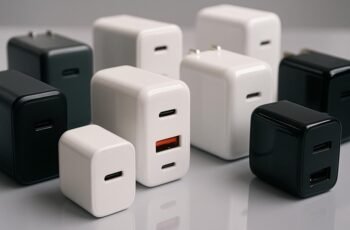
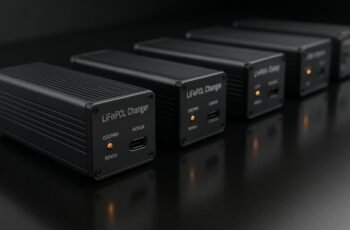
We weigh programmable versus fixed-stage LiFePO4 chargers by focusing on how each handles voltage, current, and temperature in real time. Programmable units adjust CC, CV, and taper responsively, potentially optimizing aging and safety, but with higher complexity and cost. Fixed-stage chargers offer predictability and simplicity, yet limited tailoring to cell health and environmental changes. The trade‑off matters for our application and risk tolerance, and it leaves a practical question: which path aligns with our long-term maintenance and performance goals?
Key Takeaways
- Programmable LiFePO4 chargers adapt CC/CV profiles, timing, and termination using real-time data for safer, optimized charging.
- Fixed-stage chargers use rigid voltage/current steps, offering predictability, simplicity, and lower upfront cost.
- Programmable chargers tailor temperature compensation and impedance management to cell health and aging.
- Fixed-stage designs may struggle with temperature variability and end-of-charge efficiency but suit simple, low-variability systems.
- Consider use case, budget, and fault logging when choosing: programmability enables optimization; fixed-stage favors reliability and ease of maintenance.
How Programmable and Fixed-Stage Chargers Work for LiFePO4
Programmable and fixed-stage LiFePO4 chargers differ mainly in how they sequence charging phases and adapt to cell conditions. We, as engineers and guides, explain that programmable chargers implement defined algorithms to transition through CC, CV, top-off, and taper steps, with adaptive timing and voltage thresholds tuned to cell history. These devices monitor real-time parameters and adjust current limits, termination criteria, and rest intervals to optimize longevity and performance. Fixed stage chargers, by contrast, apply rigid, pre-set stages with fixed durations and voltage endpoints, offering predictability but less responsiveness to aging, temperature, or impedance shifts. Both approaches support LiFePO4 chemistry, yet programmable chargers enable nuanced state-of-health management, while fixed stage chargers emphasize simplicity, reliability, and repeatable charge cycles.
LiFePO4 Charging Needs: Voltage, Current, and Temperature

LiFePO4 charging hinges on three interdependent parameters: voltage, current, and temperature. We examine how these interact to meet safe, efficient charging without stressing cells.
| Parameter | Effect on Charge |
|---|---|
| Voltage | Sets endpoints for each stage; excessive voltage risks overcharge, while insufficient voltage underutilizes capacity. |
| Current | Determines speed and heat; too high raises lifetime stress, too low prolongs cycle time. |
| Parameter | Practical control |
| Temperature | Influences resistance and safety; control within spec to prevent thermal runaway and maximize charging efficiency. |
We balance these factors with lifepo4 safety as a priority, and optimize charging efficiency by aligning voltage and current profiles with operating temperature.
How Programmable Chargers Work and Why It Matters for LiFePO4
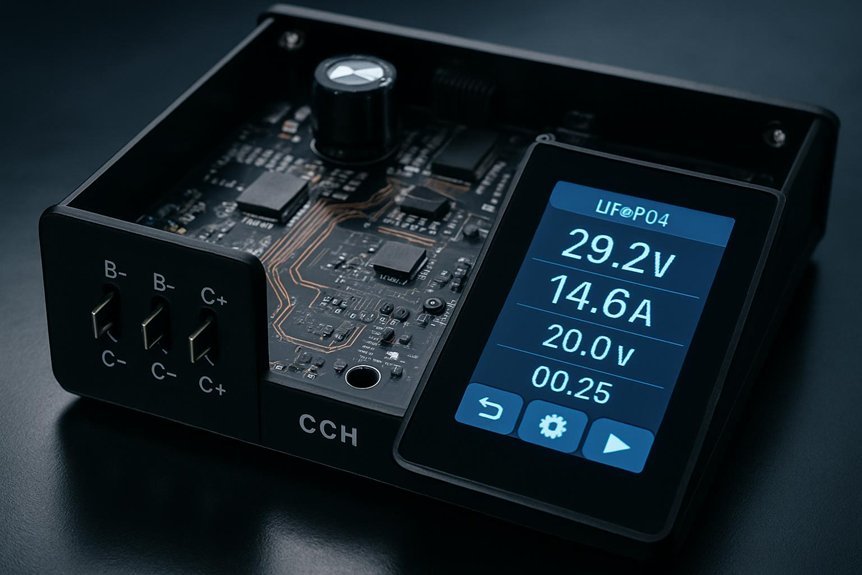
Have you ever wondered how a charger adapts to LiFePO4’s unique chemistry to maximize safety and speed? We examine how programmable charging sequences tailor current and voltage profiles to LiFePO4 cells, using precise control loops and real-time feedback. We adjust CC/CV phases, terminate at cell balance points, and respond to temperature data to prevent thermal runaway. This flexibility enables lifecycle optimization by minimizing stress, reducing impedance rise, and extending cycle life. We illustrate with demo scenarios: slow, high-precision top-off; fast-charge bursts within safety windows; and multi-cell balancing routines across packs. Safety considerations govern hard limits, watchdog timers, and fault handling to preserve integrity under fault or aging. Ultimately, programmability delivers adaptive performance beyond fixed stages, aligning charging with chemistry, usage, and safety needs.
Fixed-Stage Chargers: When They Suffice and Their Limits
How do fixed-stage chargers fit LiFePO4 packs in real-world use, and where do their limits appear? We analyze them as a baseline: fixed-stage designs deliver defined voltage and current steps, without dynamic impedance tracking or temperature-aware tapering. This predictability aids simple systems, cost control, and straightforward safety interlocks, making them viable for stationary or low-variability routines. Yet performance gaps emerge: slower end-of-charge time, limited tolerance to pack aging, and reduced efficiency under diverse temperatures. The nostalgia bias toward “set-and-forget” devices can obscure aging effects that shift charge curves from the ideal. Vendor lock in can reinforce suboptimal behavior if a supplier limits access to parameter tuning or firmware updates. In such cases, fixed-stage chargers suffice for stable, uniform packs but risk mismatch in mixed chemistries or evolving field conditions.
Choose Your Charger: Use Case, Budget, and Risk Comfort
Choosing a charger depends on the use case, budget, and risk tolerance, especially after considering fixed-stage designs as a baseline. We present a structured choice framework that weighs flexibility, control, and safety margins against simplified operation. Our focus is on objective tradeoffs and measurable outcomes rather than hype.
1) Use case diversity: match charger programmability to required voltage/current profiles, cycle timing, and temperature compensation.
2) Budget tradeoffs: quantify upfront cost, long-term efficiency, and maintenance; programmable options may reduce sacrified performance elsewhere.
3) Risk comfort: evaluate fault protection, data logging, and user error mitigation to align with operator expertise.
This approach clarifies selection criteria and highlights where programmable features add tangible value.
Real-World Profiles That Benefit From Programmable Chargers
Real-world charging scenarios reveal that programmability pays off when profiles deviate from standard CC/CV patterns. We, the readers, see how flexible control lets us tailor current steps, taper rates, and termination thresholds to actual use. Programmable chargers handle non-linear chemistries, partial-state replenishment, and multi-battery strings without compromising safety or efficiency. In practice, real world profiles often feature rest periods, variable ambient temps, and uneven cell health, all of which demand adaptive timing and voltage boundaries. Our goal is to minimize degradation while meeting pack capacity goals. The table illustrates typical mismatches between fixed-stage assumptions and live behavior, highlighting where programmable chargers excel. This capability reduces cycle losses and extends life, delivering verifiable performance gains for real world profiles.
| Scenario | Benefit |
|---|---|
| Temperature shifts | Adaptive current/voltage limits |
| Uneven cell aging | Individual stage tuning |
| Rest periods | Optimized charge pause handling |
| Multi-strings | Coordinated balancing control |
| Partial-state packs | Safe, efficient finishing |
Set Up Your LiFePO4 System: Wiring, Safety, and Monitoring Tips
To set up a LiFePO4 system safely and reliably, start with a clear wiring plan that isolates high-current paths, labels all conductors, and uses components rated above anticipated peaks. We, as installers, evaluate topology, cable sizing, and enclosure placement to minimize resistance and thermal buildup. Monitoring must cover cell voltage, pack current, temperature, and system state with alerts and data logging. We prioritize safety interlocks, proper fusing, and clear separation between AC and DC sections. Creative housing considerations ensure heat dissipation, vibration resistance, and accessible wiring. A solar bypass feature is assessed for emergency isolation and charge control. System health is verified before enrollment, and we record baselines for ongoing comparison.
- Define conductor gauges and trace widths for peak currents.
- Implement redundant temperature sensing and fault alarms.
- Design a modular, expandable enclosure with safe wiring paths.
Troubleshooting and Optimization: Common Pitfalls and Fixes
Are common LiFePO4 charging and monitoring setups slipping into avoidable faults, and if so, what targeted fixes will restore reliability? We, as practitioners, dissect failure modes and apply disciplined remedies. Common pitfalls include drifted voltage thresholds, inadequate temperature compensation, and improper balance currents. Targeted fixes involve recalibrating sensors, verifying BMS communications, and tightening current sense resistors. We also optimize by refining charge profiles, aligning stage timing with cell chemistry, and enforcing guardrails for fault states. Performance improves with repeatable test routines and documented tolerances. See table for quick reference.
| Area | Symptom | Recommended Action |
|---|---|---|
| Monitoring | Inconsistent SOC readouts | Recalibrate sensors; verify BMS links |
| Charging | Over/undercharge tendencies | Adjust voltage thresholds; verify temp comp |
| Performance | Slow balancing | Modify balance currents; review pack design |
| Economics | Maintenance cost spikes | Consider pricing considerations; optimize spares |
Frequently Asked Questions
How Does Programmable Charging Adapt to Aging Lifepo4 Cells?
We adapt via aging effects-aware profiling, adjusting charge targets and termination thresholds in real time; our system runs calibration routines periodically to compensate capacity decline, impedance rise, and voltage drift, maintaining safety margins and consistent cycle life.
Can Fixed-Stage Chargers Handle High-Temperature Environments Safely?
Can fixed-stage chargers handle high-temp safely? Yes, but only with strict thermal limits and monitoring. We assess fixed stage risk by surveillance of junction temps, ambient conditions, and derating, ensuring safe operation under high temp.
Do Programmable Chargers Support Lifecycle-Focused Battery Balancing Strategies?
We can confirm programmable chargers support lifecycle-focused battery balancing strategies, addressing programming challenges and cost considerations as we optimize cell health and lifecycle metrics, delivering precise control, diagnostics, and adaptable balancing policies for varied LiFePO4 deployments.
What Are the Hidden Costs of Programmable Chargers Over Time?
Like a careful clockwork, programmable chargers incur hidden costs over time: more programming firmware updates, debugging, and potential firmware bricking risks. We, however, conduct rigorous cost assessment while assessing maintenance, wear, and support implications for users.
How to Verify Accuracy of Charger Voltage and Current Readings?
We verify accuracy by cross-checking readings with a calibrated multimeter and reference sources, performing regular calibration procedures, and tracking misreadings drift to ensure consistent results and trustworthy charger voltage and current readings for our system.
Conclusion
We’ve compared programmable and fixed-stage LiFePO4 chargers, weighing adaptability against simplicity. Programmable chargers optimize CC/CV/taper in response to temperature, impedance, and history, improving aging and precision; fixed-stage units offer predictability with lower upfront risk. For high variability environments, or long-term maintenance aims, programmable solutions justify the investment. For tightly scoped, cost-conscious builds, fixed-stage suffices. In short, match your profile to your risk tolerance, but remember: even a smartwatch can outsmart a sundial when programmed—anachronistically, timing matters.