When we integrate Battery Management Systems (BMS) with chargers, we create a critical safety layer that actively monitors battery health and controls charging parameters. This communication guarantees real-time adjustments to prevent overcharging and overheating, which are common causes of battery failure. Understanding how this interaction works is essential for designing reliable, efficient battery systems. But what specific protocols and control strategies make this integration effective?
Key Takeaways
- BMS monitors battery voltage, temperature, and current to prevent overcharge and thermal runaway during charging.
- Seamless communication protocols between BMS and charger enable real-time data exchange for adaptive charging control.
- Chargers must support compatible interfaces like CAN or SMBus to interpret BMS safety commands effectively.
- Integration ensures synchronized fault detection and charge termination to protect battery health and maximize lifespan.
- Robust overvoltage and overcurrent protections in both BMS and charger prevent safety hazards during charging cycles.
How a Battery Management System (BMS) Protects Your Battery Pack
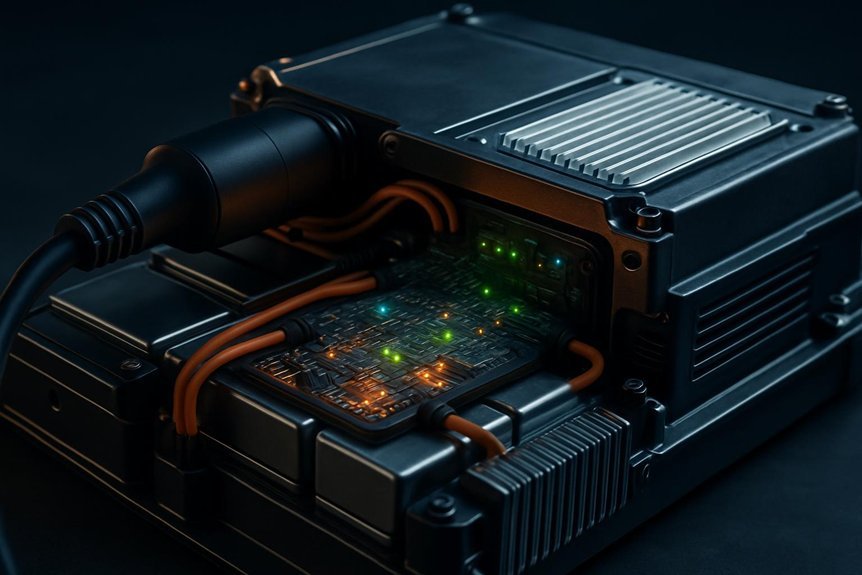
A Battery Management System (BMS) employs multiple sensors and control algorithms to continuously monitor and regulate each cell within a battery pack. By tracking voltage, temperature, and current in real time, the BMS guarantees cells operate within safe limits, preventing overcharge, over-discharge, and thermal runaway. This precise regulation optimizes charge cycles, directly contributing to extending the battery lifespan. We rely on the BMS to balance cell voltages, reducing stress and uneven wear that can degrade performance prematurely. Additionally, the BMS isolates faulty cells and manages energy flow, maintaining overall system integrity. Through these functions, the BMS safeguards the battery pack’s health and efficiency, enabling consistent, reliable operation while maximizing usable life and safety margins.
Why Charger and BMS Communication Is Critical for Safety
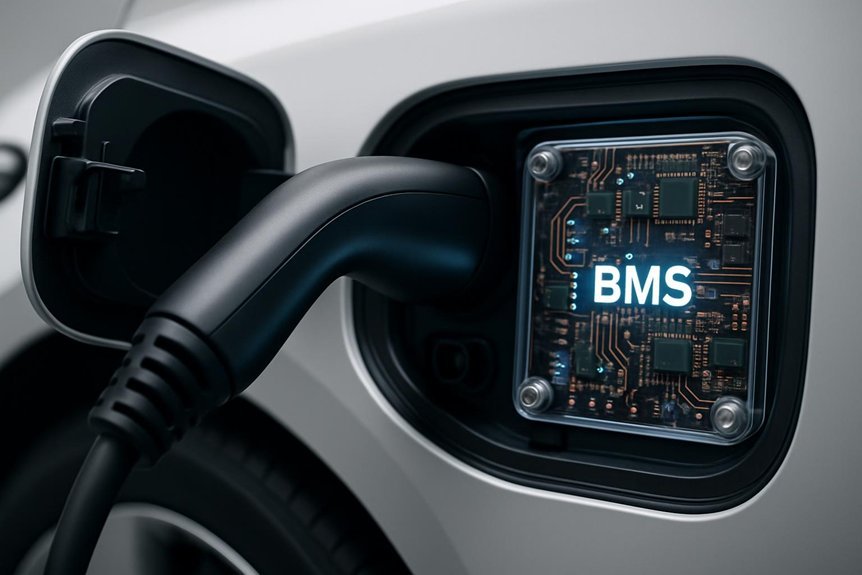
Because safe battery operation depends on coordinated control, seamless communication between the charger and the Battery Management System (BMS) is essential. This communication guarantees charger compatibility and timely safety alerts, preventing hazardous conditions. We rely on this connection for:
Safe battery operation requires seamless charger and BMS communication to ensure compatibility and timely safety alerts.
- Real-time monitoring of battery parameters to adjust charging profiles precisely.
- Immediate transmission of safety alerts to halt charging upon detecting faults.
- Verification of charger compatibility to avoid overvoltage or overheating risks.
- Synchronization of charge termination signals to protect battery longevity and safety.
Without this integration, the charger may apply inappropriate currents or voltages, increasing the risk of thermal runaway or capacity degradation. Therefore, maintaining robust, bidirectional communication between the charger and BMS is critical for safeguarding both the battery pack and the end-user.
Key Safety Protocols for BMS Integration With Chargers
To guarantee safe integration between chargers and the BMS, we must adhere to established communication protocol standards that enable reliable data exchange. Additionally, implementing robust overcurrent and overvoltage protection mechanisms is critical to prevent damage and hazards during charging. Let’s examine how these protocols safeguard battery performance and system integrity.
Communication Protocol Standards
Effective communication protocols form the backbone of safe integration between Battery Management Systems (BMS) and chargers. To guarantee robust system integration, we must address key factors:
- Data Exchange: Reliable, real-time data exchange is essential for monitoring battery status and charger commands.
- Protocol Compatibility: Selecting protocols compatible with both BMS and charger hardware reduces integration complexity.
- Interoperability Issues: Standardizing communication prevents discrepancies when interfacing different manufacturers’ devices.
- Standardization Challenges: Overcoming fragmented standards is critical to establish unified communication protocols that enhance safety.
Overcurrent and Overvoltage Protection
While integrating Battery Management Systems (BMS) with chargers, we must prioritize overcurrent and overvoltage protection to prevent damage and guarantee operational safety. Overcurrent detection is essential for identifying current levels exceeding predefined thresholds, enabling timely intervention to avoid thermal runaway or component failure. Implementing real-time monitoring circuits within the BMS allows precise measurement and rapid response to abnormal current surges. Simultaneously, overvoltage protection guarantees that the battery cells are not exposed to voltages beyond their maximum ratings, which could cause irreversible damage or safety hazards. This is achieved through voltage sensing mechanisms and controlled charger communication to regulate input voltage. By combining robust overcurrent detection and overvoltage protection, we secure the battery system’s integrity and extend its operational lifespan while maintaining charger compatibility.
How BMS Controls Prevent Overcharging and Overheating
We rely on overcharge detection mechanisms to identify when a cell reaches its maximum voltage threshold, triggering protective responses. Thermal management strategies then regulate temperature to prevent heat buildup that could degrade battery health or cause failures. Coupled with precise voltage regulation techniques, these controls work together to maintain safe operating conditions and extend battery life.
Overcharge Detection Mechanisms
Because overcharging can severely degrade battery performance and safety, our Battery Management System (BMS) integrates precise overcharge detection mechanisms to monitor voltage and temperature levels continuously. We leverage sensor integration to track cell voltages and temperatures in real-time, ensuring adherence to strict voltage thresholds aligned with specific battery chemistry. Our system enforces current limits dynamically by adjusting charging profiles to prevent excess charge accumulation. When parameters exceed safe limits, safety alarms trigger immediate intervention, halting charge flow. Firmware updates refine detection algorithms and adapt to evolving battery characteristics. Our user interfaces provide clear diagnostics and alerts to facilitate proactive maintenance. Key components include:
- Continuous monitoring via sensor integration
- Enforced voltage thresholds and current limits
- Adaptive charging profiles based on battery chemistry
- Safety alarms coupled with firmware updates and user interfaces
Thermal Management Strategies
Although overcharge detection is critical, managing thermal conditions plays an equally essential role in maintaining battery safety and performance. Our BMS employs thermal sensors integrated into monitoring systems to detect temperature spikes, preventing overheating through active cooling or passive insulation. These approaches optimize heat dissipation and minimize thermal cycling, which can degrade battery life. Material selection and design incorporate safety margins to withstand thermal stresses.
| Strategy | Purpose |
|---|---|
| Active Cooling | Rapid heat removal |
| Passive Insulation | Slow heat transfer, stability |
| Thermal Sensors | Real-time temperature data |
Voltage Regulation Techniques
When voltage fluctuations threaten battery integrity, our BMS employs advanced regulation techniques to prevent overcharging and overheating. Key methods include:
- Voltage balancing: Secures uniform charge levels across cells, mitigating stress and extending battery life.
- Ripple suppression: Filters out voltage ripples from chargers, protecting sensitive components from electrical noise.
- Dynamic voltage clamping: Actively limits peak cell voltages during charging to avoid overvoltage conditions.
- Adaptive charging profiles: Modifies voltage and current based on real-time cell status, optimizing safety and efficiency.
What Types of Chargers Work Best With Advanced BMS Features?
How do we determine which chargers best complement advanced Battery Management System (BMS) features? Smart chargers that integrate adaptive charging protocols are ideal. These chargers dynamically adjust voltage and current based on real-time data from the BMS, optimizing battery health and safety. Unlike traditional chargers with fixed output, smart chargers respond to parameters such as cell voltage, temperature, and state of charge, enabling precise control over charging cycles. This synergy reduces risks like overcharging and thermal runaway. Furthermore, chargers supporting communication standards compatible with BMS allow seamless data exchange, enhancing fault detection and mitigation. Consequently, to fully leverage advanced BMS safety capabilities, selecting chargers equipped with adaptive charging algorithms and communication interfaces is essential, ensuring efficient, safe, and reliable battery operation.
How to Design a Charger That Responds to BMS Signals
To design a charger that effectively responds to BMS signals, we must integrate communication protocols that allow real-time data exchange between the charger and the BMS. This guarantees precise control over charging parameters and enhances safety. Key steps in charger design for optimized signal response include:
- Selecting compatible communication interfaces (e.g., CAN, SMBus) to facilitate robust data transfer.
- Implementing firmware capable of interpreting BMS commands and adjusting charging current and voltage accordingly.
- Designing hardware with fail-safes that respond to critical BMS signals like overtemperature or overvoltage.
- Incorporating diagnostic feedback loops to continuously monitor charger and battery conditions.
Common Challenges in BMS and Charger Integration
Although integrating a Battery Management System (BMS) with a charger promises enhanced safety and efficiency, we often face significant technical challenges that complicate seamless communication and coordinated control. Integration hurdles arise primarily from system compatibility issues, where differing protocols and hardware interfaces obstruct effective data exchange. Communication gaps can delay critical safety signals, risking non-compliance with stringent safety standards. Interface challenges between BMS and chargers also impact real-time monitoring and control accuracy. Additionally, aligning performance metrics requires precise synchronization to avoid efficiency issues such as overcharging or thermal runaway. Addressing these challenges demands rigorous testing and standardized communication frameworks to guarantee reliable interoperability. Only by overcoming these obstacles can we fully leverage the benefits of integrated BMS-charger systems without compromising safety or performance.
How Seamless BMS-Charger Integration Extends Battery Life
Overcoming integration challenges between the BMS and charger sets the stage for greatly extending battery lifespan. Seamless BMS-charger integration optimizes charging protocols, directly impacting battery cycle efficiency and lifespan enhancement. We focus on four critical factors:
Seamless BMS-charger integration is key to optimizing charging and extending battery lifespan.
- Accurate state-of-charge (SoC) communication, preventing overcharge and deep discharge.
- Dynamic current regulation, adapting to battery condition in real time.
- Thermal management coordination, minimizing degradation caused by temperature extremes.
- Fault detection synchronization, enabling immediate response to anomalies.
Frequently Asked Questions
What Are the Cost Implications of Integrating BMS With Chargers?
We’ve found that cost analysis reveals higher upfront expenses, but investment strategies show long-term savings through improved efficiency and reduced failures. Integrating BMS with chargers demands careful budgeting but ultimately optimizes system reliability and lifecycle costs.
How Does BMS Integration Affect Charging Speed?
Imagine charging at lightning speed—BMS integration sharpens charging efficiency by precisely monitoring cell conditions, enabling power optimization that prevents overcurrent and thermal issues, ultimately balancing fast charging with battery longevity and safety.
Can BMS Integration Be Retrofitted to Existing Chargers?
We can retrofit BMS integration to existing chargers, but retrofitting challenges and compatibility issues often arise. We must carefully assess hardware and firmware to guarantee seamless communication and safety without compromising charger performance or reliability.
What Certifications Are Required for Bms-Charger Systems?
Certifications are the gatekeepers here: UL 2580, IEC 62133, and ISO 26262 validate compliance with safety regulations. We must rigorously follow these certification standards to guarantee reliable, safe BMS-charger system performance in every scenario.
How Does Temperature Variation Impact BMS and Charger Compatibility?
Temperature variation causes thermal effects that can create compatibility challenges between BMS and chargers. We analyze these fluctuations carefully, ensuring thermal management strategies align to maintain ideal communication, prevent damage, and guarantee reliable system performance under varying conditions.
Conclusion
Together, a well-integrated BMS and charger act like a skilled conductor guiding an orchestra—precisely coordinating each element to guarantee harmony. By enabling real-time communication and dynamic control, we can prevent overcharging and overheating, safeguarding battery health and safety. This synergy not only optimizes performance but also extends battery lifespan, making it essential to design chargers that fully respond to BMS signals. Ultimately, seamless BMS-charger integration is the foundation for reliable, efficient battery systems.


 Safety Integration With Chargers)