You might not realize how differently LiFePO4 chargers manage voltage plateaus compared to lead-acid ones. We’ll compare how fixed per-cell voltages, tight CC/CV control, and precise termination shape lifecycle and safety. We’ll explore how the BMS, temperature sensing, and fault paths steer charging behavior. Stay with us as we connect these dots to practical implications, so you understand why choosing the right charger matters for performance and longevity.
Key Takeaways
- LiFePO4 chargers use a tight CC/CV profile with a stable 3.4–3.6V per cell plateau, unlike lead-acid’s higher, variable absorption plateau.
- LiFePO4 charging prioritizes precise termination voltages and temperature limits to prevent overvoltage and thermal runaway.
- Temperature-compensated voltages and careful current taper are essential for LiFePO4 longevity, less critical but still important for lead-acid.
- BMS integration for LiFePO4 actively limits voltage, current, and temperature, shaping the charge curve; lead-acid relies more on equalization and voltage monitoring.
- LiFePO4 tolerates higher currents with proper thermal management, whereas lead-acid demands gentler profiles to avoid sulfation and grid degradation.
Lifepo4 Charging Vs Lead-Acid: Foundational Differences
So, what truly sets LiFePO4 charging apart from lead-acid charging at the foundational level? We’re explaining the core chemistry and control behavior that drive how these chemistries respond to charging. LiFePO4 cells hold a stable voltage plateau with minimal sulfation risk, enabling flatter, more precise current tapering and steadier state-of-charge tracking. In contrast, lead-acid chemistry suffers from voltage depression and electrolyte stratification, complicating accurate gauging and reducing usable capacity over time. This yields different safety and usage profiles; lifepo4 safety is inherently tied to predictable voltage behavior and thermal response, while lead acid efficiency declines as cycles accumulate. Together, these fundamentals shape charger topology, fault tolerance, and lifecycle expectations, guiding our design decisions for safe, efficient, and reliable energy management.
Charging Voltages: Lifepo4 Vs Lead-Acid Explained
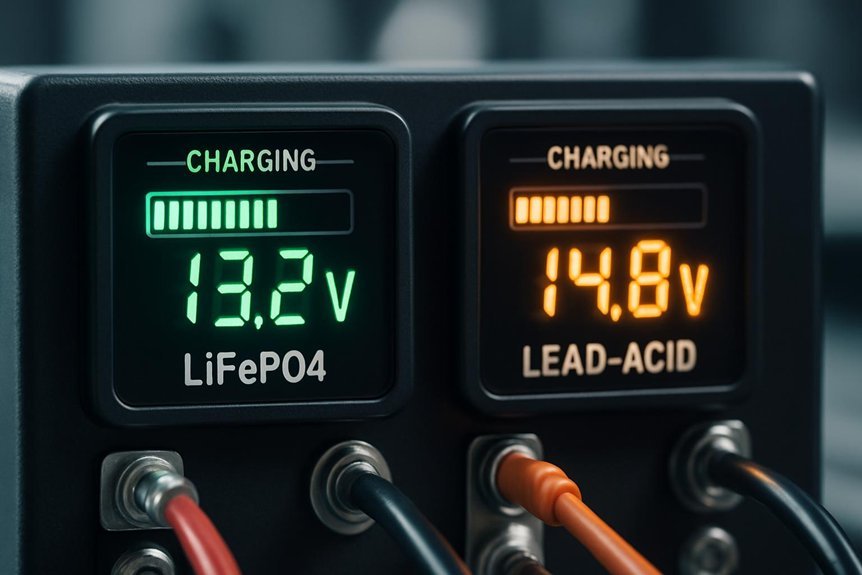
Charging voltages for LiFePO4 and lead-acid batteries diverge chiefly because of each chemistry’s voltage plateaus and electrolyte behavior. We, however, compare how charging voltages align with these realities, shaping practical charging profiles. LiFePO4 cells hold a stable plateau near 3.4–3.6V per cell, enabling precise CC/CV strategies that cap final voltage with strong lithium safety implications. Lead-acid, by contrast, uses a higher, more variable absorption plateau around 2.2–2.4V per cell, demanding careful control to avoid overcharge and sulfation. Electrolyte stability guides safety margins: LiFePO4’s stable electrolyte reduces gas evolution, while lead-acid systems risk gas buildup if voltage drifts. Ultimately, charger targets reflect chemistry: tight LiFePO4 regulation versus forgiving, but maintenance-heavy lead-acid care.
Current Profiles and Longevity: Why Charging Rate Matters
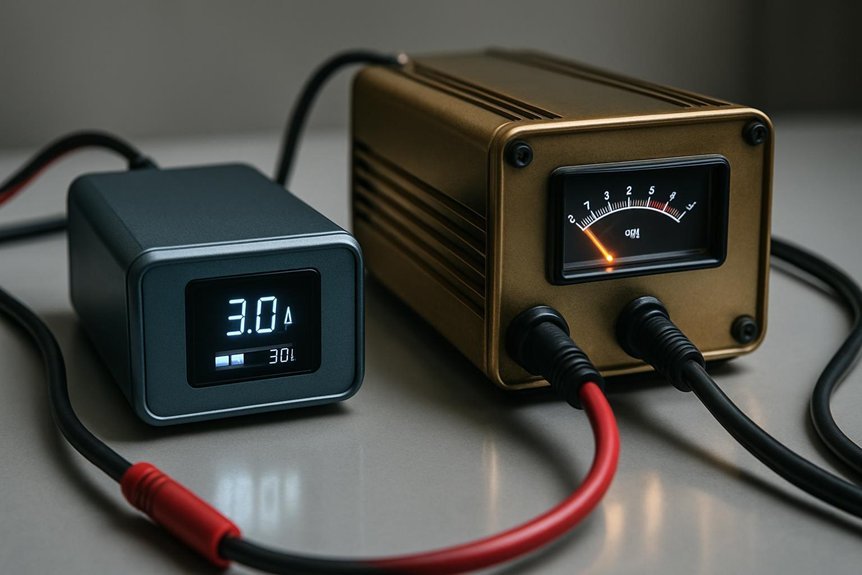
Current profiles matter because charging rate directly shapes cell thermals, capacity retention, and long-term safety for LiFePO4 and lead-acid packs. We compare lifepo4 fundamentals to lead-acid realities, showing how higher C-rates accelerate aging in both systems, but with distinct mechanisms. LiFePO4 tolerates higher currents better, yet thermal stress and surface degradation still limit longevity if pushed too hard. Lead-acid experiences calcium and grid corrosion more quickly under aggressive rates, reducing cycle life and capacity sooner. We emphasize gradual, controlled profiles that balance fast charging with thermal management and state-of-health monitoring. My take: accurate charging profiles minimize battery chemistry myths—overstated fast-charging promises often neglect real-world aging. A disciplined approach preserves capacity, safety, and reliability across chemistries.
Temperature Management in LiFePO4 Charging
Temperature management is the missing link between fast charging and long-lived LiFePO4 packs; after weighing current profiles, we see how heat shapes capacity retention and safety. We compare LiFePO4 with lead-acid, noting lower heat tolerance but tighter voltage boundaries. Temperature regulation becomes a design constraint, not an afterthought, because small thermal excursions can shift internal resistance, reduce effective capacity, and accelerate degradation. We rely on thermal sensors to monitor cell temperatures in real time, triggering corrective actions before limits are crossed. Active cooling or controlled charging ramps prevent hotspot formation and uneven aging. Our approach favors predictable performance over aggressive yet risky profiles, balancing charge speed with thermal margin. In practice, integrated sensing informs pacing, balancing efficiency, safety, and longevity.
How the BMS Influences Charging Safety and Behavior
We’ll start by separating safety roles from charging behavior and showing how a BMS actively enforces both. Compared with lead-acid systems, LiFePO4 BMSes limit cell imbalance, overvoltage, and temperature excursions, while also shaping the charge curve they allow. This creates a clear, rule-driven behavior that guides charging strategies and protects the pack, even as user demands vary.
BMS Safety Roles
So, what role does the BMS really play in charging safety and behavior, and how does that differ between LiFePO4 and lead-acid systems? We describe BMS safety roles as gatekeepers of battery chemistry, enforcing charging regulation, monitoring cell balance, and preventing abuse. In LiFePO4, the BMS prioritizes high-voltage cutoffs, current limits, and temperature safeguards to avoid microcracking and thermal runaway. Lead-acid systems rely on equalization control and voltage monitoring to prevent sulfation and overcharge. This difference shapes charging behavior: LiFePO4 tolerates more precise regulation and flat voltage curves, while lead-acid benefits from staged charging.
| Column A | Column B |
|---|---|
| battery chemistry | charging regulation |
| safeguarding | efficiency |
Charging Behavior Impact
BMSs shape charging behavior by enforcing chemistry-specific limits that prevent unsafe conditions, and this shaping differs between LiFePO4 and lead-acid systems. We, as readers, see how charging behavior shifts with cell chemistry: LiFePO4 tolerates higher C-rates briefly but clamps voltage and temperature tightly to protect safety protocols, keeping charging efficiency high without compromising longevity. Lead-acid, by contrast, emphasizes gradual current taper and strict voltage float control to avoid sulfation and overheating, trading speed for resilience. This means our charging profiles diverge early in the cycle and stay distinct through termination criteria. We monitor how the BMS modulates current, voltage, and balance events, ensuring safe transitions between stages. The result is clearer, chemistry-aware behavior that prioritizes safety protocols while optimizing charging efficiency.
Termination Voltages: Precision Matters for Safety and Life
Termination voltages aren’t just numbers on a spec sheet; they’re the guardrails that keep Lifepo4 packs safe and long-lived while avoiding wasted energy. We compare targets with lead-acid norms to reveal why precision matters for safety and life. Small deviations ripple into cycle degradation or safety faults, so we set tight margins and validate them through lifecycle testing and compatibility verification. The goal isn’t max voltage alone but correct cutoffs for charge, rest, and load conditions.
Termination voltages guard Lifepo4 packs with precision, balancing safety, life, and efficiency.
- Distinct charge and discharge thresholds across chemistries
- Validation of voltage accuracy under temperature swings
- Real-world cycle data guiding safe limits
- Cross-model compatibility checks for pack assemblies
Features That Really Matter in Chargers for These Chemistries
We’ll start by comparing how charging profiles align with each chemistry’s needs, since proper profile matching directly impacts efficiency and lifespan. Safety and longevity features aren’t optional extras; they’re foundational, shaping how cells tolerate missteps and thermal stress. Together, these factors distinguish Lifepo4 from lead-acid chargers and set the baseline for practical performance.
Charging Profile Matching
Have you ever wondered why some chargers quietly outperform others even when their labels look similar? We see it in charging profile matching: lifepo4 lifecycles demand precise voltage steps, current limits, and taper behavior that align with chemistry realities, not marketing. In contrast, lead acid myths often drive generic presets that misfit lifepo4 chemistry, slowing charging or shortening lifecycle. We compare how profiles mirror cell chemistry, balancing efficiency, temperature, and stage timing for optimal lifecycle performance.
- Matching CV/CC transitions to lifepo4 characteristics
- Temperature-compensated voltages and CARESful current taper
- Stage timing tuned to lifepo4 lifecycle realities
- Avoiding lead acid myths that degrade performance
These choices determine real-world outcomes, not labels alone, and reveal why profile matching matters more than any single spec.
Safety and Longevity Features
Are safety and longevity features the true make-or-break factors when choosing a LiFePO4 charger? We think so, and we tailor our advice accordingly. Lifepo4 safety matters beyond basic protection; it includes input filtering, thermal monitoring, and fault-tolerant charging paths that prevent runaway and overheating. We compare how longevity features—adaptive termination, pulse balancing, and low-drift voltage references—extend pack life and reduce capacity fade versus lead-acid expectations. Battery charging independence emerges when a charger maintains correct chemistry-specific voltages without user intervention, even under variable loads. Chemistry compatibility drives whether a charger supports LiFePO4’s flat voltage curve and requires minimal top-off. In short, precision control, robust safety nets, and thoughtful longevity features define reliable, maintenance-light charging and safer, longer-lasting packs.
Troubleshooting Charging Issues by Battery Chemistry
How do charging issues vary by battery chemistry, and what practical steps can we take to diagnose them? We approach troubleshooting with chemistry-aware logic, comparing lifepo4 and lead-acid behavior to reveal root causes. We focus on lithium lifecycle patterns and charging efficiency to pinpoint deviations from expected performance. Differences in voltage profiles, termination criteria, and temperature sensitivity guide our tests, charging currents, and safety checks. We share actionable steps so you can confirm a healthy system or isolate faults before component replacement.
- Verify charger profiles match chemistry and temperature conditions
- Measure voltage, current, and temperature during each phase
- Check for sulfation indicators vs. lithium-specific aging
- Assess cycle count and capacity retention to forecast endurance
Frequently Asked Questions
Can Lifepo4 Chargers Accept Standard Lead-Acid Charging Profiles?
Yes, we can’t: lifepo4 chargers typically won’t accept standard lead-acid profiles, resolving lead acid misconceptions and charging myths; our systems require LiFePO4-specific regulation, termination, and safety checks for reliable cycling and battery longevity.
Do Lifepo4 Cells Tolerate High Ripple in Chargers?
To be frank, yes, lifepo4 cells tolerate some ripple, but high ripple boosts heating and stress; we’d rather minimize it. This unrelated topic isn’t a random question, yet comparisons show lifepo4 handle gentler profiles better.
How Does Charger Size Affect Lifepo4 Cycling Efficiency?
Size impact matters: larger chargers improve efficiency by reducing ripple and heat, but incur diminishing returns. We balance size against efficiency tradeoffs, noting that optimized, moderate surge-capable packs often yield the best cycling performance for LiFePO4.
Are Usb-Powered Chargers Safe for Lifepo4 Packs?
We say yes—USB-powered chargers can be safe for LiFePO4 packs when they’re properly controlled for current, voltage, and protection; USB safety is about built‑in regulation, while ripple tolerance prevents noise from harming chemistry in our packs.
Do Balanced Charging Requirements Differ for Lifepo4 Batteries?
We do: balanced charging for LiFePO4 requires careful CCCV with narrow safety margins, unlike some lead-acid schemes. It’s tighter, more precise, and we emphasize safety margins to prevent overcharge while preserving pack longevity and reliability.
Conclusion
We’ve traced how LiFePO4 and lead-acid chargers diverge in voltage plateaus, current ramps, and safety nets, with the BMS steering each chemistry’s behavior. In short, LiFePO4 demands tight CC/CV control and precise termination, while lead-acid tolerates larger voltage swings and longer maintenance. Think of it as tuning two instruments to the same orchestra. The result is safer, longer life for LiFePO4, and dependable, lower-maintenance performance for lead-acid. Proceed with chemistry-aware charger choices.