We’re examining industrial and commercial LiFePO4 charging systems to understand how they orchestrate precise voltage, current, and temperature control across large fleets. Our focus is on BMS integration, fault handling, and thermal management that prevent degradation and extend life, all while ensuring safety and compliance. The landscape is complex and tightly regulated, with modular architectures and data-driven maintenance. There’s more to uncover about reliability, scalability, and end-of-life optimization—and that path demands careful scrutiny.
Key Takeaways
- Real-time control of voltage, current, and temperature optimizes safety, life cycle, and charging efficiency in industrial LiFePO4 systems.
- BMS integration with chargers enables cell balancing, fault handling, and safeguards across scalable, high-throughput operations.
- Thermal management design, including cooling strategies and remote monitoring, mitigates hot spots and supports reliable performance.
- Compliance, documentation, and auditing ensure safety, interoperability, and traceability throughout installation and operation.
- Maintenance, scalability, and defined cadences with modular architectures enable predictable expansion and reduced downtime.
LiFePO4 Charging in Industry: How It Works and Why It Matters
LiFePO4 charging in industry hinges on precise control of voltage, current, and temperature to optimize safety, life cycle, and efficiency. We examine how industrial charging systems orchestrate power delivery, monitoring, and protection to sustain high-throughput operations. Our focus is on consistent, repeatable processes that minimize degradation and surprise faults. We implement rigorous charging profiles, calibrated to cell chemistry, pack configuration, and duty cycle, ensuring each cycle remains within safe limits. Real-time sensing of voltage, current, and thermal metrics drives adaptive control, reducing thermal runaway risk and extending battery life. We emphasize battery safety through layered protections, fault isolation, and fail-safe shutdowns, while validating performance with traceable diagnostics. In short, disciplined coordination across hardware, software, and procedures underpins reliable industrial charging efficiency.
LiFePO4 Fundamentals: Charging Profiles and BMS Basics
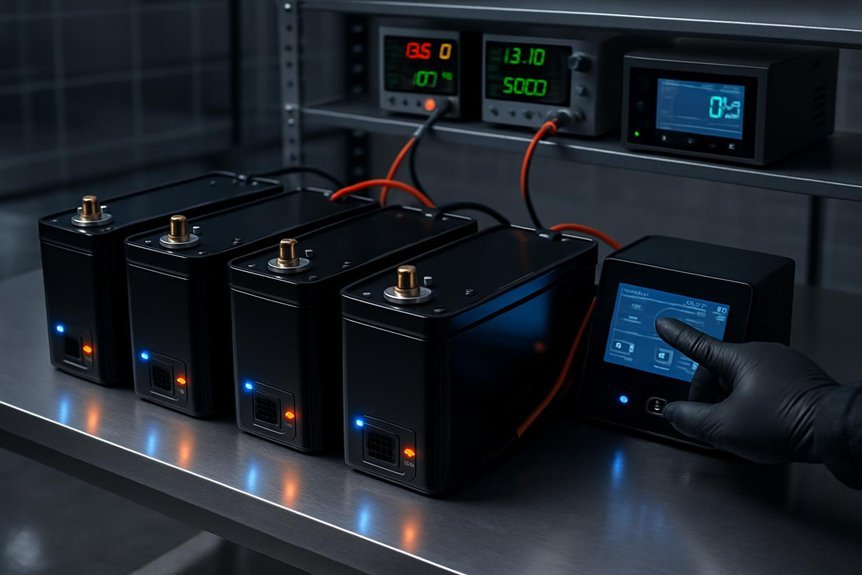
How do charging profiles and BMS basics shape LiFePO4 performance? We approach this by linking fundamental battery chemistry to practical control strategies. Charging profiles define voltage ceilings, current taper, and termination criteria that preserve cell balance, minimize degradation, and maximize cycle life. BMS basics translate those profiles into real-time safeguards: cell voltage, temperature, state of charge estimates, and cross-cell balancing actions. Together, they determine achievable energy throughput, efficiency, and safety margins in industrial contexts. We emphasize charger architecture: power stages, control loops, and communication to the BMS. Proper integration ensures accurate current sharing, temperature management, and fault handling. Precise profiling reduces creep, improves wide-temperature operation, and supports predictable end-of-life behavior for LiFePO4 packs.
Why LiFePO4 Benefits Fleets and Facilities
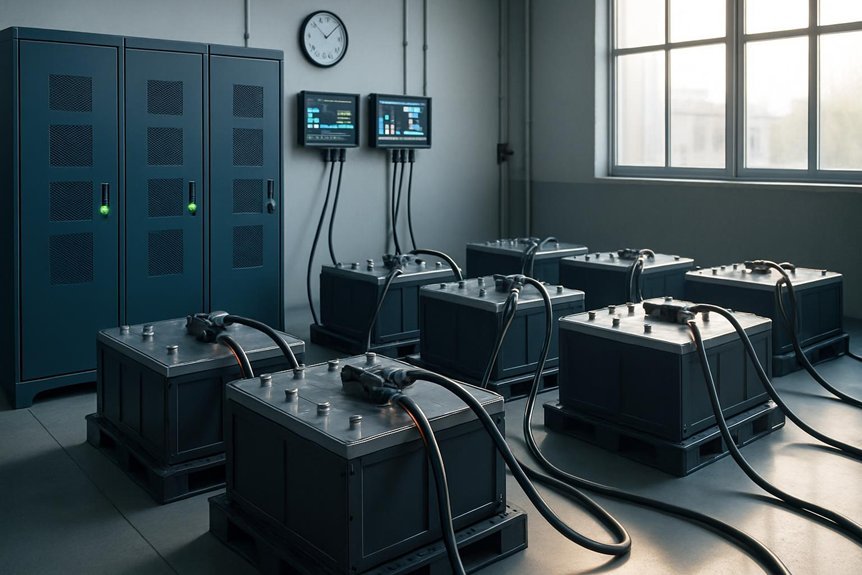
What makes LiFePO4 a practical choice for fleets and facilities is its durability and total cost of ownership. We frame the benefits through measurable performance metrics—cycle life, payload impact, and maintenance frequency—so readers can assess true value over time. In our view, reliability translates to fewer shutdowns, steadier scheduling, and lower risk exposure for operations teams. Compared with alternatives, LiFePO4 delivers predictable degradation curves and stable energy throughput, enabling tighter fleet utilization and facility charging windows. Our analysis excludes irrelevant topic anecdotes and avoids unneeded discussion; instead, it centers on data-driven tradeoffs, cost modeling, and lifecycle considerations. By aligning chemistry with operational demands, fleets gain resilience, cost containment, and smoother capital planning for charging infrastructure investments.
Thermal Management Essentials for Industrial LiFePO4 Packs
Thermal management is a critical design element for industrial LiFePO4 packs, directly impacting safety, performance, and total cost of ownership. We examine how heat flows from cells to the cooling system, quantify thermal ripples, and align cooling strategy with pack architecture. Our focus is on predictable temperature profiles, minimized hotspots, and reliable long‑term operation under variable load. We rely on measured heat generation, thermal resistances, and validated models to select appropriate cooling strategies, including conduction paths and controlled air or liquid loops. Effective designs leverage cooling coils where rapid dissipation is required, and thermal buffers to dampen excursions. Meticulous integration with charging controls ensures balanced temperatures during cycling.
- Predictable profiles reduce risk and extend life.
- Targeted cooling coils enable rapid response to peaks.
- Rigorous testing validates stability under diverse duty cycles.
Safety Essentials for Commercial LiFePO4 Installations
Ensuring safety in commercial LiFePO4 installations demands a rigorous, systems-level approach that integrates cell chemistry awareness, enclosure design, and robust fault management. We examine electrical separation, proper cable sizing, and fault annunciation to prevent cascades. Our checks emphasize compatible chargers, balanced string configurations, and correct BMS interfaces, avoiding mismatches that could provoke thermal runaway or undercharge risk. We insist on certified enclosures with ample ventilation, flame-resistant materials, and clearly labeled ingress protection. Ground fault and short-circuit protection are nonnegotiable, with regular integrity testing and access control to prevent tampering. Documentation remains vital: material safety data, maintenance logs, and change-control records. While we address unrelated topic considerations and variegated concerns, our focus stays disciplined, measurable, and auditable to uphold safety, reliability, and regulatory compliance.
Lifecycle Economics for LiFePO4: Calculating TCO in Industrial Use
Lifecycle economics for LiFePO4 is a calculable discipline: we must quantify total cost of ownership (TCO) across the system life, from procurement and installation to operation, maintenance, and end-of-life disposal. We model TCO with clear drivers: capital expenditure, operating costs, and end-of-life recoveries, plus risk-adjusted depreciation. We also account for secondary effects like unused battery recycling implications and rare earth sourcing constraints that influence sourcing strategy and logistics.
1) Weigh upfront capital against long-term reliability, predicting downtime costs and replacement cycles.
2) Quantify maintenance, efficiency losses, and charging-cycle impacts to inform optimization choices.
3) Assess disposal, recycling incentives, and material reuse to capture true lifecycle value and sustainability benefits.
Design Industrial LiFePO4 System Architecture: Fans, HVAC, and Remote Monitoring
How do we architect an industrial LiFePO4 system to manage heat, air, and visibility effectively? We design a cohesive architecture that coordinates fans, HVAC, and remote monitoring for predictable thermal performance and operational insight. Our approach assigns dedicated airflow paths to battery banks, inverters, and charging enclosures, minimizing hot spots and thermal lag. We specify controllable fans with PWM curves tied to cell temperatures and ambient conditions, coupled with HVAC zoning to maintain stable cabinet and room temperatures. Remote monitoring aggregates sensor data, alarms, and environmental metrics, enabling proactive maintenance and rapid fault isolation. We treat two word discussion ideas as evaluative anchors: paint finishes, noise reduction. This framework emphasizes reliability, observability, and auditable performance across industrial deployments.
How to Decide: Off-Grid, Grid-Tied, or Hybrid LiFePO4 Setups
Which mode best fits our operation: off-grid, grid-tied, or hybrid LiFePO4 setups? We present a decision framework grounded in data, reliability, and cost. We assess demand profiles, local energy costs, and resilience requirements to determine the optimal configuration. We balance system complexity against return on investment, ensuring lifecycle performance aligns with usage patterns. Consider battery depth of discharge, inverter efficiency, and charging controls to minimize losses. The goal is a stable, predictable energy supply with predictable revenue or cost avoidance. Our method emphasizes rigorous comparisons rather than assumptions, enabling transparent selection.
- Evaluate energy reliability needs to choose between off grid and grid tied solutions.
- Quantify capital, operating, and maintenance costs for each topology.
- Validate resilience and return on investment under realistic load scenarios.
Compliance and Safety Standards for Industrial LiFePO4 Installations
Industrial LiFePO4 installations must meet rigorous compliance and safety standards to protect personnel, equipment, and operations. We approach this topic with disciplined scrutiny, aligning our practices to recognized frameworks and risk assessments. Compliance testing emerges as a core activity, validating electrical clearances, insulation integrity, battery management system interoperability, and charging profile verification under load conditions. We map procedures to safety regulations that govern installation, commissioning, and ongoing operation, including labeling, access controls, and emergency shutdown methods. Our stance emphasizes documentation, traceability, and periodic re-evaluation to address evolving standards and component replacements. We also integrate third-party audits and internal quality gates to ensure objective verification. Ultimately, rigorous adherence minimizes incidents, extends lifecycle, and supports dependable industrial performance.
Maintenance, Troubleshooting, and Scalability Paths for LiFePO4 Systems
Maintenance, troubleshooting, and scalability for LiFePO4 systems require a structured, data-driven approach. We address reliability by defining repeatable processes, recording metrics, and validating results against spec sheets. Our focus centers on maintenance checks and systematic troubleshooting steps that isolate root causes efficiently, minimizing downtime and risk. We emphasize diagnostic rigor, sensor calibration, and thermal management as core levers for performance and safety. Scalability paths rely on modular architectures, prognostic health indicators, and standardized interfaces that preserve integrity during expansion. Readers gain a clear framework for decision-making, cost control, and continued compliance.
1) Establish baseline performance and logging cadence to detect drift early.
2) Apply standardized troubleshooting steps with checklists before component replacement.
3) Plan staged scalability by validating modular subsystems under simulated load.
Frequently Asked Questions
How to Size Chargers for Peak Industrial Load?
We size chargers by analyzing peak load dynamics and duty cycles, then apply safety margins. We’ll model demand during highest coincident usage, factor in efficiency, derating, and charging profiles, and choose scalable units to cover future load growth.
What Are Best Practices for Battery Installation Clearances?
Clearance counts, careful calibration—clearance spacing ensures installation safety. We insist on precise, practical practices, reader, so we guide you: maintain vented, unobstructed gaps, secure mounts, and verify clearances before commissioning, optimizing safety and reliable operation for every installation.
How to Integrate Lifepo4 With Existing UPS?
We can integrate LiFePO4 with our UPS, but we must navigate integration challenges and safety considerations first, aligning voltage, chemistry, and firmware. We’ll implement rigorous protection, proper cabling, and monitoring to ensure reliable, safe operation.
What Are Common Causes of Capacity Fade in Fleets?
We see capacity fade as a primary driver of fleet aging, driven by high C-rate cycles, temperature fluctuations, sulfation, unequal cell aging, and insufficient balancing. We optimize management strategies to mitigate capacity fade and slow fleet aging.
How to Verify Charger Efficiency Under Load Conditions?
We can verify load efficiency by applying precise load profiles and measuring input versus output power; we systematically document results to verify load efficiency and perform charger benchmarking across conditions, ensuring repeatable, rigorous comparisons for fleet charging systems.
Conclusion
We’ve laid out the framework, from charging profiles to BMS integration, and from thermal management to compliance. What matters now is quiet discipline: precise monitoring, rigorous maintenance, and disciplined data governance. When you align protection with performance, risks recede and reliability rises, almost invisibly guiding cost and uptime. In short, the system’s resilience is a mirror of your processes—steady, measured, enduring, and quietly capable of delivering value beyond obvious metrics.