We ask whether adaptive, smart charging truly outperforms fixed, standard profiles for LiFePO4 packs. We evaluate how CC, CV, impedance, and temperature feedback shape efficiency, safety, and longevity, and what trade-offs emerge with BMS compatibility and cost. If our goals include reduced heat, tighter top-off tolerance, and safer termination, we must weigh the practical limits of standard chargers against the sophistication of smart controls. That tension invites deeper examination.
Key Takeaways
- Smart LiFePO4 chargers adapt CC/CV timing, voltage, and temperature data to optimize charging, safety, and longevity; standard chargers follow fixed profiles.
- Smart charging throttles current based on pack impedance and temperature trends; standard charging uses a rigid CC until a preset CV is reached.
- Temperature monitoring in smart chargers informs dynamic termination and balancing; standard chargers may not respond to real-time thermal data.
- Smart systems improve cell balancing, reduce heat, and extend lifecycle; standard chargers risk under/overcharging and greater degradation.
- Compatibility and BMS alignment are crucial for smart chargers to work effectively, while standard chargers require simpler, well-matched packs and predictable profiles.
How Lifepo4 Chargers Work: Smart vs Standard
Smart Lifepo4 chargers use adaptive control to regulate charging stages, while standard chargers apply fixed voltage and current limits. We examine how each approach influences cell behavior, safety, and overall system performance. In smart systems, we track voltage, current, temperature, and state of charge, adjusting stages to optimize balancing and charge time. This dynamic regulation reduces overpotential, minimizes heat, and improves charging efficiency without stressing cells. Standard chargers, with rigid profiles, risk undercharging or overloading packs when conditions shift, leading to longer fill times and potential degradation. We also consider how firmware decisions impact warranty implications, since manufacturers often tie coverage to proper usage of intelligent charging. In our assessment, smart control offers measurable precision benefits, with clearer performance predictability and risk management for Lifepo4 packs.
What Changes Between Smart and Standard Charging
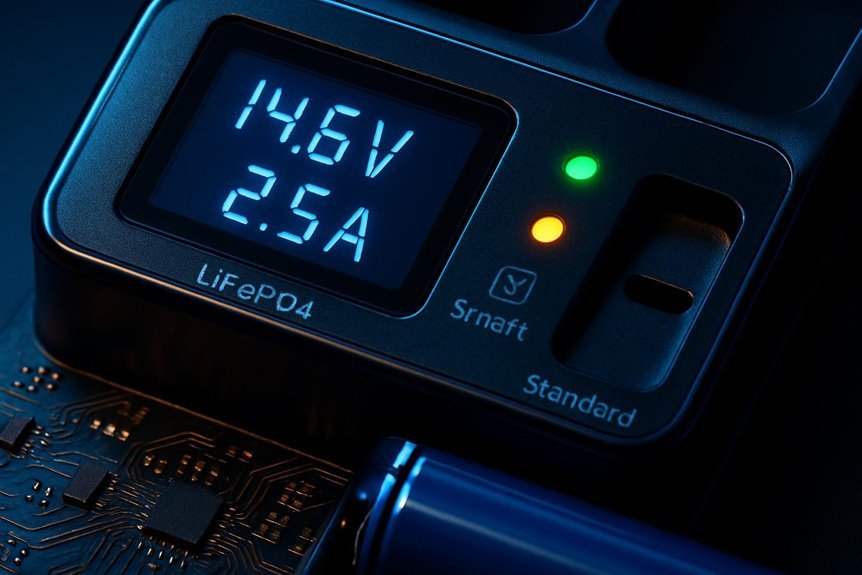
What changes between smart and standard charging hinge on how the charger interprets and responds to real-time pack conditions. We, as designers and users, compare the logic pathways that govern current, voltage, and termination criteria. Smart chargers actively monitor cell balance, impedance shifts, and temperature trends to adjust charging stages, cutoffs, and safety thresholds. Standard chargers follow fixed profiles, delivering pre-set current until a voltage target is met, with less regard for instantaneous health indicators. The result is a divergence in efficiency, cycle life estimates, and fault handling. In practice, smart charging enables a quick decision when anomalies appear, and supports routine planning by maintaining consistent health telemetry. The contrast highlights the value of adaptive control over rigid, one-size-fits-all approaches.
Core LiFePO4 Charging: CC, CV, and Temperature Roles
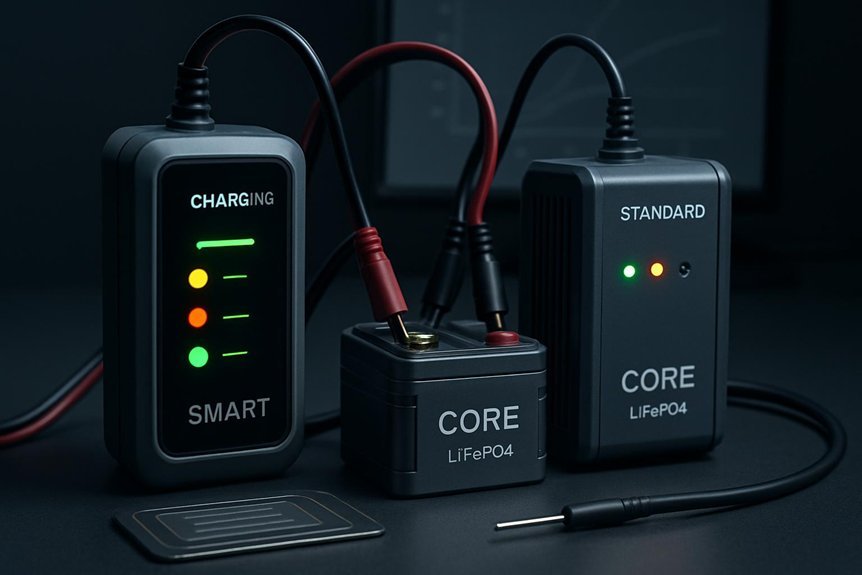
We examine how CC and CV shaping governs LiFePO4 charging, with constant-current prep feeding into a controlled constant-voltage finish to reach full capacity. Temperature constraints determine safe current limits and exit thresholds, shaping both efficiency and longevity. Together, these factors define practical charging limits and guide our analysis of smart versus standard charging behavior.
CC and CV Roles
The CC and CV phases define how LiFePO4 cells are driven as they approach full charge: constant-current charging ramps up amperage until the cell voltage reaches the designated CV threshold, then the current tapers off to zero as the cell nears 100% state of charge. In practice, CC establishes rapid energy transfer, while CV ensures voltage accuracy and cell balance. We monitor timing and voltage profiles to minimize overshoot and heat, preserving cycle life. This interplay dictates charging efficiency and recovery time, with smarter controls adapting to pack impedance. From a cost-comparison perspective, sophisticated CC/CV logic can reduce wasted energy and shorten charging windows, influencing total ownership cost. Brand warranties may hinge on precise termination criteria, reinforcing the value of robust CV regulation.
Temperature and Charging Limits
Temperature imposes practical limits on LiFePO4 charging because cell resistance and chemistry respond to heat and cold more than other chemistries. We examine how CC and CV interact with temperature, noting that higher ambient temps accelerate resistance rise and safer endpoints, while low temperatures hinder lithium diffusion and practical charging rates. As current is held constant, heat dissipation becomes a governing factor for pack health, rate capability, and cycle life. We observe that temperature setpoints influence charging windows and require intelligent control logic to avoid runaway or undercharge. Smart pricing of charging sessions can reflect thermal state, while thermal models guide charging current limits. Efficient heat dissipation enables higher charge rates and reliable CC/CV transitions across operating conditions.
Why Temperature Monitoring Protects Lifepo4 Cells
Why does monitoring temperature protect LiFePO4 cells? We approach it by linking thermal data to electrochemical safety and longevity. Temperature deviations signal internal resistance changes, electrolyte behavior shifts, and potential degradation pathways. In charging, heat accumulation accelerates SEI aging and reduces usable capacity; in discharging, overheating can prompt plating risks when voltage limits are exceeded. Temperature sensing enables dynamic current throttling, voltage clamping, and termination criteria, preserving cell integrity and pack balance. We examine how a smart charger interprets thermistor readings, applies two word discussion ideas: alternative charging, temperature myths, and translates data into actionable control. By contrast, a standard charger may neglect real-time feedback, letting heat excursions run unchecked. Our analysis underscores precise thresholds, response times, and logging as essential guardrails.
Balancing and Safe Termination: What Happens in Each Phase
During charging, balancing activates when cell voltages diverge beyond a set threshold, and safe termination enforces a final current or voltage limit to prevent overshoot; during discharging, balancing may pause to preserve pack safety, while termination halts discharge at preset cutoff. We examine balancing and termination phases with a precise lens, avoiding nontechnical jargon while preserving clarity for readers practicing charging etiquette. In both modes, balancing equalizes cell states to minimize voltage disparity and heat, then stops once harmony is achieved. Safe termination protects the pack from overcurrent or overvoltage, preventing stress and degradation. Our viewpoint remains analytical, focusing on how logic, timing, and safeguards interact to maintain reliability and lifecycle integrity.
Balancing aligns cell voltages; termination prevents overshoot and protects lifecycle integrity.
- Balanced cells visualize even pressure across the pack, reducing hot spots
- Termination signals act as a gatekeeper, preventing overshoot and damage
- Clear etiquette and checks ensure consistent performance without surprises
When to Use a Smart Charger: Real-World Scenarios
We’ll outline real-world charging scenarios where a smart charger adds measurable value, from variable input conditions to battery health impact. We’ll quantify benefits such as reduced charge time variance, improved top-off accuracy, and better longevity predictions tied to profile adaption. By comparing these outcomes with standard charging, we’ll clarify when the smarter approach yields meaningful, data-supported advantages.
Real-World Charging Scenarios
Real-world charging scenarios hinge on matching charger behavior to the battery’s chemistry, cycle life, and your usage patterns. We assess how smart features respond to LiFePO4 realities, not abstractions, to prevent stress, sulfation risk, or reduced capacity. By aligning charging profiles with battery chemistry, we minimize cycling losses and avoid charging myths that overstate benefits. In practice, high-frequency top-offs, long idle periods, and varying ambient temperatures demand adaptive current and voltage control to protect longevity. We prefer data-driven decisions over generic claims, ensuring the charger knows when to taper, hold, or resume. This precision reduces heat buildup and improves consistency across seasons, loads, and schedules.
- A charger modulates current as the cell temp shifts, like a thermostat guiding a battery’s health.
- We observe real-time impedance and voltage trends to avoid premature termination or overstress.
- Battery chemistry dictates safe targets and recovery behaviors under diverse cycle regimes.
Smart Charger Benefits Realized
Are smart chargers genuinely worth it in real-world LiFePO4 use cases, or do they merely add cost and complexity? We evaluate benefits through concrete scenarios, emphasizing measurable outcomes. In practice, smart control improves cell balance during high-rate or irregular-usage cycles, reducing capacity fade and extending pack life. They optimize charging taps to protect voltage windows, which directly supports safety benchmarks during fast recharge or multi-cell configurations. We also consider charger economics: initial unit cost vs. long-term savings from fewer replacement cycles and lower maintenance. Real-world data shows improved lifecycle predictability and fault detection, enabling proactive interventions. However, gains depend on battery management system compatibility and user behavior. For fleets and off-grid systems, the benefits become most pronounced when monitoring and automation align with operational demands.
When a Standard Charger Is Enough: Practical Cases
When is a standard charger sufficient for LiFePO4 cells, and what practical scenarios justify sticking with a basic unit? We analyze cases where cost, simplicity, and reliability trump feature depth. For small hobby packs, mild charging controls, and environments with minimal risk, a basic charger meets needs without complexity. In fleet scenarios with standard, well-matched packs and stable power, high-end balancing isn’t always required. We treat charging as a controlled, repeatable process, not an opportunity for impulse upgrades. Irrelevant topic ideas should be ignored; an off topic idea would distract from core safety and accuracy. Practical indicators include known pack chemistry, consistent voltage caps, and routine maintenance. If these hold, a standard unit remains appropriate and economical.
A basic charger suffices for simple LiFePO4 packs and stable, low-risk charging contexts.
- Simple, compact packs with predictable profiles
- Stable, known voltage limits in controlled settings
- Routine, low-risk charging workflows
Compatibility You Must Check: Battery Types, Packs, and BMS
We must verify battery types, packs, and BMS compatibility before choosing a charger. We’ll analyze type families, pack configurations, and how BMS signaling and voltage limits interact with charging profiles. This ensures safe, efficient charging and prevents misfit issues across smart and standard chargers.
Battery Types Compatibility
Battery types, packs, and BMS must be checked for compatibility before charging any LiFePO4 pack. We analyze how differing chemistries, voltages, and BMS gate constraints affect performance. Mismatches degrade efficiency and can accelerate battery degradation through improper cell balancing or over/under charging. We emphasize that charger voltage windows, cell counts, and BMS communication protocols must align with the pack to prevent unsafe conditions. Our focus is on identifying compatibility gaps early to preserve longevity and safety. We also consider how pack design influences charging efficiency, especially under varying load profiles. Thorough pre-checks reduce parasitic losses and voltage drift, enabling the charger to operate within optimal tolerance bands.
- Visualize mismatched voltage as a bottleneck that limits current delivery
- Imagine a mismatched BMS as a misread safety gate
- Picture degradation creeping from subtle, uncontrolled balancing errors
Packs and Configurations
Packs and configurations define the practical limits of any LiFePO4 charging setup, so we start by mapping battery types, cell counts, and BMS architectures to the charger’s capabilities. We emphasize pack voltage, capacity, and series/parallel ratios, ensuring the charger’s voltage range and current limits align with max cell count and BMS constraints. Compatibility checks cover chemistries, C-ratings, balancing strategies, and isolation needs, all of which influence charging efficiency. We assess charger porting, connector standards, and fuse protection to prevent mismatches. From a user workflow perspective, we document stepwise setup, state-of-charge tracking, and fault reporting to minimize configuration errors. Precision in sequencing, timing, and safety interlocks reduces risk and improves repeatability, delivering predictable performance across standard and high-demand configurations.
BMS Integration Considerations
Are you sure your charger can harmonize with the BMS and pack topology you’re using, down to the cell chemistry and balancing strategy? We assess BMS integration by verifying chemistry compatibility, pack configuration, and balancing method, then map charging profiles to BMS logic. We focus on real-world constraints like charging latency and communication latency, ensuring the charger’s timing aligns with the BMS’s cell monitoring loop. We also evaluate solar compatibility, ensuring panels and MPPT interfaces deliver stable, expected current within BMS thresholds. This prevents control conflicts, overcurrent events, or misbalanced packs, preserving longevity and safety. Key checks include protocol support, voltage window adherence, and fault signaling alignment.
- Chemistry- and topology-aware interface mapping
- Latency- and timing-aware charge curves
- Solar-compatible, BMS-synced signaling
Costs, Safety, and Long-Term Savings
So, how do cost, safety, and long-term savings compare between smart and standard LiFePO4 chargers, and what does that mean for total ownership? We approach this with a rigorous cost comparison, examining upfront hardware, installation, and lifelong energy efficiency. Smart chargers incur higher initial costs due to embedded electronics and communication modules, but they reduce operational waste by optimizing charging cycles, extending battery life, and lowering cycle degradation. Safety protocols are more robust in smart models, enabling precise current, voltage, and temperature management, plus remote monitoring and fault alarms. Long-term savings arise from improved longevity, reduced maintenance, and potential warranty benefits tied to monitored usage. Overall, smarter systems can lower total ownership despite higher entry costs, particularly in demanding or remote installations.
Quick Decision Framework: Which Charger Fits Your Routine
Choosing the right charger depends on how you use your LiFePO4 system, your tolerance for upfront cost, and how you value reliability and monitoring. We present a concise decision framework that aligns routine needs with technical capabilities. Smart chargers emphasize real-time data, adaptive termination, and load-aware pacing; standard chargers prioritize simplicity, robustness, and cost efficiency. Our framework balances demand for precision against operational convenience, guiding you to the appropriate feature set without overengineering. Consider cycle frequency, criticality of uptime, and your monitoring habits. Key factors: state-of-charge accuracy, temperature compensation, and fault reporting. Ask: does your routine tolerate potential misalignment between charging profiles and usage spikes? If yes, a smart charger is warranted; if not, a standard unit may suffice.
- Visualize routine drift: steady, predictable, and constrained
- Picture telemetry cues: alerts, thresholds, and automatic adjustments
- Imagine performance clarity: minimal ambiguity, decisive outcomes
unrelated topic, irrelevant focus
Frequently Asked Questions
Can a Standard Charger Ever Be Safer Than a Smart Charger?
Yes, a standard charger can be safer in specific, controlled scenarios. We analyze safely with conservative currents, but smart charging optimizes safety, monitors cell health, and enables cost savings through precision if properly configured for LiFePO4 packs.
Do Lifepo4 Cells Self-Discharge Differently With Smart Charging?
Smart charging affects LiFePO4 cells by actively managing voltage and temperature, reducing self discharge compared to passive methods; we, however, note that chemistry still dictates baseline self-discharge rates, so proactive monitoring remains essential for both charging approaches.
How Do Smart Chargers Handle Cell Imbalances Over Time?
Smart charging mitigates imbalance by constant current/constant voltage routines, active balancing when needed, and real-time cell monitoring; imbalance management relies on targeted equalization cycles, temperature-aware adjustments, and state-of-health tracking to preserve pack longevity.
Can You Retrofit a Standard Charger to Become Smart?
We can’t fully retrofit a standard charger to smart; retrofit limitations exist and safety tradeoffs arise. We analyze practical options, acknowledge constraints, and propose safer, feasible paths while outlining measurable risks and continued performance implications.
Do Smart Chargers Always Save Money Long-Term?
Smart chargers don’t always save money; it depends on usage. We analyze efficiency, cycle optimization, and demand charges. When smart charging aligns with off-peak windows and battery degradation is minimized, cost savings accrue over time.
Conclusion
We conclude, carefully, choosing chargers with clarity and caution. Smart systems safeguard with sophisticated sensing, seasonal scheduling, and steady-state stability, while standard styles stay simpler, cheaper, and swifter—sometimes sufficient. Still, smart sensing spots subtle shifts, balancing battery health, temperature, and impedance in real time. So, select suited systems, scrutinize specs, and synchronize with your BMS, pack, and usage. Smart stewardship stabilizes longevity; standard speed may surprise, so plan prudently, prioritize protection, and prefer precise, proactive performance.