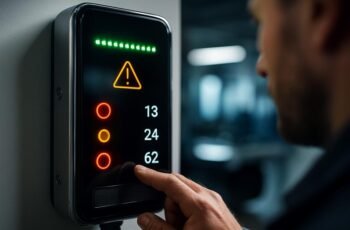
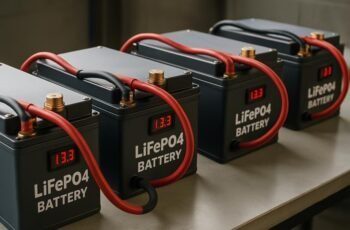
We approach safe parallel charging of multiple LiFePO4 banks with a system-level, standards-driven mindset, ensuring synchronized, current-shared charging from a single source while preserving identical chemistries and aging profiles. We’ll map topology to avoid parasitic loops, implement fault isolation, and deploy calibrated thermal monitoring with distributed sensors. Real-time telemetry and balanced management guide equalized voltages and SOC progress, with clear fault flags. There’s more to align before we begin the session, and that alignment matters for scalability.
Key Takeaways
- Ensure identical chemistry, matched capacity, and synchronized charging profiles across banks to enable safe parallel charging.
- Verify voltage matching, healthy cell balance, and appropriate charger capabilities before connecting banks in parallel.
- Use controlled wiring with equal impedance paths, protective fuses, and robust isolation to prevent hotspots and currents loops.
- Implement real-time monitoring of voltages, currents, and temperatures with fault flags and rapid isolation on anomalies.
- Document step-by-step setup, verification tests, and post-cycle voltage equality to confirm safe, predictable convergence.
What Parallel Charging Means for LiFePO4 Banks
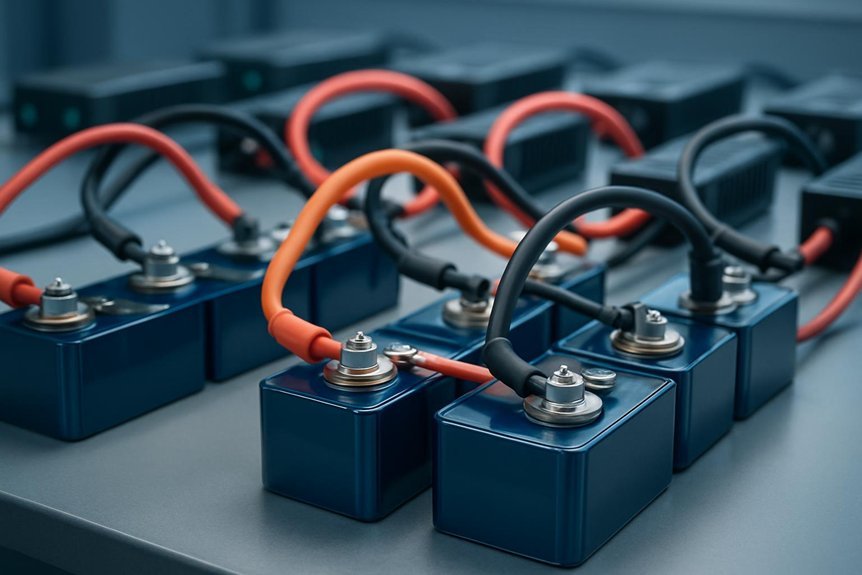
Parallel charging for LiFePO4 banks means powering multiple cells or strings from a single source at the same time, while keeping each path balanced and within safe limits. We define parallel charging as the coordinated operation of interconnected cells so that voltage, current, and temperature stay aligned across all branches. Our focus is on achieving uniform state progression, minimizing imbalances, and preserving pack longevity. We assess source impedance, balance circuits, and cell matching to ensure predictable charging behavior. Safety considerations drive our design choices, including fault isolation, overcurrent protection, and thermal monitoring. We establish clear operating envelopes, monitor real-time metrics, and verify that each branch meets prescribed limits before safe completion. This approach supports reliable, repeatable charging outcomes for LiFePO4 bank configurations.
When Parallel Charging Is Appropriate for Your LiFePO4 System
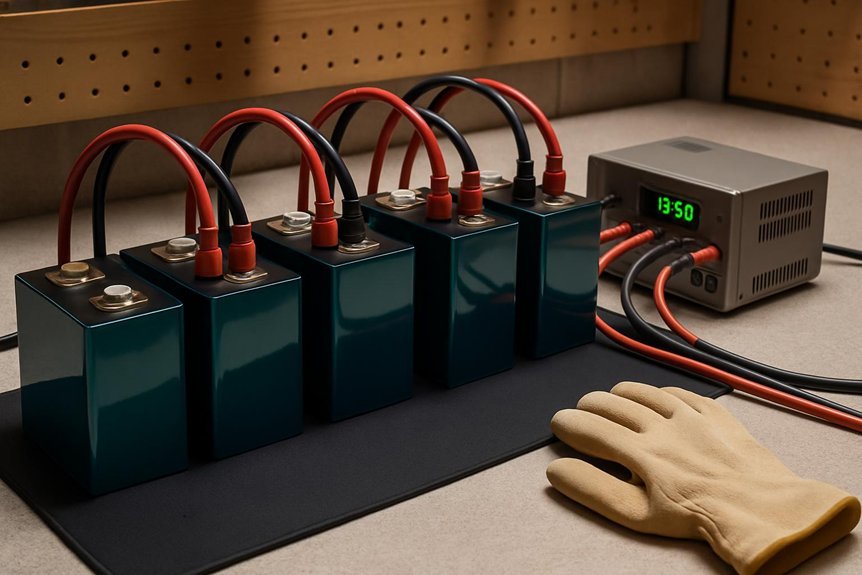
We determine when parallel charging is appropriate by evaluating safety and system balance constraints across the entire LiFePO4 bank. We will outline clear criteria for safe parallel charging, including voltage matching, cell balance status, and charger capabilities, to ensure a controlled, system-level process. If these conditions are not met, we avoid parallel charging and pursue isolated charging or sequence-based methods.
When Is Parallel Charging Safe
Is parallel charging safe when the battery banks share identical chemistry, voltage, and state of charge, and are wired in a way that maintains balanced cell groups? Yes, when strict controls are in place we can proceed with parallel connections. We assess compatibility: identical LiFePO4 chemistry, matched capacity, and consistent aging profiles. We verify wiring topology supports current sharing without introducing parasitic loops or voltage gradients that pry apart balance. We implement standardized isolation, fusing, and monitoring to detect deviations quickly. We document charging profiles, using equalization only within safe limits and per manufacturer guidance. We emphasize parallel safety through state-aware sequencing, monitored currents, and thermal oversight. This approach supports aging mitigation by minimizing mismatches that accelerate degradation, ensuring predictable performance and safe operation across the banked system.
System BALANCE Considerations
When considering system balance, we guarantee that parallel charging preserves equalized cell voltages and uniform current sharing without introducing imbalance-prone pathways. Our approach aligns with standards-driven practice, enabling predictable bank balancing across all cells and modules within the bank. We target minimum voltage dispersion, maximizing longevity and safety while maintaining charge efficiency.
- Establish consistent SOC metrics across banks
- Monitor individual cell temperatures to prevent thermal cascades
- Use matched string impedances to ensure even current distribution
- Validate voltage equality after each full cycle and during rest periods
This framework supports reliable parallel charging, reduces imbalance risk, and supports scalable bank balancing strategies for LiFePO4 systems.
Safe Wiring Topologies for Equalizing LiFePO4 Banks
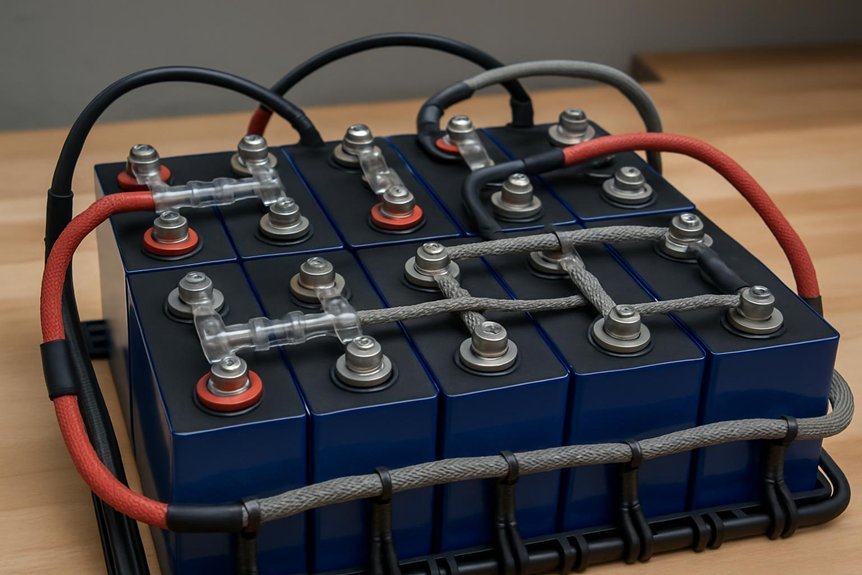
We outline safe wiring topologies for equalizing LiFePO4 banks with a focus on predictable current paths, balanced load sharing, and clear fault isolation. We examine equalizing wiring configurations, parallel bank balancing strategies, and safe diode arrangements to prevent backfeed and ensure proper isolation during charging. Our guidance emphasizes standards-driven, system-level practices that reduce risk while maintaining measurable, repeatable performance.
Equalizing Wiring Topologies
Equalizing wiring topologies must prioritize both safety and balance accuracy across LiFePO4 bank strings. We describe configurations that enable controlled current sharing while minimizing path impedance disparities and voltage feedback errors. Our approach emphasizes conductive symmetry, robust fusing, and clear isolation between banks to prevent cross-talk during equalization pulses. We select topologies that support predictable convergence of cell voltages, align with manufacturer guidance, and maintain thermal margins throughout balance events. By standardizing interconnect lengths and using matched conductors, we reduce parasitics that degrade accuracy. We document verification steps, including differential voltage checks and current flow tracing, to confirm safe equalizing topologies in practice. – Equalizing topologies leverage symmetrical connections – Current sharing is validated under load and no-load conditions – Fusing and isolation are integral – Documentation supports repeatability
Parallel Bank Balancing
How can parallel bank balancing be executed safely without compromising accuracy or thermal margins? We approach parallel balancing with disciplined topology, ensuring equalized string currents and preserved bank isolation. Our method emphasizes measurement accuracy, controlled current sharing, and thermal monitoring to prevent cross-bank heating. We implement dedicated shunts, synchronized timing, and per-bank supervision to constrain offsets within narrow tolerances. This yields robust, scalable charging that maintains uniform state-of-charge while containing fault propagation. We verify isolation boundaries to avoid inadvertent cross-connections during balancing, preserving system integrity under fault conditions. Our standards-driven approach favors modular hardware, explicit sleep-wake states, and deterministic responses to imbalance events. Parallel balancing thus delivers predictable performance without compromising safety, reliability, or lifecycle.
| Parameter | Value | Constraint |
|---|---|---|
| Accuracy | High | ±0.5% SOC |
| Isolation | Bank | Guaranteed |
| Monitoring | 3-Point | Timers |
Safe Diode Configuration
Can diode-driven wiring topologies ensure safe, scalable equalization without compromising isolation or thermal margins? We answer yes through disciplined topology choice, defined by safe diode placement, reverse blocking, and clear current paths. Our approach minimizes cross-bank coupling while preserving cell balance accuracy and fault containment.
- Safe diode placement reduces stray coupling and maintains isolation margins
- Reverse blocking prevents backfeed during transients and shutdowns
- Dedicated return paths preserve equalization currents without hotspots
- Standardized spectral layout supports scalable bank addition and maintainability
We document criteria for selecting diodes, including voltage rating, current rating, and thermal deratings, to ensure system-level reliability. Our emphasis remains precise, verifiable, and aligned with applicable safety and charging standards, delivering predictable equalization behavior across LiFePO4 banks.
How to Set Voltage and Current Targets for Multi-Bank Packs
Determining the correct voltage and current targets for multi-bank LiFePO4 packs is essential to balanced, safe charging. We establish targets that reflect pack topology, individual cell state, and charger capability, ensuring consistent parallel charging performance. Our approach sets clear voltage targets per bank, aligned to a common system voltage, while respecting cell voltage tolerances and manufacturer recommendations. We define current targets based on total pack capacity, ambient conditions, and conductor resistance, preventing localized overcurrent that could spark imbalance. We emphasize synchronization across banks so each module follows the same charging profile, minimizing differential aging. We document measurement points, cutoffs, and verification tests, enabling repeatability. In practice, we translate specs into actionable setpoints, avoiding overfitting and ensuring safe, predictable operation.
Temperature Control to Prevent Runaway and Aging
Temperature control is our line of defense against runaway and accelerated aging in parallel LiFePO4 banks. We implement a system-level approach that keeps cell temps within safe bands, minimizes thermal gradients, and preserves capacity over time. Our controls center on calibrated cooling strategies, heat-sinking, and balanced airflow to prevent hotspots. We avoid topic drift by focusing on actionable temperature targets, ambient considerations, and pack topology that reduce thermal buildup. We acknowledge that an unrelated focus on ancillary metrics can mislead priorities, so we prioritize direct temperature management as a primary reliability lever.
- Calibrated cooling curves aligned with charge states
- Thermal sensors distributed for uniform monitoring
- Active airflow management near high-heat zones
- Regular validation against performance and aging benchmarks
What to Monitor and How to Detect Faults in Real Time
To detect faults in real time, we continuously monitor key electrical and thermal indicators that reveal health and balance status across the bank. We track cell voltages, currents, and state-of-charge disparities, enforcing tight tolerances to reveal deviations quickly. Temperature sensors provide spatial profiles to identify hot spots and thermal gradients that precede aging or failure. We compare real-time data against baseline models and accepted limits, triggering fault indicators when thresholds are exceeded or trends diverge from expectations. Protective actions, such as balance adjustments or isolation, are executed deterministically to prevent propagation. We document events with timestamped logs for audit and diagnostics. With calibrated instrumentation, early fault detection reduces risk of thermal runaway and maintains uniform performance across all cells.
Step-by-Step Setup for a Safe Parallel Charging Session
How do we reliably start a parallel charging session, ensuring safety and balance from the outset? We align equipment, verify connectors, and set baseline parameters before power application. We establish a shared reference, confirm equalized state of charge, and confirm communication between BMS, chargers, and conductors. We then power up in a controlled sequence, monitor inrush, and confirm voltage harmony across banks. We implement strict current limits and balancing procedures, documenting each step for traceability. We maintain continuous awareness of battery safety, thermal conditions, and fault thresholds, ready to isolate if anomalies arise.
- Verify charger compatibility and interlock sequences
- Confirm identical battery ages, chemistries, and SOC
- Set equal current share and temperature thresholds
- Initiate power with staged ramp and real-time monitoring
Common Mistakes and How to Avoid Them
We start by outlining common wiring pitfalls, ensuring conductor sizing, fuse protection, and balanced interconnects match our system standards. Next, we address balanced bank sizing to prevent cell under- or over-utilization and maintain uniform charging currents across modules. Finally, we codify safe charging practices, emphasizing proper monitoring, voltage limits, and secure connections to reduce risk throughout the charging event.
Common Wiring Pitfalls
Have you double-checked how each battery in a LiFePO4 bank is wired before charging? We approach wiring with precision, not idle chatter or unrelated talk. We outline pitfalls that undermine balance, safety, and performance, then present corrective actions.
- Verify consistent series/parallel topology across all strings to avoid circulating currents.
- Confirm identical wire gauge and secure lugs; mismatches cause voltage drops and heating.
- Check terminal orientation and polarity to prevent cross-connection faults.
- Inspect fusing and disconnects to ensure proper protection without introducing resistance.
We maintain standards-driven checks, document findings, and correct any deviations before power-up. We emphasize repeatability, traceability, and system-level integrity to prevent hidden arcs or fires. Our guidance trims extraneous chatter, focusing on safe, predictable, and replicable wiring practices.
Balanced Bank Sizing
Ensuring each string in a LiFePO4 bank is sized to match its peers prevents imbalance, undue stress, and premature aging. We optimize balanced bank sizing by enforcing consistent conductor gauges, cell counts, and rating margins across strings. Common mistakes include asymmetric capacities, uneven aging, and mismatched BMS thresholds, which degrade pack reliability. We verify that each string shares identical amp-hour capacity, similar state-of-charge targets, and equalized cable lengths to minimize parasitic resistance. Our approach relies on system-level metrics: precise capacity planning, harmonized thermal profiles, and standardized protection settings. Avoid random speculation and unrelated topic detours; instead, document specifications, perform controlled balancing tests, and implement deterministic cutoffs. By constraining sizing to a single target, we reduce balancing currents, extend cycle life, and maintain safe parallel operation under all load profiles.
Safe Charging Practices
Where do most charging faults originate? We’ll trace faults to improper sequencing, inadequate monitoring, and vague charging targets. Our approach is precision-driven and system-level, emphasizing repeatable procedures for parallel charging across LiFePO4 banks. By defining exact charge currents, voltage ceilings, and balance checks, we minimize risk and maximize energy density without sacrificing safety. We align charging steps with standards, ensuring sensors, BMS communications, and cooling are harmonized. We also validate that pack states are compatible before connection, preventing undervoltage or overcurrent conditions. This disciplined practice reduces common mistakes and supports reliable, scalable operation for multi-bank systems.
- Establish fixed charge profiles for all banks
- Verify state-of-charge and BMS readiness before parallel charging
- Monitor temperature and current with defined thresholds
- document deviations and perform routine audits
Scaling From 2 Banks to 4 or More Safely
Scaling from 2 to 4 or more LiFePO4 battery banks must preserve balance, safety, and reliability across the system. We adopt a standardized, system-level approach to parallel charging, ensuring equalization where nodes share current within tight tolerances. Each bank receives matched charging profiles, and monitoring reflects real-time voltage, temperature, and state of charge to prevent drift. We implement robust bank isolation strategies to prevent cross-bank interactions during transients, preserving module integrity and fault containment. Wiring topology, connector integrity, and impedance matching are treated as design constraints, not afterthoughts. We verify that protection schemes—overcurrent, overvoltage, and thermal cutoffs—trigger coherently across all banks. Documentation and procedures emphasize verification of balance, safety margins, and reliability before any expansion beyond two banks.
Troubleshooting When Performance Falters
When performance falters, we start with a systematic diagnostic to isolate whether the issue is with individual banks, interbank connections, or the charging control logic. We adopt a structured approach to identify root causes and preserve safe, predictable operation through parallel charging and bank balancing.
- Verify per-bank voltage and current against spec, noting deviations that indicate imbalance or aging.
- Inspect interbank wiring and connectors for corrosion, loose terms, or continuity issues affecting balance paths.
- Audit the balance management logic and controller firmware for timing, sequencing, or fault flags.
- Validate telemetry and sensing accuracy to ensure measurements reflect real conditions without introducing systemic error.
Frequently Asked Questions
How to Detect Underrated Cables Causing Voltage Drop During Parallel Charging?
We identify cable faults by measuring each leg’s voltage drop under load, then monitor connections and perform fault isolation to confirm underrated cables causing voltage drop during parallel charging. We monitor connections, identify cable issues, and isolate faults systematically.
Is a Dedicated Balance Charger Necessary for Lifepo4 Banks?
A dedicated balance charger isn’t strictly necessary for LiFePO4 banks, but it improves cell parity; studies show balanced packs last 20–30% longer. We’d advise a dedicated balance approach for critical, precision-driven LiFePO4 banks.
Can Parallel Charging Work With Mixed Cell Capacities Safely?
Yes, parallel charging mixed capacity packs is unsafe without balancing; we follow parallel safety standards, isolating cells and equalizing voltages. We, as a system, prioritize mixed capacity risks, insist on proper management, and avoid unsafe, ad-hoc connections.
What Is the Safest Way to Disconnect Banks During Fault Conditions?
We disconnect banks via established disconnection protocols, ensuring fault isolation. We implement explicit steps, verify isolation with interlocks and status signaling, and maintain system-level integrity through standards-driven checks for safe, rapid fault containment.
How Does State-Of-Health Impact Parallel Charging Safety Margins?
State of health directly affects safety margins, reducing available headroom as degradation increases imbalance and internal resistance. We monitor SOC/SOH, balance currents, and enforce stricter limits to preserve system safety and reliable parallel charging performance.
Conclusion
We’ve laid out a precise, standards-driven approach to parallel charging LiFePO4 banks, emphasizing synchronized current sharing, robust fault isolation, and real-time telemetry. By adhering to safe wiring topologies, calibrated temperature control, and disciplined sequencing, we ensure equalized voltages and uniform SOC progression across banks. In short, follow the protocol, monitor every node, and treat each session like a conductor guiding an orchestra—except we’re using a compass and a vintage dial phone as our anachronism to visualize disciplined coordination.