We’ll tackle voltage spikes and surges in LiFePO4 charging with a systematic approach, linking grounding, isolation, and fast-acting protection to a coherent defense. We’ll analyze what causes spikes, how they harm chargers and packs, and how smart charging and vigilant maintenance fit into the guardrail. Our goal is to build dependable, low-noise operation, but the most effective strategy rests on details that set the boundary between safe charging and costly disruptions. What comes next may change how you protect your system.
Key Takeaways
- Use surge protection devices (TVS diodes, varistors) and appropriate input filters to clamp and absorb voltage spikes before reaching LiFePO4 chargers.
- Ensure robust grounding, proper layout, and galvanic isolation to prevent fault currents and ground loops from causing transients.
- Implement adaptive CC/CV charging with staged ramping and low-demand window scheduling to reduce spike impact during charging.
- Regularly monitor voltage, current, temperature, and impedance with automated fault detection and alerting to catch anomalies early.
- Maintain auditable documentation, benchmarking, and fault-simulation testing to tune protection thresholds and ensure ongoing reliability.
What Causes Voltage Spikes in LiFePO4 Charging
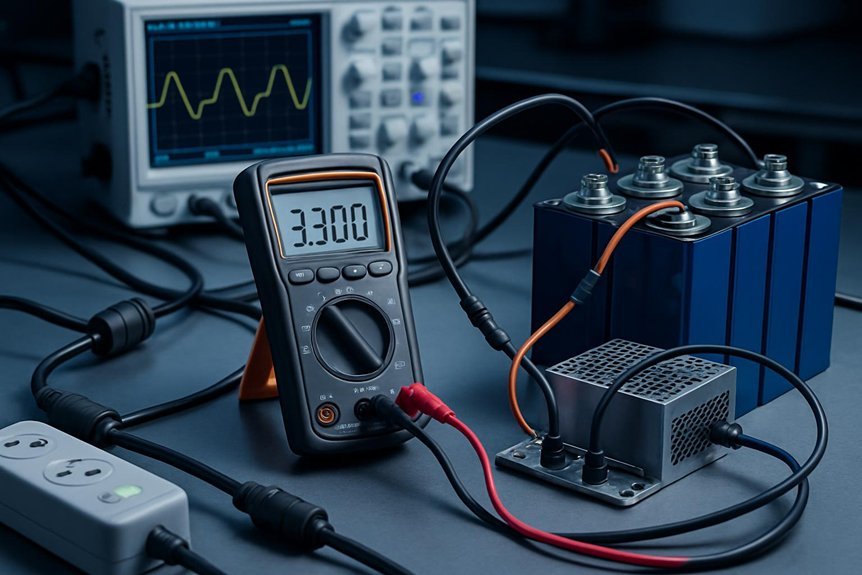
Voltage spikes during LiFePO4 charging stem mainly from transient surges in the supply, abrupt changes in current, and the interaction between the charger’s regulation loop and the battery’s impedance. We analyze these elements in a structured way to quantify risk and identify mitigation paths. When supply voltage momentarily overshoots, the charger must react quickly, but limited bandwidth can cause overshoot, ringing, or sustained high-frequency oscillations. Battery impedance, which varies with state of charge and temperature, shifts the system’s natural response, creating voltage drift that confounds regulation. EMI interference further perturbs sensing and feedback, degrading accuracy. By isolating each factor and measuring response under controlled loads, we can model spike trajectories and design robust filtering, tighter loop control, and resilient wiring layouts to minimize spike impact.
How Spikes Damage LiFePO4 Chargers and Packs
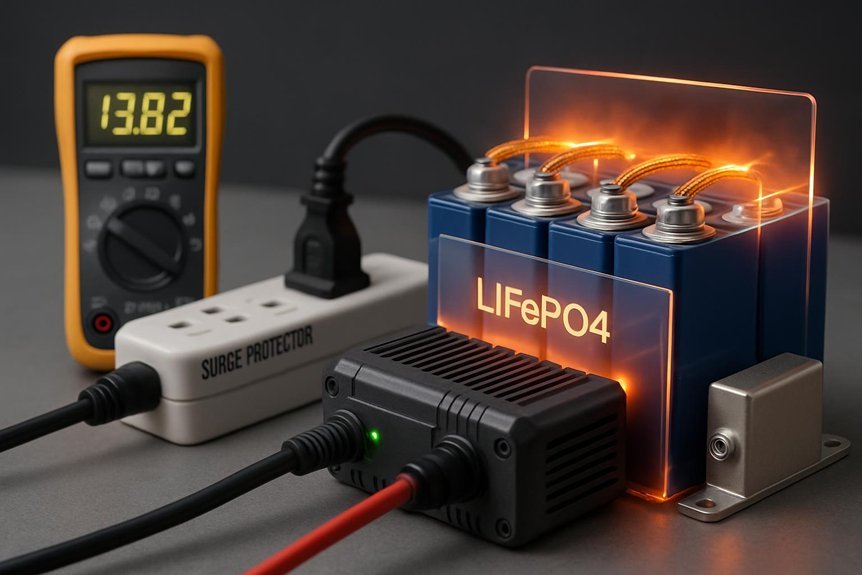
We examine how spikes stress LiFePO4 chargers and packs, focusing on the immediate impact on internal components and connection integrity. We then identify battery pack stress points that amplify vulnerability, guiding readers to targeted protection strategies. Finally, we outline surge protection essentials that align with precise charger design and safe operating practice.
Spike Impact On Chargers
What happens when a sudden voltage spike hits a LiFePO4 charger? We observe immediate stress on input electronics, insulation, and protection circuits. The spike can induce overvoltage on charging ICs, trigger transient suppressors beyond rating, and push MOSFETs toward unsafe conduction states. Repeated events accelerate degradation, reduce accuracy, and risk thermal runaway in extreme cases. Our approach emphasizes measurement, mitigation, and reliability, not guesswork. Safe grounding and robust isolation reduce fault current paths, while well-designed protection keeps portable chargers functional under surge conditions.
| Element | Effect | Mitigation |
|---|---|---|
| Input stage | Overvoltage stress | Hardened components, TVS diodes |
| Regulation | Oscillation risk | Sharp transient filtering, stable loops |
| Thermal | Hot spots | Adequate cooling, thermal vias |
| Grounding | Ground loops | Proper grounding schemes |
Battery Pack Stress Points
Battery pack stress points arise when spikes propagate beyond the charger’s input protections and into the pack itself. We analyze how voltage spikes interact with LiFePO4 cells, examining the paths they take and the timing of their arrival. Our focus is on stress points that elevate cell impedance, trigger protection cutoffs, or cause anomalous charging currents. We quantify where surge energy concentrates: interconnects, bus bars, and balance leads, and we trace how rapid voltage changes can form microarcs or impedance hotspots. We emphasize that a battery pack’s internal resistance and cell-to-cell variation influence damage likelihood. By mapping these relationships, we identify thresholds where common overshoots translate into measurable degradation, guiding us toward improved component selection and better diagnostics for persistent spike events.
Surge Protection Essentials
How do voltage spikes travel through a LiFePO4 charging system, and what damage do they actually cause? We assess path and impact: spikes traverse input wiring, switchgear, and DC-DC stages, then couple into cells via BMS thresholds, causing overvoltage stress, electrolyte imbalance, and degraded cell impedance. In practice, transient over-voltages trigger protective cutoffs or heat, reducing capacity and cycle life. We quantify risk by peak magnitude, duration, and system impedance, not by myth alone. We map mitigations to outcomes, distinguishing immediate protection from long-term weather resilience.
| Source | Pathway | Effect |
|---|---|---|
| AC input | EMI coupling | BMS alarm, cutout |
| DC bus | Transformer leakage | Heat, imbalance |
| Cabling | Surge backflow | Connector wear |
Grounding Techniques for Safe LiFePO4 Charging
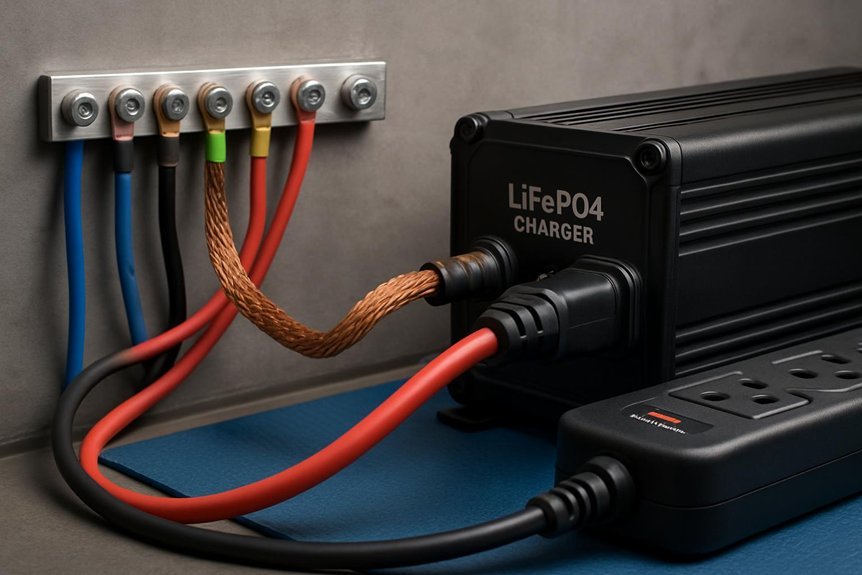
Grounding is a foundational safety practice for LiFePO4 charging, and we approach it methodically to minimize risk. We inspect grounding paths, verify continuity, and document the results to ensure a consistent safety baseline. Our focus stays on design, not folklore, challenging grounding myths with evidence and clear criteria. We also evaluate earthing practices for effectiveness in diverting fault currents.
- Confirm proper conductor sizing and connection integrity to reduce impedance.
- Verify the equipment grounding conductor runs back to a known earth reference and is uninterrupted.
- Test tripping behavior and continuity after any routine changes to ensure reliable fault clearance.
Essential Surge-Protection Hardware for LiFePO4 Systems
Surges and voltage spikes can compromise LiFePO4 systems far more than nominal supply variations, so we start with a concise inventory of essential surge-protection hardware and how it functions. We identify core components: surge protectors with varistors or transient voltage suppression (TVS) diodes, power filters, and input-disconnect devices. Each unit serves a distinct role, from clamping excessive voltages to attenuating high-frequency noise. We evaluate placement strategies to maximize effectiveness while maintaining system efficiency. Voltage regulation elements stabilize reference voltages and help tolerate brief transients without charger misoperation. Surge isolation methods, including galvanic isolation and optical or transformer-based barriers, prevent fault currents from propagating downstream. Together, these components form a layered defense that preserves LiFePO4 integrity, promotes reliability, and minimizes nuisance triggering.
Smart Charging Practices to Minimize Surges
Smart charging practices minimize surges by aligning charger behavior with battery tolerance and grid conditions. We approach this analytically, detailing concrete steps that reduce spike risk while preserving charge performance. Our method emphasizes predictable charge profiles, avoiding abrupt transitions that stress Lifepo4 cells.
- Synchronize current limits with real-time grid and battery state, using adaptive CC/CV strategies.
- Schedule charging during low-demand windows and apply staged ramping to prevent abrupt voltage steps.
- Verify firmware updates and calibration routines to maintain accurate monitoring and response.
These practices also touch on broader considerations, such as pricing dynamics and legal compliance, to frame the strategic landscape. By following disciplined control logic, we minimize surge exposure without sacrificing efficiency or reliability.
Maintenance and Monitoring for Reliable LiFePO4 Charging
We implement regular system checks and clear fault detection protocols to maintain LiFePO4 charging reliability. By standardizing inspection intervals and automated alerts, we minimize unnoticed drift and early-stage faults. This approach keeps performance consistent and helps us respond quickly to anomalies.
Regular System Checks
Regular system checks are essential to ensure LiFePO4 charging remains reliable and safe. We analyze data trends, verify connections, and document deviations to prevent drift from optimal performance. Our approach balances rigor with practicality, addressing real-world operation without unnecessary complexity. Below, we present a concise, non technical overview aligned with marketing considerations and technical accuracy.
- Schedule and record-keeping: establish routine intervals, capture voltages, temperatures, and charge currents to detect anomalies early.
- Hardware integrity: inspect connectors, fuses, and enclosures for corrosion, wear, or loose elements that could cause spikes.
- Performance benchmarking: compare current data to baselines, identify gradual degradation, and plan proactive maintenance.
This disciplined routine supports reliability, informs customers, and clarifies how maintenance translates to robust charging performance.
Fault Detection Protocols
How can we detect faults early and prevent charging interruptions for LiFePO4 systems? We focus on fault detection protocols that are repeatable and auditable. We define baseline operating envelopes and continuously compare real-time measurements against these references. We implement multi-layer checks: voltage and current anomalies, temperature excursions, impedance shifts, and charge/discharge curve deviations. Automated fail-safes trigger alerts and controlled shutdowns before damage occurs. We quantify performance with reliability metrics, tracking mean time to detect, false alarm rate, and recovery time. Fault simulation campaigns validate detection thresholds under varying load, aging, and voltage spike scenarios. Regularly review results, adjust thresholds, and document responses. This disciplined approach reduces nuisance interruptions while preserving safety and charging efficiency.
Frequently Asked Questions
How Do You Detect Hidden Surge Sources in a Lifepo4 Setup?
We detect hidden surge sources by monitoring line-to-line and line-to-ground voltage patterns with high-resolution loggers, identifying ghost transients, and correlating with equipment startup/shutdown. We share findings, isolate sources, and implement safeguarded, repeating tests for confirmation.
Can Surge Protection Affect Charging Efficiency or Speed?
Surge protection can slightly reduce charging efficiency due to added impedance, but it doesn’t meaningfully slow charging. We analyze input filtering and regulation, ensuring protection components minimize losses, preserving charging speed while safeguarding the system and maintaining reliability.
Do Different Lifepo4 Chemistries Require Unique Protection Methods?
“Different LiFePO4 chemistries require unique protection methods.” We say, we design with ultra fast protection and battery management, analyzing chemistries precisely, methodically, and always, “a stitch in time saves nine,” to optimize safety and performance.
What Is the Expected Lifespan of Surge Protectors on Lifepo4 Systems?
We expect surge protectors in lifepo4 systems to last about 5–10 years under normal use, varying with surge magnitude and frequency. Our lifepo4 protection assessments emphasize quality components and regular diagnostics to maximize surge lifespan and reliability.
Are There Weather-Related Surge Risks for Outdoor Lifepo4 Installations?
Yes, weather risks threaten outdoor installations; we study storms, humidity, and lightning effects, then implement shielding, grounding, and enclosure strategies. We assess risks, log data, compare protections, and adjust placement to minimize weather-related surge impact for reliability.
Conclusion
We’ve built a shielded system, a steady drumbeat against chaos. When spikes threaten, our layered defenses stand ready: solid grounding, galvanic barriers, and fast, matched surge devices act like vigilant gatekeepers. We monitor, we filter, we adapt—smart charging guiding our rhythm with quiet precision. So, as currents surge and recede, our LiFePO4 charging stays calm, predictable, and safe. It’s not luck; it’s disciplined engineering shaping resilience from raw electrical weather.