Did you know that even small mismatches between your solar array and LiFePO4 charger can quietly trip battery protection before you notice it? We’ve seen alarms cascade when MPPT voltage, wiring gauges, and temperature compensation aren’t matched to the chemistry. In this discussion, we’ll outline a disciplined approach—documented system selection, safe charging profiles, real‑time monitoring, and seasonal recalibration—so you can anticipate issues and keep packs healthy. There’s more to cover, and the details matter for long‑term reliability.
Key Takeaways
- Verify LiFePO4-compatible charge controllers and solar arrays with matching voltage, wattage, and climate ratings before installation.
- Implement fixed charging profiles with defined bulk, absorption, and float stages tailored to LiFePO4 chemistry.
- Establish real-time monitoring with calibrated temperature sensors and centralized dashboards; set automated alerts for deviations.
- Conduct regular diagnostics, impedance checks, and balance monitoring; document conditions and reproduce anomalies for fixes.
- Maintain thorough maintenance logs covering inspections, preventive actions, cable integrity, torque, and safety testing.
Choose LiFePO4-Compatible Solar Array and Controller
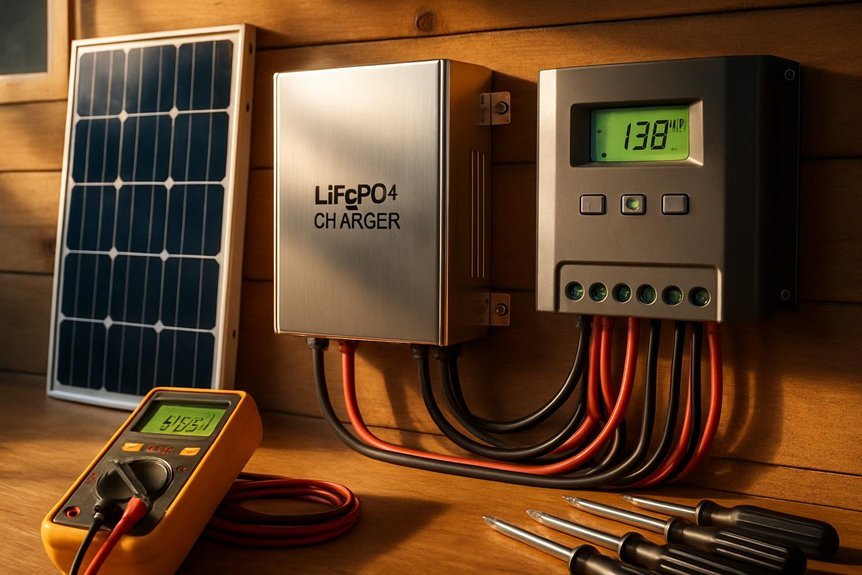
Choosing a LiFePO4-compatible solar array and charge controller is foundational to reliable operation. We begin by selecting a solar array rated for your load, climate, and sun conditions, ensuring wattage and voltage align with the battery system. Next, we verify controller compatibility, confirming the charge controller supports LiFePO4 chemistry and the system’s voltage window. We audit wiring, fuse sizing, and MPPT or PWM characteristics to minimize losses and prevent overvoltage scenarios. We document temperature coefficients, ensuring the controller adjusts duty cycle appropriately in heat or cold. We prioritize communication with the battery or BMS, confirming data reporting and state-of-charge accuracy. Finally, we maintain a conservative design margin, keeping future expansion feasible without compromising safety or performance.
Set LiFePO4 Charging Profiles for Solar
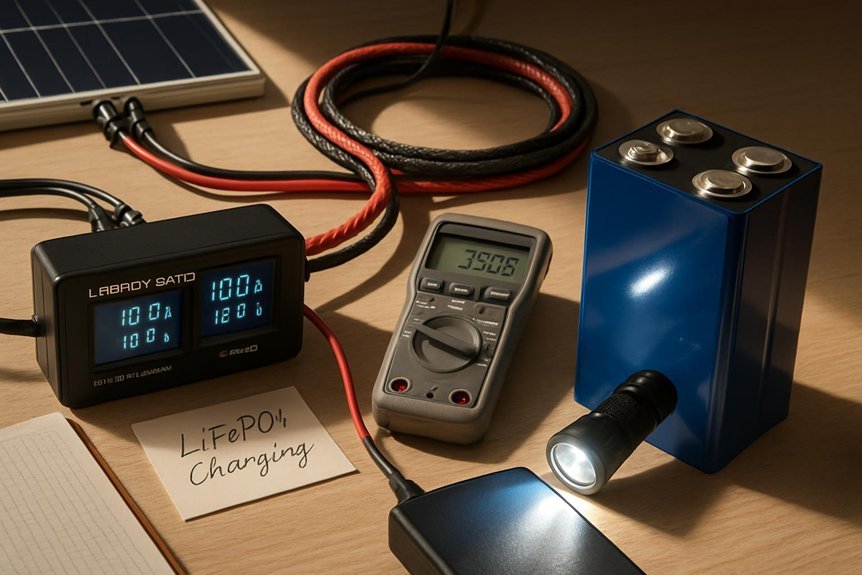
We set LiFePO4 charging profiles for solar by aligning the battery’s chemistry, the controller’s parameters, and the array’s real-world conditions. We establish fixed charge stages, voltage ceilings, and current ramps that respect cell balance and longevity.
We tailor LiFePO4 charging profiles to align chemistry, controller settings, and real-world conditions for balanced, long-lasting solar performance.
- Compatibility testing confirms voltage windows, end-of-charge thresholds, and safety limits before deployment.
- Shadow charging replicates daily demand without discharging the bank, validating profile stability under load variations.
- Incremental tuning adjusts bulk, absorption, and float stages to maintain energy capture without overheating.
We document outcomes, monitor ripple, and preserve consistency across cycles. With disciplined profiling, we minimize stress, optimize efficiency, and ensure predictable performance in diverse solar environments.
Monitor LiFePO4 Temperature and Battery Health in Real Time
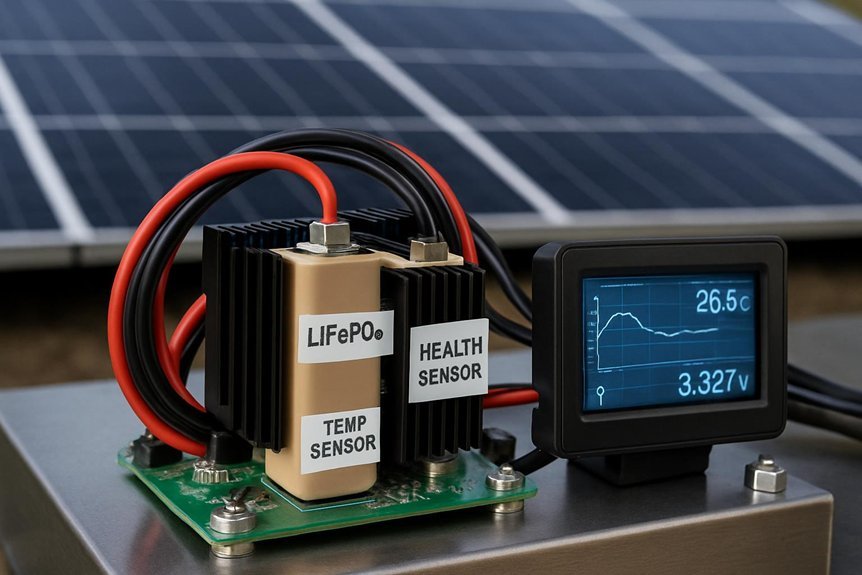
How can we guarantee LiFePO4 batteries stay safe and perform reliably in real time? We monitor temperature and health signals continuously, using calibrated sensors and centralized dashboards. We track cell and pack temperatures, ambient influences, and voltage imbalances, flagging deviations before they escalate. We correlate thermal data with charge/discharge cycles to detect early signs of stress, and we verify state-of-health indicators like impedance rise and capacity fading. We implement automated alerts, throttling, or isolation when thresholds are breached. This reduces lifetime cost by preventing damage and extending cycle life. By documenting trends, we spot lingering risk factors that could cause thermal runaway and address them promptly with corrective action and preventive maintenance. Continuous monitoring ensures consistent performance and safety.
Prevent LiFePO4 Over-Discharge and Deep Cycling
Over-discharge and deep cycling threaten LiFePO4 longevity and performance, so we implement safeguards that align with real-time monitoring. We describe our proactive measures to prevent over discharge risks and ensure deep cycling prevention through disciplined controls and data-driven adjustments.
We implement real-time safeguards to prevent over-discharge and deep cycling, protecting LiFePO4 longevity.
- We set precise state-of-charge thresholds and automated cutoffs to halt discharge before risk zones, preserving capacity and cycle life.
- We schedule periodic resting intervals and charge boosts that minimize stress from partial cycles and high C-rates.
- We continuously validate voltage, current, and temperature signals, triggering alerts and automatic rebalancing when deviations appear.
These steps create a robust guardrail against degradation, ensuring dependable, long-term solar charging performance.
Safe Wiring and Cabling Practices for LiFePO4 Solar Systems
Safe wiring and cabling are foundational to LiFePO4 solar systems. We outline a disciplined approach to ensure reliability and safety. First, we select conductors with appropriate ampacity, voltage rating, and insulation for the system’s operating conditions, avoiding undersized cables. Second, we route cables away from heat sources, sharp edges, and moving parts, using dedicated conduits and strain reliefs to prevent damage. Third, we adhere to cabling standards for DC and AC circuits, labeling every run, maintaining consistent color coding, and documenting conductor lengths and terminations. Fourth, we secure connections with torque-approved tools and anti-oxidant as needed, and perform insulation resistance tests after installation. Finally, we verify correct polarity and grounding, and confirm enclosure integrity before commissioning.
Routine Maintenance and Inspections for LiFePO4 Longevity
We perform regular inspector checks and routine battery health monitoring to catch issues early and keep LiFePO4 systems reliable. By following a systematic cadence, we verify connections, inspect for corrosion, and confirm that voltage, current, and temperature readings stay within spec. These practices establish a clear baseline for longevity and guide timely maintenance decisions.
Inspector Checks Routine
To keep LiFePO4 chargers performing reliably, we establish a regular inspector checks routine that covers both the solar array and the battery system. We approach each inspection with a checklist mindset, documenting findings and scheduling follow-ups. Our goal is to identify deviations early and prevent cascading faults through disciplined routine audits.
- Visually verify wiring integrity, secure mounts, and enclosure seals, noting signs of corrosion or abrasion.
- Measure operating voltages, current readings, and solar panel output under load to confirm spec adherence.
- Observe temperature and ventilation, recording anomalies that could signal cooling needs or contact resistance.
These inspector checks keep us ahead of performance decline, preserving safety and reliability across the system.
Battery Health Monitoring
How can we reliably gauge LiFePO4 battery health to extend longevity and prevent downtime? We approach battery health with a structured, repeatable protocol. Begin by logging voltage and current during a full charge and discharge cycle to establish baseline metrics. Regularly measure open-circuit voltage after resting, and compare to nominal cell ratings to detect drift. Monitor impedance trends with a portable tester; rising internal resistance signals aging or imbalance. Inspect for physical signs of swelling, venting, or electrolyte leakage during routine inspections. Use a balanced charging routine to maintain cell equilibrium, and record capacity fade over time to quantify health status. Prioritize consistent scheduling, traceable data, and prompt follow-ups when anomalies appear. This disciplined monitoring health practice helps prevent surprises and sustains performance.
Diagnostics and Troubleshooting LiFePO4 Solar Issues
We walk through a concise Fault Diagnostics Checklist and a practical Troubleshooting Charging Anomalies approach to help you pinpoint issues quickly. We’ll start with systematic checks on connections, voltages, and current readings, verifying that all sensors and controllers respond within spec. If anomalies appear, we document exact conditions, reproduce steps, and apply targeted fixes in a controlled, repeatable sequence.
Fault Diagnostics Checklist
A systematic fault diagnostics checklist helps us quickly isolate issues in LiFePO4 solar systems and restore reliable charging. We outline a focused, repeatable process that keeps fault diagnostics clear and actionable, and we avoid guesswork through careful checks. Our approach emphasizes fault isolation by confirming each element’s role in the charging path before moving on.
1) Inspect wiring integrity: secure connections, corrosion-free contacts, appropriate gauge, and traceable continuity.
2) Verify controller and sensors: correct configuration, proper voltage references, calibrated sensors, and firmware consistency.
3) Measure system voltages and currents: compare against spec sheets, note anomalies, and document deviations for follow-up.
This structured method minimizes ambiguity, supports rapid remediation, and preserves system safety while we pursue reliable LiFePO4 charging.
Troubleshooting Charging Anomalies
Ever wonder why LiFePO4 solar chargers sometimes behave oddly? We’ve seen it happen, and we approach it methodically. When anomalies appear, we first verify fault indicators and log symptoms, then correlate with operating conditions. Next, we check voltage, current, and panel irradiance to rule out external influences. If readings diverge from expected profiles, we isolate the charger from load and monitor thermal events, noting any rapid temperature rises. We calibrate sensors, inspect cables, and verify fusing status before reapplying charge profiles. Document every step to build a traceable fault history, then re-test under controlled loads. If issues persist, consider firmware or hardware revisions and escalate for manufacturer guidance. Regularly review logs to catch patterns before failures escalate.
| Column A | Column B |
|---|---|
| Fault indicators | Thermal events |
| Sensor calibration | Cable integrity |
| Load isolation | Firmware considerations |
| Re-test protocols | Documentation practices |
| Pattern detection | Escalation criteria |
Seasonal Use Adjustments to Extend LiFePO4 Battery Life
Seasonal use adjustments can noticeably extend LiFePO4 battery life by aligning charging and discharging patterns with environmental changes. We detail concrete steps that respect seasonal scheduling and temperature effects so performance stays steady across months.
- Monitor ambient temps weekly and adjust charge targets to remain near optimal voltages, reducing stress during heat waves or cold snaps.
- Shift discharge windows to avoid deep cycles in extreme temperatures, preserving capacity and cycle life.
- Recalibrate solar charging curves seasonally, ensuring generator input matches daytime sunlight variability without overcurrent.
Frequently Asked Questions
How Often Should I Recalibrate Solar Charging Profiles for Lifepo4?
We recalibrate solar charging profiles every six months, unless field data suggests drift; we monitor performance and temperature impacts, then adjust calibration frequency as needed. Recalibration frequency aligns with usage patterns and panel aging for reliability.
Can Lifepo4 Be Safely Connected to Microinverters and Optimizers?
Incompatibility considerations exist; lifepo4 can connect to microinverters and optimizers, but proceed with caution. We’ll test, document shutdown procedures, and monitor voltage behavior, ensuring safe operation while we verify system harmony and protective clearances.
What Is the Ideal Float and Absorption Voltages for Lifepo4 Solar Kits?
We recommend float voltages around 3.45–3.55V per cell and absorption at 3.60–3.65V, careful to avoid overvoltage with charge optimizers; we monitor temperatures and balance cells for safe, long-term LiFePO4 solar kit performance.
How Do Shading or Partial Sun Affect Lifepo4 Charging Cycles?
Shading impacts LiFePO4 charging, and partial sun challenges can dramatically slow, confuse, or halt cycles. We detail every step we take: monitor irradiance, adjust timing, verify voltage, and stagger exposure to maintain safe, efficient charging.
What Are Early Signs of Lifepo4 Degradation From Solar Time Clocks?
We observe early life degradation signs, including reduced capacity and slower charging, influenced by environment factors like heat and humidity. We monitor timing drift in solar time clocks, inspect cell balancing, and flag unequal voltages as early indicators.
Conclusion
We’ve mapped a clear, methodical path to keep our LiFePO4 solar system thriving. By choosing compatible arrays and controllers, tightening charging profiles, and watching temperatures in real time, we guard against shocks and sags. Regular inspections, wired reliability, and disciplined seasonal calibrations act like a steady pulse—preventing outages and prolonging life. With vigilant diagnostics, alarms, and precise record-keeping, our battery’s glow will endure, steady as a lighthouse beacon guiding us through sun and storm.