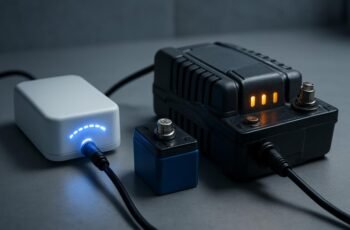
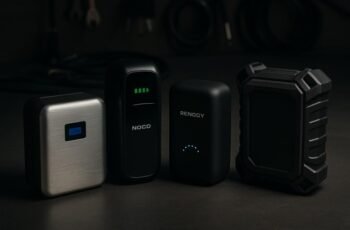
We’ll compare AC-to-DC and DC-to-DC LiFePO4 chargers by looking at architecture, regulation, and practical trade-offs. Each topology brings distinct benefits—isolation and line conditioning versus tighter control and smaller heat loads—but also constraints like input variability or reliance on a stable upstream source. This balance shapes real-world performance, safety margins, and lifecycle cost. We invite you to contemplate your mains, space, and thermal budget as we explore which path fits your application best.
Key Takeaways
- AC-DC chargers handle mains directly with line conditioning, isolation, and bulk regulation, offering straightforward integration but potentially larger size and heat at higher outputs.
- DC-DC chargers use a pre-regulated DC bus, enabling tighter regulation, higher efficiency, and smaller form factors, albeit with dependency on upstream source stability.
- LiFePO4 charging requires precise CC/CV control, tight voltage/window management, and strong BMS compatibility, impacting topology choice and fault protection needs.
- Topology affects EMI, thermal management, and protection schemes; AC-DC emphasizes isolation and line conditioning, while DC-DC emphasizes EMI control and upstream regulation.
- Practical trade-offs include cost per watt, enclosure space, heat duty, and use-case fit, guiding the decision by load variability and regulatory requirements.
Understanding Core Architectures: AC-DC vs DC-DC for LiFePO4
What fundamentally distinguishes AC-DC from DC-DC architectures for LiFePO4 charging, and why does that choice matter for performance and safety? We, as engineers, compare how each topology handles source conditioning, voltage adaptation, and regulation loops. AC-DC designs draw directly from mains, requiring line filtering, surge protection, and rectification followed by bulk regulation, which influences sizing, efficiency bands, and safety margins. DC-DC topologies accept a pre-regulated DC bus, enabling tighter control of charging current and voltage with fewer steps, potentially reducing heat but relying on upstream stability. This affects how charging cables and connectors carry current, and how user interfaces present state, limits, and fault notifications. Both require robust protection, accurate sensing, and clear UX to prevent misconnections and improper charging.
Efficiency, Heat, and Reliability by Topology
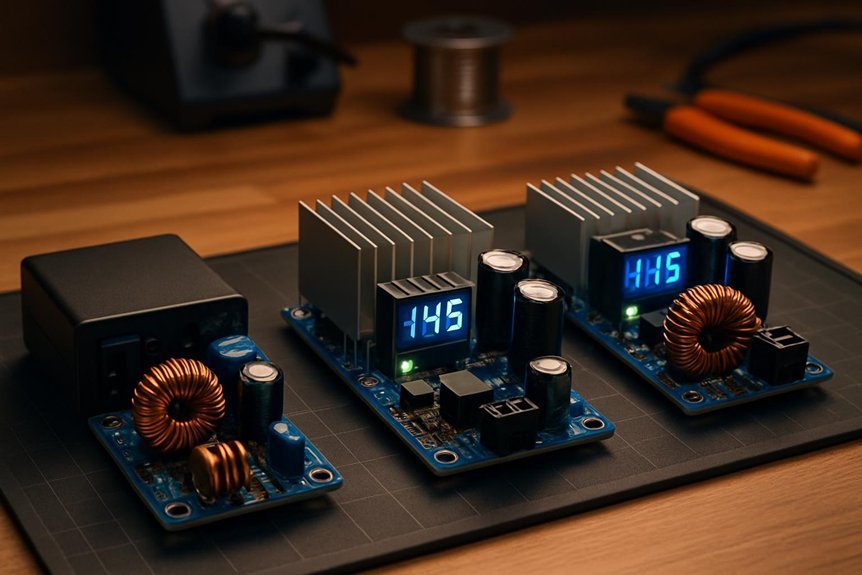
Efficiency, heat, and reliability hinge on topology because each path from AC or pre-regulated DC to the LiFePO4 cell defines where losses occur and how thermal and fault margins are managed. Our assessment compares architectures by intrinsic conversion steps, switch timing, and loss distribution. AC-DC paths expose transformer and rectifier junctions, where conduction and switching losses accumulate and cooling must handle peak dissipation. DC-DC topologies shift losses toward high-frequency switching devices and magnetic components, influencing EMI and thermal density. We weigh efficiency across load spans, noting that topology dictates steady-state heat rise and safety margins. We emphasize AC coupling and DC isolation as structural choices that modulate fault isolation, maintenance accessibility, and system resilience under fault or degraded input conditions.
LiFePO4 Charging Profiles, Voltage Stability, and BMS Compatibility
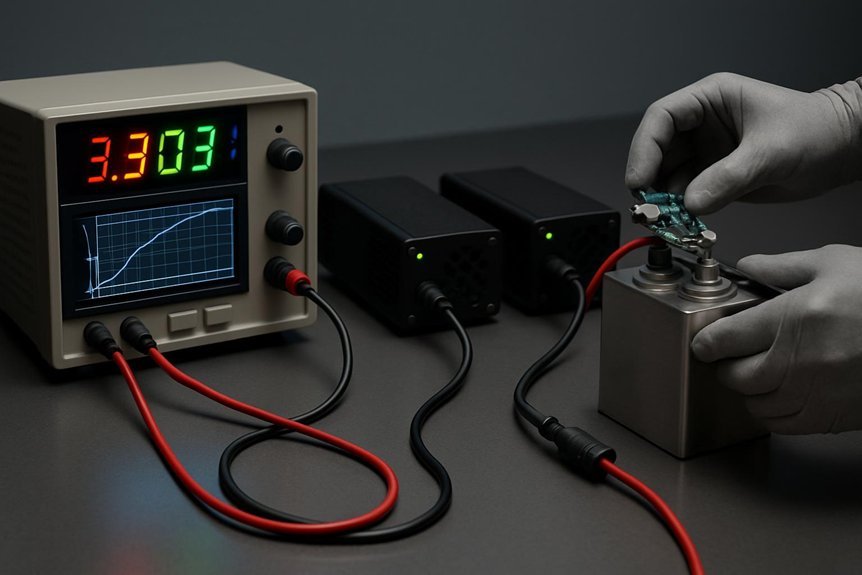
LiFePO4 charging profiles hinge on cell chemistry limits, voltage stability, and BMS interoperability, so we start from how each topology shapes charge acceptance and protection. We align charging topology with LiFePO4’s narrow voltage window, ensuring safe CC/CV stages, precise termination, and active balancing considerations. Voltage stability hinges on strict adherence to end-of-charge thresholds, temperature compensation, and ripple control to prevent overvoltage or undercharging, which would degrade capacity and cycle life. BMS compatibility drives cell impedance tracking, cell-by-cell balancing, and fault signaling, influencing charger handshakes, safety cutoffs, and firmware updates. We assess lifecycle implications by comparing grid interaction, thermal duty cycles, and long-term degradation pathways. Our goal is predictable current profiles, minimal voltage drift, and robust protection without compromising charging efficiency or reliability.
Noise, EMI, and Durability in Real-World Chargers
We assess how noise manifests across AC-DC and DC-DC LiFePO4 chargers, quantifying spectral content, amplitude, and load-dependent variability to inform interference risk. We then outline EMI mitigation strategies—layout optimization, filtering, shielding, and switching-frequency considerations—and how these choices trade off efficiency and cost in real use. Finally, we define field durability metrics, including thermal cycling, vibration resilience, and long-term reliability under typical duty cycles, to link design decisions with real-world performance.
Noise Impact Assessment
Could noise and EMI limits in real-world chargers reveal hidden durability issues that lab tests miss? We investigate how measured noise profiles correlate with long-term reliability across charging topology variations. Our focus is on capturing practical EMI signatures under typical load transients, cable layouts, and enclosure grounding, rather than idealized bench conditions. We compare AC-to-DC and DC-to-DC implementations, noting that switching頻 dynamics and dv/dt stress interact with isolation barriers and EMI filters, sometimes exposing marginal components. We assess whether elevated conducted and radiated emissions align with premature component wear or connector degradation. In this context, EMI challenges become a diagnostic signal for durability, guiding design margins and test protocols. Clear, repeatable metrics enable early risk detection and more confident lifecycle forecasts.
EMI Reduction Strategies
Confronting EMI in real-world chargers requires moving from measured noise profiles to concrete reduction strategies that preserve durability under practical conditions. We examine how electric noise propagates through common power topology configurations, distinguishing switching legs, input filters, and output filtering effects. Our approach combines targeted PCB layout, optimized trace routing, and shielding, reducing loop areas and radiated emissions without compromising efficiency. We implement differential signaling where feasible, ferrite containment, and soft-switching techniques to limit dv/dt and di/dt stress. Component selection focuses on EMI-tolerant capacitors, magnetics with low residual flux, and robust transient handling. We quantify improvements using conducted and radiated measurements, ensuring compatibility with regulatory limits while maintaining reliability across temperature and load variations. This disciplined method aligns performance with durability in real-world operation.
Field Durability Metrics
Field durability metrics for real-world LiFePO4 chargers hinge on robust noise, EMI, and longevity assessments. We evaluate durability testing by stressing converters under thermal, vibrational, and line-impedance variations to reveal performance margins. Noise metrics quantify baseline ripple, conducted emissions, and transient coupling, linking them to regulation integrity and signal integrity in charging control loops. EMI assessment focuses on emissions during peak switching, startup surges, and load-step events, ensuring compliance without compromising safety margins. Field reliability combines thermal cycling, dust ingress, and connector wear to project mean time between failures. We compare AC-to-DC and DC-to-DC topologies on fault tolerance, electromagnetic resilience, and structural durability. Our approach yields actionable insight for spec’d guarantees, service lifetimes, and real-world failure modes.
Practical Trade-Offs: Cost, Size, and Use-Case Fit
Which approach offers the best blend of cost, size, and suitability for a given LiFePO4 charging scenario? We evaluate practical tradeoffs by matching system goals to topology. AC-to-DC units excel in simple integration, moderate size, and lower per-output complexity, while DC-to-DC converters shine in efficiency, isolation control, and tight voltage regulation. Our focus is on real-world constraints: cost per watt, enclosure space, heat, and use-case fit. Two word discussion ideas: efficiency balance. Practical tradeoffs emerge as design margins tighten between bulk and performance. For readers, the choice hinges on ownership duration, exposure to ambient limits, and edge-case charging profiles. Use the bullets to weigh: load variability, efficiency targets, thermal budget, regulatory compliance, integration effort.
- Cost per watt and acquisition price
- Size and enclosure fit
- Thermal management constraints
- Efficiency targets under load
- Integration effort and lifecycle support
How to Choose Your LiFePO4 Charger: A Clear Decision Framework
We start by weighing charger input flexibility against battery management considerations to guide a clear selection. We’ll assess how input ranges, efficiency, and thermal behavior interact with LiFePO4 cell chemistry and BMS requirements. Our framework aims to map use-case needs to charger capabilities, avoiding unnecessary complexity while highlighting critical trade-offs.
Charger Input Flexibility
Charger input flexibility matters because it determines how gracefully a LiFePO4 system adapts to available power sources and evolving needs. We evaluate options by how they handle diverse input voltages, currents, and source types, ensuring charging flexibility and input adaptability without compromising safety or efficiency.
- Accepts multi-voltage AC inputs with automatic range detection
- Supports DC input from panels or battery banks for on-site charging
- Includes programmable current limits to protect wiring and cells
- Maintains stable charging profiles across source variations
- Provides clear status, fault, and loss-of-supply indicators
We favor chargers that minimize conversion losses, maximize compatibility, and preserve state-of-charge accuracy across source changes. This focus helps readers assess how input flexibility aligns with system goals like reliability, scalability, and energy resilience.
Battery Management Considerations
Battery management is the backbone of choosing a LiFePO4 charger, because it defines how the charger protects cells, preserves capacity, and maintains safe operation across real-world usage. We examine cell balancing, voltage and current limits, and temperature monitoring to ensure uniform aging and predictable performance. A charger should implement proper state-of-charge and state-of-health tracking, with clear cutoffs that prevent overcharging or undercharging, which directly influence battery lifetime. Thermal monitoring tied to charging algorithms minimizes thermal gradients and reduces degradation mechanisms. We assess protections against shorts, resonance, and overcurrent, then verify shutdown behavior under fault conditions to prevent thermal runaway. Finally, we compare firmware update paths, diagnostics, and data logging for traceability, guiding us to a charger that sustains reliability while maximizing capacity retention.
Frequently Asked Questions
How Do AC-DC and DC-DC Chargers Affect Battery Warranty Terms?
AC DC warranty and DC DC warranty terms hinge on charger compatibility and proper usage; we protect warranties when profiles match battery specs, avoid overvoltage, and follow install guidelines, so our guidance minimizes risk and keeps claim eligibility intact.
Can Lifepo4 Be Safely Charged From Solar With These Chargers?
We can safely charge LiFePO4 from solar using proper charge controllers; think of a prudent dam. How solar charging safeguards battery safety hinges on MPPT/PWM regulation, voltage limits, and current saturation to prevent overcharge or heat buildup.
What Maintenance Is Required for Long-Term DC-DC Charger Use?
We perform regular maintenance checks and monitor connector wear to ensure long-term DC-DC charger use remains reliable, accurate, and efficient, informing you promptly of any degradation, torque specs, and preventive steps to minimize failure risks.
Do Chargers Support Fast-Charging Without Harming Cycle Life?
Yes, we can fast-charge without harming cycle life, provided you stay within the charger’s recommended C-rate and temp limits. We carefully monitor cell balance, voltage taper, and thermal profiles to protect cycle life while charging rapidly.
How Do Ambient Temperatures Influence AC-DC Vs DC-DC Performance?
Ambient temperatures influence efficiency: higher temps reduce DC-DC efficiency more than AC-DC, while very low temps raise internal resistance for both. We note ambient effects shrink output at extremes; efficiency tradeoffs become prominent as temperatures swing.
Conclusion
We’ve weighed AC-DC and DC-DC LiFePO4 chargers across architecture, efficiency, and real-world reliability, and the takeaway is clear: match topology to your inputs, enclosure, and thermal budget. If you need wide mains compatibility and isolation with simpler integration, AC-DC wins; if you prioritize tight regulation, higher efficiency, and a compact form, DC-DC pays off. So, what’s your upstream stability threshold and space constraint, and how will that shape your charger choice?