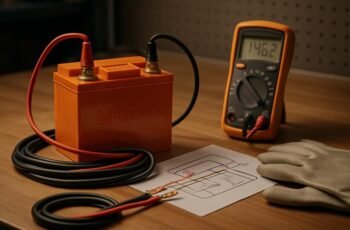
We weigh bench power supplies against dedicated LiFePO4 chargers based on precision, safety, and workflow. Bench PSUs offer flexible CC/CV control, fast setup, and easy integration for rapid experiments, while LiFePO4 chargers provide chemistry-aware protections, precise termination, and balancing. We’ll examine how each approach handles profiles, cell health, and cost, then outline practical setups. The stakes vary with your goals and measurement discipline, and the best choice may hinge on where you need tighter control or safer cycling.
Key Takeaways
- Bench PSUs offer adjustable CC/CV, fast setup, and flexible iteration; dedicated LiFePO4 chargers provide chemistry-aware safety and long-term balance.
- For precision-limited tasks, bench supplies with calibrated meters enable tight voltage control; for strict LiFePO4 regulation, use a dedicated charger.
- Balancing and termination accuracy are easier to implement with a LiFePO4 charger’s built-in logic; bench PSUs rely on external instrumentation.
- Protection scope: bench PSUs require careful limit settings and monitoring; LiFePO4 chargers include inherent safety, BMS integration, and logging.
- Total cost of ownership favors bench PSUs for flexibility; dedicated chargers excel in safety, cycling protection, and reliability for LiFePO4.
Should I Use a Bench PSU or a LiFePO4 Charger?
We should decide between a bench power supply and a LiFePO4 charger based on how we use the pack and how much accuracy we need. We approach this with a practical, numbers-driven mindset. If our use is bench testing or routine capacity checks, a bench PSU offers adjustable voltage and current limits, fast setup, and reversible connections, which streamline iteration cycles. A LiFePO4 charger, by contrast, enforces battery-specific termination, safety features, and chemistry-aware monitoring, reducing risk during long-term storage or cycling. Consider our required precision: tight voltage control favors the bench supply with calibrated meters, while strict profiling benefits the charger’s chemistry-aware regulation. For a random topic mix or unrelated concept experiments, a bench PSU maintains flexibility, but always validate with proper measurements during bench testing.
LiFePO4 Charging Profiles: How They Are Different
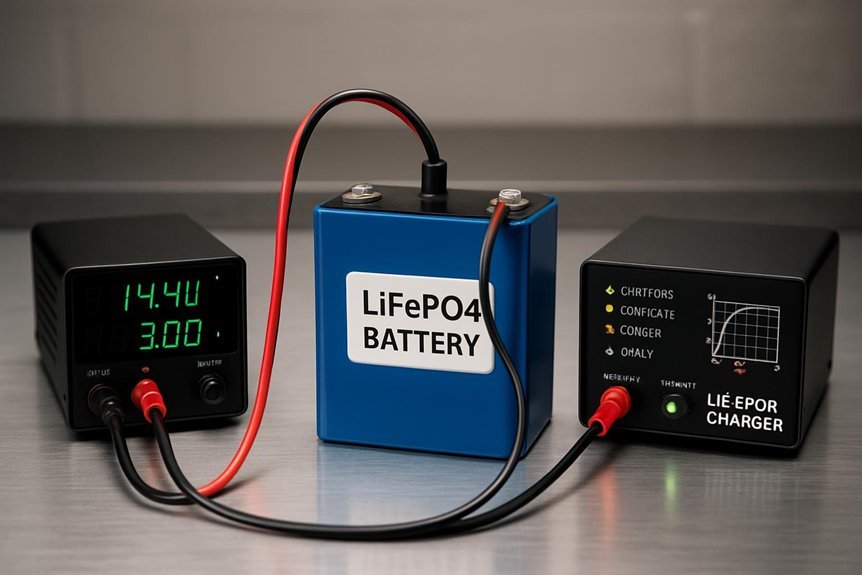
We’ll outline how LiFePO4 charging profiles differ in stages, balancing, termination, and the associated safety and efficiency metrics. We’ll compare typical stage sequences, how balancing affects long-term cell health, and how termination criteria influence charge accuracy and maintenance. This framing keeps our discussion practical as we assess how bench PSUs and dedicated chargers handle these profile specifics.
LiFePO4 Charging Stages
So, what are the distinct charging stages for LiFePO4 and how do they differ from other chemistries? We outline four practical stages that our charger or bench supply can implement, focusing on safety, efficiency, and stability. In LiFePO4, stage transitions emphasize controlled current, precise voltage endpoints, and thermal awareness.
- Initial CC stage with conservative current to avoid inrush and protect cells
- Constant voltage taper when nearing termination, ensuring full cell balance
- Regulation phase for final current cutoff, preventing overcharge
- Safe shutdown and cooldown with monitored cell temperatures and board protections
Key practices: bms testing and heat management are integral to stage accuracy and reliability.
Balancing And Termination Profiles
Balancing and termination profiles focus on finishing LiFePO4 charging with cell-to-cell harmony and safe endpoints. We describe how we steer toward uniform cell voltages and controlled drop-offs, preventing overcharge risks and long-term imbalances. In practice, balancing optimization occurs during rest periods or low-current phases, nudging outliers toward the target voltage without wasting capacity. Termination strategies define when the pack reaches its safe cutoff, avoiding overstress while preserving health. The table below visualizes the process as a sequence of states, where each column represents a focus area and each row marks a decision point.
| Stage | Action | Outcome |
|---|---|---|
| Initialization | Sense cells | Baseline balance |
| Balance power | Equalize | Tight tolerance |
| Cutoff threshold | Verify | Safe termination |
| Rest | Monitor | Stability |
Safety And Efficiency Metrics
We’ve already covered how balancing and termination strategies shape cell harmony and safe endpoints; now we turn to the metrics that verify safety and optimize efficiency in LiFePO4 charging profiles. We assess data-driven indicators that quantify protection effectiveness, heat generation, and charge trajectory fidelity, while avoiding unnecessary deviations. Our focus is on reproducible results, not anecdotes, so we prefer measurable thresholds, real-time alarms, and well-defined end conditions. Two word discussion ideas, irrelevant topic, may appear in preliminary notes, but they don’t drive the core metrics. Practical targets include fail-safe current taper, voltage hold accuracy, and thermal margins during high-rate segments.
1) Current limit conformity
2) Voltage accuracy and drift
3) Temperature and derating response
4) Charging efficiency and cycle loss prevention
What a Proper LiFePO4 Charging Curve Looks Like
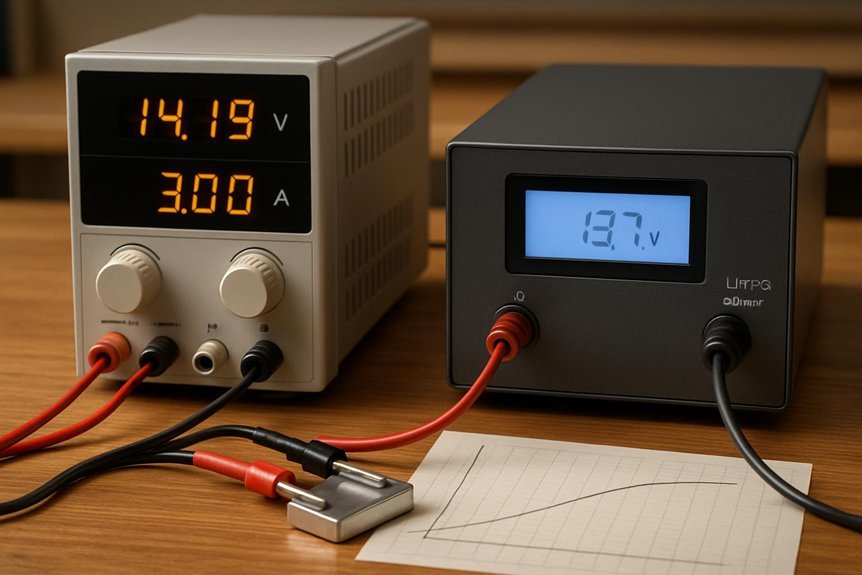
What does a proper LiFePO4 charging curve look like, and why does it matter for reliability and longevity? We outline a controlled process: a CC-CV profile with a tight end-of-charge window, minimal voltage ripple, and stable current tapering into balance. We emphasize bench testing to validate each stage, ensuring charger and cell impedance stay within spec. The curve should maintain about 3.6–3.65 V per cell during the CV phase and taper to a cut-off near 2.8–2.9 V per cell for safety. We monitor temperature and voltage trends to avoid overshoot. A table helps readers grasp targets.
| Stage | Target Voltage | Key Observation |
|---|---|---|
| CC | 3.4–3.6 V | Constant current |
| CV | 3.6–3.65 V | Voltage ripple < 20 mV |
| Termination | ≤2.9 V | Stable, no drift |
| Balance | 0.02–0.05 C | Cell alignment |
| End-point | 0.5–1 A | Minimal ripple |
Pros and Cons of Bench Power Supplies for LiFePO4
Bench power supplies offer flexibility and control for LiFePO4 charging, but they come with trade-offs. We balance adaptability and accuracy against complexity, safety, and cost, focusing on practical outcomes for bench testing and power sourcing.
1) Flexibility vs. risk: adjustable current/voltage help fine-tune stages, but improper limits can overcharge cells.
2) Monitoring requirements: you must rely on external instrumentation and sequencing logic to verify safety and termination criteria.
3) Granular control benefits: precise CC/CV profiles aid reproducibility, yet integration with LiFePO4 curves demands discipline.
4) Portability and cost: compact rigs are affordable, but long-term reliability and protection features may lag.
Pros and Cons of Dedicated LiFePO4 Chargers
Dedicated LiFePO4 chargers streamline charging with built-in safety and chemistry-aware logic, offering a focused alternative to general bench supplies. We weigh reliability, efficiency, and lifecycle impact, noting that dedicated chargers minimize setting errors and optimize current profiles for LiFePO4 chemistry. Their safeguards—voltage, current, and balance checks—reduce risks, while compact form factors suit tight workspaces. However, higher upfront cost and limited cross-chemistry flexibility can constrain users needing versatility. We compare bench PSU adaptability against fixed-function dedicated chargers, prioritizing predictable outcomes for LiFePO4 packs. In practice, selection hinges on volume, desired automation, and maintenance overhead.
| Category | Advantage | Limitation |
|---|---|---|
| Safety | Built-in protections | Less flexible |
| Efficiency | Optimized charging | Higher cost |
| Size | Compact footprint | Limited chem support |
| Cost | Long-term savings | Upfront expense |
| Automation | Scheduling options | Fewer modes |
Essential Protections for Safe LiFePO4 Charging
Essential protections for LiFePO4 charging hinge on proactive, chemistry-aware safeguards that are straightforward to implement in practice. We outline concrete measures we use to preserve cell balance, prevent overcharge, and avoid thermal runaway without unnecessary complexity.
1) Implement strict CC/CV charging with cutoff verification and temperature-based derating.
2) Use accurate cell balancing and individual cell monitoring to detect drift early.
3) Enforce overvoltage, under-voltage, and short-circuit protections with fast, reliable response.
4) Provide thermal monitoring and fan or passive cooling controls to prevent hot spots; log events for traceability.
These steps emphasize reliable, repeatable behavior rather than unrelated topic or random pairing in the control loop.
Precision, Termination, and How Accurate Your Charger Needs to Be
How precise does a LiFePO4 charger need to be, and where should we draw the line on termination accuracy? We’ll quantify accuracy in voltage and current terms, then assess how it impacts charging rounds, safety margins, and long term storage readiness. In practice, most LiFePO4 chemistries tolerate small termination errors without affecting cell integrity, but tighter termination reduces overcharge risk and improves repeatability across cycles. Temperature drift matters: a charger’s reference and sensing circuits drift with ambient and battery temperature, shifting cutoffs subtly. We balance practicality with performance, shooting for voltage setpoints within a few millivolts per cell and current stability within a few percent during bulk and absorption. For long term storage, stricter termination helps preserve capacity; for rapid cycles, looseness saves cost while staying safe.
Balance Monitoring and Cell Health: What to Track
We begin by tracking cell voltage trends to spot aging or creeping imbalances early. We also set clear balance current limits to avoid overcharging while ensuring cells stay in sync. Together, these focus areas keep overall pack health and charging behavior predictable for our LiFePO4 configurations.
Cell Voltage Trends
Do cell voltage trends reveal battery health as clearly as they seem? Yes, but interpretation matters. We monitor how individual LiFePO4 cells drift under load, resting, and during charge to detect early imbalances and aging. Trends guide bench testing and inform whether a pack maintains homogeneity, which is critical for safe operation and predictable performance. We compare each cell’s voltage trajectory against reference baselines and look for outliers, rate of change, and recovery behavior after rest. Subtle deviations can indicate degraded capacity, increased internal resistance, or poor interconnects. Power scaling decisions hinge on reliable trend signals, not single readings. Look for consistent, monotonic shifts with known test conditions rather than noisy spikes.
1) baseline alignment across cells
2) drift rate under identical current
3) recovery after rest periods
4) impact of load changes on balance
Note: bench testing, power scaling.
Balance Current Limits
Balance current limits define how aggressively we can correct cell imbalances without risking overcurrent, heating, or stress on individual cells. In our practical approach, we specify a maximum balancing current that matches pack chemistry and pack size, preventing voltage excursions that degrade longevity. We monitor delta between highest and lowest cell voltages, then apply controlled discharge or charge as needed, staying within thermal and safety margins. This discipline avoids oscillations and minimizes parasitic losses while achieving uniform state-of-charge across the string. Our discussion ideas emphasize configuring limits that reflect charger capability, BMS watchdog behavior, and cooling efficiency. Balancing current should be low enough to be safe yet sufficient for timely convergence. We translate these limits into actionable checks, ensuring stability, predictability, and reliable health tracking.
Cost of Ownership: Upfront, Maintenance, and Replacement
Costs of ownership for bench power supplies and dedicated LiFePO4 chargers break down into upfront price, ongoing maintenance, and replacement timing. We weigh total cost of ownership by upfront hardware costs, long‑term efficiency, and service cycles, focusing on reliability and uptime. Our approach blends practical budgeting with performance predictability, aligning with Idea A and Idea B to minimize risk.
- Upfront price comparisons between generic bench supplies and purpose‑built chargers
- Maintenance labor, parts availability, and inspection intervals
- Energy efficiency impact on operating costs over the life span
- Replacement timing based on component wear, warranty, and planned obsolescence
When to Mix Approaches: Practical Setup Strategies and Next Steps
When should you mix approaches to implement a practical, reliable power solution? We start with a baseline: use a LiFePO4 charger for cells that demand precise voltage control, and a bench supply for testing, conditioning, and balancing tasks. The mix is valid when you need fast transient response, modular expansion, or diagnostic flexibility without committing to bespoke hardware. Establish clear roles: chargers handle charge termination and cell monitoring, bench supplies supply load testing, calibration, and shore power emulation. Implement safety gating, clearly labeled interfaces, and documented transition procedures. Next steps involve validating interoperability, measuring efficiency across states of charge, and simulating fault conditions. Two word discussion ideas, comma separated, about Subtopic not relevant to the Other H2s listed above. continuous integration, risk mitigation.
Frequently Asked Questions
How Do I Adapt a Bench PSU for Lifepo4 Safety Limits?
We adapt a bench PSU by implementing LiFePO4-specific cutoffs and current limits; bypassing nonessential rails isn’t an option. This adaptation faces challenges, but we prioritize safety considerations, documentation, and precise monitoring to prevent overcurrent or overheating.
Can I Charge Lifepo4 Without a Dedicated BMS?
We can, but it’s risky; we wouldn’t recommend charging LiFePO4 without a dedicated BMS. For charging safety and unit durability, use proper protection, monitoring, and cutoff limits to prevent overcharge, short circuits, or thermal runaway.
What Maintenance Does a Lifepo4 Charger Require Over Years?
We maintain a strict maintenance schedule to guarantee long term compatibility, and we’ll keep monitoring indicators and calibration tight. We, readers, stay proactive, checking connections, firmware, and vent conditions as part of our ongoing LiFePO4 charger care.
Are There Emi/Noise Concerns With Bench PSUS for Lifepo4?
Yes, there are EMI concerns with bench PSUs for LiFePO4, and noise can couple into the load. We mitigate with proper grounding, shielding, layout, and EMI filters; also use decoupling and regulated outputs for noise mitigation.
What Is the Failure Mode if Charging Curves Are Wrong?
We’d note that 90% of LiFePO4 pack faults arise from improper charging curves. If charging curves are wrong, failure mode includes overcurrent, thermal runaway risk, and violations of safety limits, potentially damaging cells and triggering protection shutdown.
Conclusion
We’ll wrap this up with a pragmatic compass: choose accuracy and control when the project demands tight convergence, and lean into a LiFePO4 charger when chemistry-aware safeguards matter most. Think of bench PSUs as a precise instrument arm, and dedicated chargers as a trusted curator of cells. For mixed or evolving needs, blend approaches with careful monitoring. In short, precision and safety steer the ship, while cost and maintenance trim the sails.