When we work with LiFePO4 chargers, protecting them from voltage spikes and power surges is essential to guarantee reliable operation and extend their lifespan. These electrical disturbances can cause irreversible damage to both the charger and the battery, compromising performance and safety. By understanding the common causes and implementing targeted protective measures, we can greatly reduce these risks. But what specific devices and strategies should we prioritize to achieve peak protection?
Key Takeaways
- Install surge protection devices like MOVs, GDTs, or TVS diodes close to the charger input for effective voltage spike mitigation.
- Use fuses or circuit breakers matched to charger current and voltage ratings to prevent damage from power surges.
- Maintain robust grounding and short, straight cabling to reduce transient current impact and electrical noise interference.
- Regularly monitor voltage using high-resolution meters or data loggers to detect and respond to voltage anomalies promptly.
- Perform routine maintenance, including inspecting wiring, verifying protection device functionality, and updating charger firmware for optimal safety.
What Causes Voltage Spikes and Power Surges in LiFePO4 Chargers
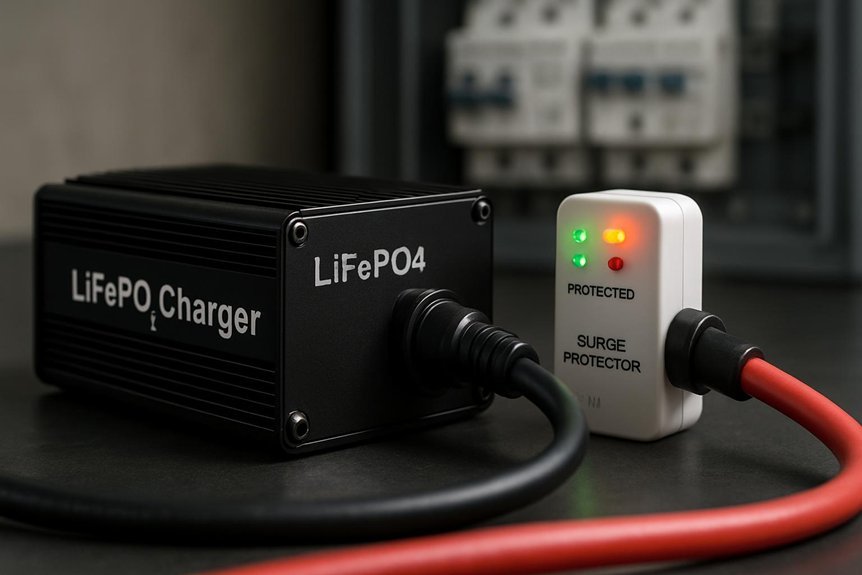
Although LiFePO4 chargers are designed to regulate voltage efficiently, they can still experience voltage spikes and power surges due to various factors. The root causes often stem from environmental factors such as lightning strikes or extreme temperature fluctuations, which impact power quality. Additionally, sudden changes in electrical loads—like motor startups or switching heavy machinery—can induce transient voltage spikes. Equipment malfunction within the charger or connected systems may also generate irregular voltage patterns. Furthermore, grid instability, including frequency deviations and voltage fluctuations from the utility supply, contributes greatly to these surges. Understanding these elements helps us pinpoint vulnerabilities in our LiFePO4 charging systems and guides us in implementing protective measures to maintain ideal performance and prolong equipment life.
How Voltage Spikes Damage LiFePO4 Chargers and Batteries
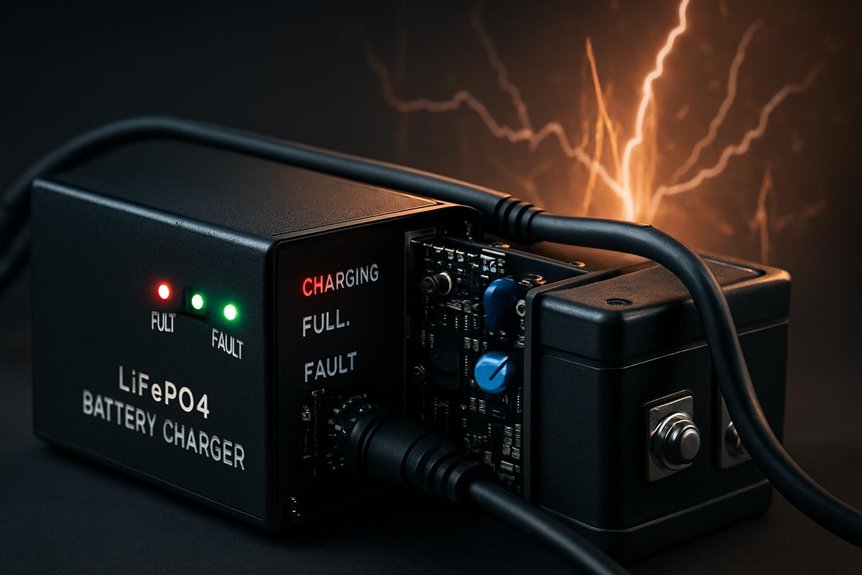
When voltage spikes occur, they subject LiFePO4 chargers and batteries to electrical stress that can quickly degrade their components. Due to the inherent voltage sensitivity of these systems, sudden surges in power quality lead to excessive current flow, causing thermal stress and damaging semiconductor elements in chargers. This damage reduces charger lifespan and impairs their ability to regulate voltage accurately. Furthermore, battery degradation accelerates as voltage spikes disrupt the stable charging profile essential for LiFePO4 chemistry, leading to capacity loss and diminished cycle life. Repeated exposure to such transient events compromises both the charger’s electronics and the battery’s internal structure, emphasizing the critical need to maintain consistent power quality. Understanding these mechanisms helps us appreciate the vulnerability of LiFePO4 charging systems to voltage irregularities.
Essential Surge Protection Devices for LiFePO4 Charging Systems
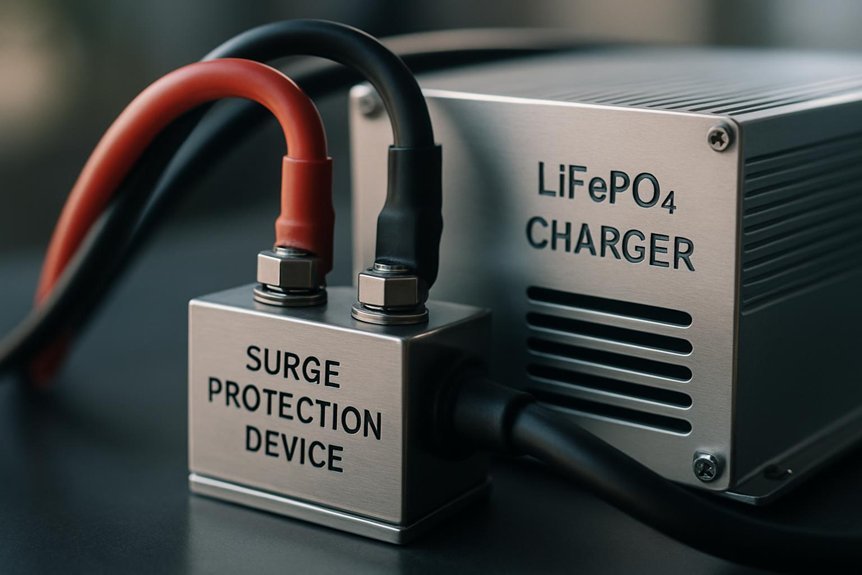
To safeguard our LiFePO4 charging systems, we must select appropriate surge protector types such as metal-oxide varistors and transient voltage suppressors. Proper installation practices, including correct grounding and placement, are critical to ensuring effective surge mitigation. Let’s examine how these devices integrate into our system to optimize protection.
Surge Protector Types
Several key types of surge protectors play a critical role in safeguarding LiFePO4 charging systems from voltage spikes and transient surges. Among the primary surge protector types, Metal Oxide Varistors (MOVs) are widely used for their rapid response and ability to clamp high voltage transients effectively. Gas Discharge Tubes (GDTs) offer robust protection by diverting surges to ground but activate slightly slower than MOVs. Transient Voltage Suppression (TVS) diodes provide precise clamping voltage control, making them ideal for sensitive electronics within chargers. Each surge protector type exhibits distinct surge protector features such as response time, clamping voltage, and energy absorption capacity. By understanding these characteristics, we can select the most appropriate devices to guarantee the longevity and reliability of LiFePO4 charging systems against unpredictable power surges.
Installation Best Practices
Although selecting the right surge protection devices is essential, proper installation practices greatly influence their effectiveness in LiFePO4 charging systems. To maximize protection and system reliability, we must focus on charger placement, cable management, and grounding techniques. Here are key best practices to follow:
- Install surge protectors as close to the charger input as possible to minimize voltage spike exposure.
- Maintain short, straight cable runs with tight, organized cable management to reduce electromagnetic interference.
- Guarantee robust grounding connections to provide a low-impedance path for transient currents.
- Avoid placing chargers near high-power inductive loads or sources of electrical noise.
- Use appropriately rated wiring and connectors to handle surge currents without degradation.
Adhering to these guidelines guarantees ideal surge suppression and prolongs the operational life of LiFePO4 chargers.
How to Install a Surge Protector for Your LiFePO4 Charger
When we install a surge protector for our LiFePO4 charger, we considerably reduce the risk of damage caused by voltage spikes and transient surges. To begin, we verify the surge protector is compatible with our charger’s voltage and current specifications, as charger compatibility is vital to maintaining peak function and safety. We then select a surge protector rated for the maximum expected surge current and response time. Installation involves connecting the surge protector on the AC input line before the charger, preferably near the power source to intercept surges early. We securely ground the protector to enhance performance and verify all connections meet electrical codes. By adhering to these precise steps, we maximize the surge protection benefits, extending the charger’s lifespan and maintaining reliable operation.
Using Voltage Regulators to Stabilize LiFePO4 Charger Input
Beyond protecting our LiFePO4 charger from voltage spikes with surge protectors, maintaining a stable input voltage is equally important to guarantee consistent charging performance. Voltage regulators serve as critical components in voltage stabilization techniques, ensuring the charger receives a steady voltage within its operational range. When selecting a regulator, we must consider charger compatibility considerations such as input voltage range, current capacity, and response time. Key factors include:
- Type of voltage regulator (linear vs. switching)
- Maximum input and output voltage tolerances
- Efficiency and thermal management
- Transient response to rapid voltage changes
- Integration with existing surge protection measures
Why Proper Grounding Is Critical for Surge Protection
Since surge protection depends heavily on safely diverting excess voltage, proper grounding plays an essential role in preventing damage to our LiFePO4 charger. Effective grounding techniques guarantee that transient voltage spikes have a low-resistance path to earth, minimizing the risk of electrical stress on sensitive charger components. Without a reliable ground reference, surge currents can cause voltage differentials that lead to component failure or safety hazards. Implementing industry-standard grounding methods, such as dedicated ground rods and low-impedance connections, enhances electrical safety by reducing electromagnetic interference and preventing ground loops. To summarize, accurate application of grounding techniques is fundamental to maintaining the integrity and longevity of our LiFePO4 charger while safeguarding both the device and users from voltage surges.
Choosing the Right Fuse and Circuit Breaker for Your Charger
To guarantee ideal protection for our Lifepo4 chargers, we need to select the appropriate fuse type and circuit breaker rating based on the charger’s electrical characteristics. Understanding the differences between fast-blow and slow-blow fuses, as well as matching circuit breakers to current and voltage demands, is essential. Additionally, following installation best practices will help maintain system reliability and safety.
Fuse Types Explained
When selecting the right fuse or circuit breaker for our LiFePO4 charger, we must carefully consider the specific electrical characteristics and protection requirements of the system. Understanding fuse types is essential to optimize safety and performance. Fuse ratings determine the current threshold before interruption, while fuse placement affects protection efficacy. Common fuse types include:
- Fast-blow fuses for sensitive, low-current circuits
- Slow-blow fuses to handle transient surges without nuisance trips
- Cartridge fuses offering high interrupting ratings for industrial applications
- Glass tube fuses for visual inspection of fuse condition
- Automotive blade fuses designed for DC circuits with compact form factors
Circuit Breaker Ratings
Selecting the correct circuit breaker rating is critical to guarantee reliable protection for our LiFePO4 charger system. We need to match circuit ratings precisely with the charger’s maximum current and voltage parameters, ensuring the breaker trips before any damage occurs. Different breaker types—thermal, magnetic, or combo—offer distinct response characteristics. Thermal breakers react to heat buildup, suitable for prolonged overloads, while magnetic breakers respond instantly to short circuits. Choosing the right breaker type depends on the specific surge and fault conditions expected in our system. Overrating the breaker risks equipment damage; underrating causes nuisance trips. By analyzing the charger’s operational profile and expected electrical stresses, we can select a circuit breaker with ideal ratings and type, providing effective, reliable safeguarding against voltage spikes and power surges.
Installation Best Practices
Although choosing the right fuse and circuit breaker involves understanding detailed electrical specifications, we can streamline the installation process by adhering to best practices that align protection devices with our LiFePO4 charger’s operational demands. Proper charger placement and wiring considerations are critical to guarantee prompt fault detection and effective surge protection.
Key best practices include:
- Select fuse and breaker ratings slightly above the charger’s maximum current to prevent nuisance trips.
- Position protection devices close to the power source to minimize wiring loop length and voltage drop.
- Use wiring with sufficient gauge to handle inrush and continuous currents without overheating.
- Confirm charger placement allows easy access for inspection and maintenance without compromising safety.
- Verify compatibility between fuse type (fast-blow vs. slow-blow) and charger startup characteristics for reliable protection.
These steps optimize system resilience against voltage spikes and power surges.
How to Monitor Voltage Fluctuations During Charging
Since voltage stability directly impacts the safety and efficiency of LiFePO4 charging, we must closely monitor voltage fluctuations throughout the charging cycle. Employing advanced voltage monitoring techniques, such as high-resolution digital multimeters or dedicated data acquisition systems, enables real-time tracking of voltage variations. Integrating these tools with automated logging facilitates detailed charging data analysis, allowing us to identify transient spikes or dips that could compromise charger integrity. Applying statistical methods to this data helps pinpoint anomalies and predict potential failures before they escalate. By continuously analyzing voltage profiles, we can adjust charging parameters proactively, ensuring peak performance and longevity. This systematic approach to voltage monitoring is essential for mitigating risks associated with power surges and maintaining stable charging conditions for LiFePO4 batteries.
Tips for Maintaining Your LiFePO4 Charger’s Electrical Safety
When we maintain our LiFePO4 chargers with rigorous attention to electrical safety, we greatly reduce the risk of damage and extend the charger’s operational lifespan. Charger maintenance must focus on controlling voltage irregularities and ensuring component integrity. To optimize electrical safety, we should:
- Regularly inspect wiring and connectors for corrosion or wear
- Verify that fuses and circuit breakers function correctly
- Clean ventilation areas to prevent overheating
- Use surge protectors compatible with LiFePO4 chargers
- Monitor charger firmware updates for improved safety protocols
Best Practices to Prevent Voltage Spikes in Solar and EV Setups
Because voltage spikes can severely damage LiFePO4 chargers in solar and EV systems, we must implement targeted strategies to mitigate these surges. First, integrating surge protection devices (SPDs) at critical points in the circuit helps clamp transient voltages effectively. Additionally, optimizing our solar panel arrays by ensuring proper wiring gauge and minimizing shading reduces irregular voltage fluctuations. Employing robust DC-DC converters with built-in overvoltage protection further stabilizes input to the chargers. For EV charging efficiency, we recommend using chargers with advanced voltage regulation and real-time monitoring to detect anomalies early. Grounding and bonding practices also play a pivotal role in mitigating voltage spikes by providing a controlled path for surge dissipation. By combining these methods, we greatly enhance the reliability and longevity of LiFePO4 charging systems in solar and EV setups.
Frequently Asked Questions
Can Voltage Spikes Affect My Lifepo4 Battery’s Lifespan?
Yes, voltage spikes can degrade our Lifepo4 battery’s lifespan by stressing its cells. We must prioritize surge protection and diligent battery maintenance to prevent damage and guarantee peak performance throughout the battery’s operational life.
Are Lifepo4 Chargers Compatible With All Surge Protectors?
Like fitting a key to a lock, not all charger types match every surge protector. We recommend analyzing compatibility carefully to guarantee effective surge protection, avoiding interference with charging protocols and preserving Lifepo4 battery integrity.
How Do Temperature Changes Impact Voltage Spike Risks?
Temperature fluctuations can increase voltage spike risks by stressing electrical components and altering resistance. We need to enhance surge protection designs to accommodate these changes, ensuring Lifepo4 chargers maintain stable performance and prevent damage effectively.
Can Software Updates Improve Charger Protection Against Surges?
Software updates greatly strengthen surge safeguards. By sharpening charger firmware, we boost surge detection, enabling quicker, more accurate responses to voltage spikes. This proactive progress prevents potential damage and enhances overall charger reliability and resilience.
Is It Safe to Use a Lifepo4 Charger Outdoors During Storms?
We don’t recommend using a LiFePO4 charger outdoors during storms. For ideal storm safety, an outdoor setup must include proper surge protection, waterproof enclosures, and grounded wiring to minimize risks from voltage spikes and power surges.
Conclusion
Together, we can shield our LiFePO4 chargers like a fortress against sudden voltage spikes and power surges. By integrating MOVs, TVS diodes, and precise fuses, we create a seamless barrier that absorbs harmful surges before they reach sensitive components. With vigilant monitoring and smart grounding, we maintain a steady electrical flow—like a calm river—ensuring our chargers and batteries perform reliably and last longer in any environment. Let’s power forward with confidence.