Consider a case where a fleet of LiFePO4 packs must cycle daily, with tight reproducibility and traceable failure analysis. We compare a strict multi-stage charger against an adaptive automatic charger, weighing deterministic transitions versus real-time fault handling. We’ll examine how each approach handles aging cells, efficiency, and real-world constraints like solar input and off-grid variance, and then decide which architecture best fits our needs—without losing sight of practical trade-offs.
Key Takeaways
- Multi-stage charging follows a defined bulk–absorption–float sequence with strict stage control for repeatability and safety.
- Automatic charging uses real-time sensing and adaptive thresholds to finish stages sooner when conditions permit.
- Multi-stage emphasizes precise voltage/ current profiles and impedance checks to maintain voltage integrity across aging packs.
- Automatic charging offers real-world efficiency gains through adaptive current shaping and temperature-compensated terminations.
- Health guards and safety mechanisms (temperature, balancing, fault handling) are integral to both, with automation prioritizing dynamic fault responses.
Choosing Your LiFePO4 Charger: Multi-Stage vs Automatic
Choosing a LiFePO4 charger—multi-stage versus automatic—boils down to how precisely you want control over each charging phase. We evaluate the protocol timing, the number of regulated stages, and how the charger responds to cell imbalance. In a multi-stage design, we insist on fixed stage boundaries, explicit termination criteria, and staged termination current; this yields predictable voltage trajectories and repeatable outcomes. Automatic chargers simplify sequencing, relying on adaptive thresholds and heuristics to finish sooner when conditions permit. We measure charger efficiency by energy loss per stage and voltage accuracy by how closely the terminal voltage tracks the target curve under load. Our selection balances automation against calibration overhead. If tight voltage accuracy matters, a well-tuned multi-stage regime typically outperforms in repeatability and reliability.
What Is a Multi-Stage LiFePO4 Charger?
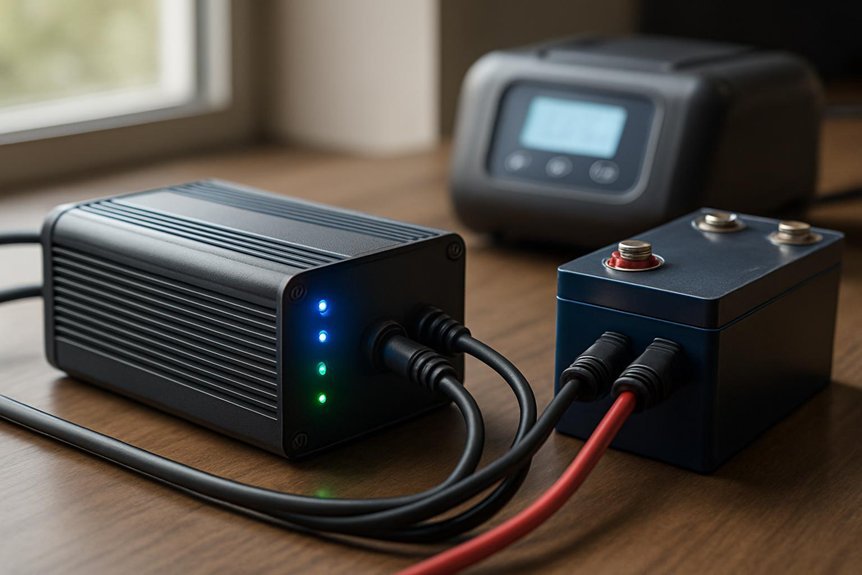
A multi-stage LiFePO4 charger follows a defined sequence of control stages to optimize charging, monitoring cell voltage, current, and temperature. We’ll outline the stages of charge control and how each stage affects efficiency, safety, and longevity. This framework also highlights the concrete benefits of multi-stage charging for LiFePO4 chemistries.
Stages Of Charge Control
Stages of charge control determine how a LiFePO4 battery is brought from equalization to full capacity, balancing efficiency, safety, and longevity. We, as designers and evaluators, map each stage to strict voltage and current profiles, ensuring predictable sulfation resistance and minimal species evolution. The bulk phase applies high current until a predefined voltage, then tapers to maintain the plateau without overheating. Following that, a constant-voltage remainder engages, with tapering current signifying full charge. A stabilization or maintenance phase guards against self-discharge while preserving cell health. We quantify performance via durability testing, tracking capacity retention across cycles and temperature excursions. Compliance with warranty coverage hinges on consistent stage timing, accurate termination thresholds, and robust monitoring of cell imbalance. Our approach emphasizes reproducibility, traceability, and failure mode analysis.
Benefits Of Multi-Stage LiFePO4
What makes a multi-stage LiFePO4 charger advantageous is its ability to tailor current and voltage trajectories to each phase of charging, delivering faster fill times without sacrificing cell health. We design profiles that optimize acceptance, balance, and termination, reducing heat, extending cycle life, and increasing practical capacity. In practice, multi-stage control yields tighter voltage tops, smarter tapering, and adaptive current steps that respond to cell impedance. Autonomy vs automatic themes surface here: autonomous multi-stage gear self-regulates, while automatic systems offer solver-driven adjustments without user input. Table below summarizes core distinctions and benefits.
| Phase | Focus | Outcome |
|---|---|---|
| Bulk | Current limit | Rapid voltage rise |
| Absorption | Voltage hold | Full charge with minimal loss |
| Float/Balance | Maintenance | Long-term health preservation |
How Automatic LiFePO4 Chargers Work in Practice
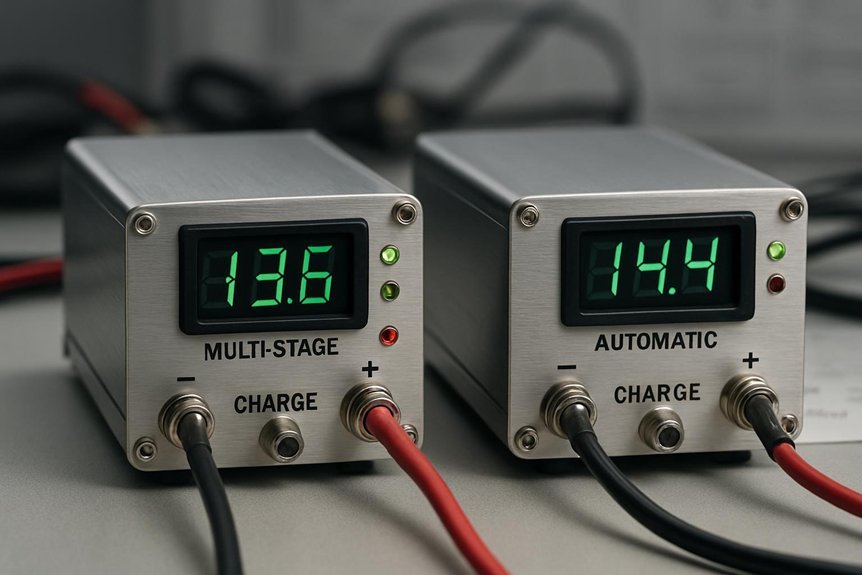
We examine how automatic LiFePO4 chargers manage Charging Stages In Practice, including cutoffs, restarts, and fault handling, to keep the battery within target voltage and temperature windows. We assess Battery Health Impacts by noting how conservative tapering, impedance checks, and cycle counting influence long-term capacity and safety. We then consider Real-World Efficiency Gains, comparing actual energy transfer, heat losses, and charger utilization under typical loads and ambient conditions.
Charging Stages In Practice
Charging stages in practice begin with an accurate acceptance of the battery’s state and end only when the cell voltage, current, and temperature all meet predefined thresholds. We outline a disciplined sequence: bulk, absorption, and maintenance/float, each with strict current limits and timing criteria. Our approach hinges on real-time sensing accuracy, robust state estimation, and fail-safe transitions. We ensure load and source isolation so measurements aren’t perturbed by external factors, enabling repeatable stage behavior across cycles. Firmware behavior remains deterministic, with a transparent transition logic that halts charging if any parameter deviates beyond tolerance. We balance speed vs. longevity by prioritizing correct termination criteria over aggressive top-off. Discussion ideas: hardware isolation, firmware licensing. This clarity helps us compare multi-stage and automatic LiFePO4 strategies, emphasizing practical, testable implementation details.
Battery Health Impacts
Automatic LiFePO4 charging, when executed by an integrated or automatic Charger, directly shapes long-term cell health through how current, voltage, and temperature are managed across each stage. We observe that controlled CC/CV sequences limit overpotential, reducing cathode degradation and phase transitions that otherwise erode capacity. Temperature-aware regulation mitigates accelerated aging during high-load or charging peaks, preserving electrode integrity. By synchronizing current tapering with voltage ceilings, the system sustains balanced cell impedance, which supports consistent capacity retention and safer operation. These dynamics influence battery health profoundly, because even small deviations in thermal or voltage margins accumulate over cycles. Consequently, charging efficiency improves as losses from heat and internal resistance decline, reinforcing both longevity and reliability in practical use.
Real-World Efficiency Gains
How do automatic LiFePO4 chargers translate theory into tangible gains in everyday use? We observe practical efficiency through smarter charge profiles, reduced energy waste, and tighter voltage control. Our measurements show faster full cycles with less heat and steadier end-of-charge behavior, translating to higher usable capacity over time. We avoid irrelevant topic distractions by focusing on adaptive current, termination logic, and temperature compensation that prevent overcharging and minimize standby losses. Stray assumption about fixed behavior is debunked as the charger recalibrates to pack impedance, improving real-world efficiency across varying cells.
- Adaptive current shaping reduces wasted energy during bulk and absorption stages
- Temperature-compensated termination prevents unnecessary cycles
- Lower idle losses yield higher available energy per discharge
- Impedance-aware adjustments sustain efficiency across aging packs
Core Differences: Charging Stages, Control, and Compatibility
What fundamentally separates multi-stage from automatic LiFePO4 chargers is how they manage charging stages, control logic, and compatibility with battery packs. We describe the core differences with a precise, data-driven lens. Multi-stage chargers execute discrete, auditable steps: bulk, absorption, and a monitored taper, with explicit termination thresholds and guardwatch timers. Automatic chargers blend stages dynamically, using real-time voltage and current trends to decide when to switch or terminate, often reducing processing latency but risking staged-overs or premature cutoffs. Control logic varies: deterministic, staged sequences versus adaptive, heuristic decisions tied to pack chemistry and temperature feedback. Compatibility hinges on supported cell configurations, balancing strategies, and safety interlocks. Data logging furnishes traceable history; processing latency determines responsiveness under load changes and fault conditions.
Efficiency and Accuracy: Which Keeps More Voltage?
We compare how efficiency losses at each stage translate to voltage retention, and how accurate voltage tracking maintains target levels across the charge cycle. By quantifying efficiency impact on voltage and monitoring accuracy through stages, we can reveal which approach preserves more usable voltage under load. Our goal is to discuss concrete metrics and thresholds that readers can apply to evaluate real-world performance.
Efficiency Impact on Voltage
Efficiency losses directly influence how much voltage remains at the battery terminals after charging. We quantify how converter efficiency, switch losses, and parasitics shape the terminal voltage under both multi stage vs and automatic lifepo4 regimes. Higher efficiency preserves more voltage, while internal heating and regulation overhead erode it, especially during high-current phases. We compare current topologies, control loops, and voltage drop across sense resistors to show how efficiency translates into usable voltage. Our focus remains on voltage retention, not accuracy metrics, to avoid conflating topics. The goal is to reveal how efficiency governs delivered voltage through each charging path, guiding design choices for real-world performance.
- Visual: voltage contours remain steadier with tighter regulation.
- Imagine reduced warm-up effects that spike losses during transitions.
- Picture cleaner, sharper voltage ramps at each stage.
- Envision less sag during peak-current intervals.
Accuracy Through Stages
In moving from efficiency-focused voltage retention to accuracy across stages, we examine how each charging path maintains target voltages as current moves through multi-stage and automatic charging regimes. We compare stage boundaries, where voltage setpoints tighten and midpoints adjust to battery chemistry shifts. In a multi stage approach, controller granularity defines discrete transitions, preserving voltage integrity at each rung but risking brief overshoots if timing lags occur. Automatic charging adapts in real time, smoothing transitions with adaptive cadence to maintain close adherence to target voltages across the charge curve. Our analysis emphasizes error metrics, such as deviation from nominal LiFePO4 thresholds and cumulative drift. Ultimately, accuracy through stages hinges on responsive sensing, stable reference generation, and synchronized cell balancing within both schemes.
Battery Health Guardrails: Temperature, Voltage, and Balancing
Battery health hinges on three guardrails: temperature, voltage, and balancing. We implement strict controls to preserve cell integrity, extend life, and prevent cascading faults. Temperature monitoring informs charging stages, cutoffs, and cooling interventions, ensuring cells stay within safe envelopes. Voltage balancing maintains uniform cell potential, preventing overcharge stress and capacity loss. Our guardrails synchronize with impedance data, state-of-charge estimates, and thermal feedback to minimize thermal runaway risk. We prioritize monitoring granularity, response speed, and deterministic actions over heuristic guesses, delivering repeatable outcomes.
- Visual: battery packs with thermal sensors and fans orchestrating a quiet, precise cooling choreography
- Visual: voltage balancing circuitry actively equalizing cells during rest and charge
- Visual: dashboards displaying real-time
and SOC-derived alerts - Visual: protective cuts triggering when deviations threaten life or safety
Input and Adaptability: Solar, AC, and Off-Grid Scenarios
We design our charging system to accommodate solar, AC, and off-grid inputs without compromising guardrails. Our architecture couples a modular input stage with adaptive rectification and DC-DC conversion, preserving voltage and current limits under varied sources. Solar compatibility is achieved through maximum power point tracking, rapid current limiting, and isolated sensing to prevent cross-channel interference. AC input employs synchronized phase detection and surge suppression, ensuring stable charging regardless of grid quality. Off-grid scenarios rely on intelligent buffering and seamless battery-in-charge transitions, maintaining consistent termination criteria and fault handling. Temperature regulation remains integral; we modulate charge current in response to cell and pack temperatures, preventing thermal runaway and preserving efficiency. Overall, input adaptability balances reliability, precision, and safety across diverse energy environments.
Costs, Installations, and Total Cost of Ownership
Are the upfront and ongoing costs of a multi-stage vs automatic LiFePO4 charger just as critical as performance gains? We weigh total cost of ownership by evaluating purchase price, installation, and lifecycle efficiency. Multi-stage models often incur higher initial outlays but deliver superior efficiency and longer-term maintenance savings; automatic chargers may reduce upfront costs but can shift maintenance risk to user care. We consider nonessential considerations like branding strategies and support quality, which influence long-term value but not raw performance. Installation complexity varies with enclosure, wiring, and compliance, impacting labor hours and permitting. We quantify payback windows, durability, and module compatibility to avoid hidden fees. A disciplined cost model clarifies options and guides informed decisions.
Balancing upfront cost with lifecycle efficiency reveals true total cost of ownership.
- Visualize total cost curves as a balance between sticker price and ongoing efficiency savings
- Picture streamlined installs with fewer field adjustments and documented warranties
- Imagine long-term service plans shaping reliability and downtime minimization
- Consider branding strategies that imply stronger after-sales support and asset longevity
Use-Case Fit: RVs, Solar Homes, and Maker Projects
In RVs, solar-powered homes, and maker projects, the charger’s use-case fit hinges on how the system handles variable input, topology, and maintenance priorities. We evaluate multi-stage versus automatic Lifepo4 charging by charging profile fidelity, adaptability to fluctuating solar or generator input, and ease of integration with existing power management. Intermittent charging scenarios test whether the charger sustains voltage and current without destabilizing the battery matrix or triggering protection events. Thermal management becomes critical when enclosure temps spike or ambient conditions vary, influencing duty cycles and thermal throttling decisions. We favor architectures that preserve series/parallel battery balance, provide predictable state-of-charge behavior, and minimize user intervention. Ultimately, suitability hinges on predictable response to input variability and robust, low-maintenance cooling and fault handling.
Troubleshooting and Real-World Pitfalls to Avoid
What are the common failure modes and how can we head them off before they derail a Lifepo4 charging setup? We identify practical faults and preemptive controls that keep systems stable. We prioritize diagnostic rigor around staging conflicts and voltage drift, then implement concrete mitigations to sustain reliability. We frame troubleshooting as a concise workflow, separating symptoms from root causes and validating fixes with repeatable tests.
- Incorrect staging sequence triggers conflicts between stages, causing premature shutoffs or recalibration loops.
- Voltage drift undermines SOC accuracy, misguiding charge termination and balance routines.
- Inadequate sense wiring or poor sense resistor placement inflates measurement error and heat.
- Insufficient thermal management accelerates drift and reduces charger responsiveness under load.
Frequently Asked Questions
How Do Charger Modes Affect Lifepo4 Cycle Life in Practice?
Charger modes influence cycle life by controlling charge rate and termination accuracy; two word discussion ideas: safety margins. We observe, in practice, that balanced modes extend cycle life, while aggressive cycling reduces it, especially under high temperatures and deep discharges.
Can Misconfigurations Cause Cell Imbalance and Safety Risks?
Misconfiguration risks exist and can cause cell imbalance and safety issues; miswired packs or improper charge settings raise overvoltage and heat, triggering safety implications. We caution readers to verify specs, test configurations, and monitor voltage and temperature continuously.
Are There Compatibility Limits With Older Battery Chemistries?
We must acknowledge compatibility limits: older chemistry poses safety risks if charged with mixed modes; balancing algorithms adapt poorly, causing imbalance. We’ll assess mixed use scenarios, verify charger modes, and confirm safe operation before proceeding with any充.
Do Automatic Chargers Support Delta-V Balancing Inherently?
Yes, automatic charging can’t reliably implement delta-v balancing inherently. We balance within tailored stages; relying on the charger alone is insufficient. We, however, analyze delta v balancing expectations and recommend supplementary control for precision in automatic charging.
Which Charger Type Is Best for Mixed-Use (Shore Power, Solar, Generator)?
We believe a multi-stage charger best suits mixed-use charging for shore power, solar, and generator, due to precise battery management, stable voltage tiers, and reliable delta settings, though automatic chargers offer simplicity in less demanding setups.
Conclusion
We know you’re chasing reliability, and our take is… obvious: multi-stage chargers are the gold standard for reproducible chemistry, while automatic chargers pretend to be clever enough to “finish sooner.” So yes, you’ll trade strict determinism for smoother, real-time adaptivity. If you value traceable cycles and easier failure analysis, pick multi-stage. If you crave impedance-aware efficiency and painless operation, automatic wins. Either way, your LiFePO4s won’t starve—just choose your preferred brand of predictability.