Did you know that improperly parallel charging LiFePO4 battery banks can reduce overall lifespan by up to 30%? To prevent this, we need to guarantee all banks share a closely matched voltage and state of charge before connecting them. Understanding the precise steps and equipment involved is essential for safety and efficiency. Let’s explore how to set up and maintain these systems correctly to optimize performance and avoid common pitfalls.
Key Takeaways
- Ensure all LiFePO4 battery banks have matching voltages and state of charge within ±5% before parallel connection.
- Use equal length, gauge wires with high-quality connectors and proper insulation to maintain safety and reduce heat buildup.
- Select smart chargers optimized for LiFePO4, supporting balanced charging and dynamic current distribution across all banks.
- Continuously monitor voltage, current, and temperature of each bank to prevent overheating, overcharging, and uneven charge distribution.
- Integrate a reliable BMS and perform regular maintenance to ensure cell balancing, fault isolation, and long-term battery health.
Why Parallel Charging LiFePO4 Batteries Matters
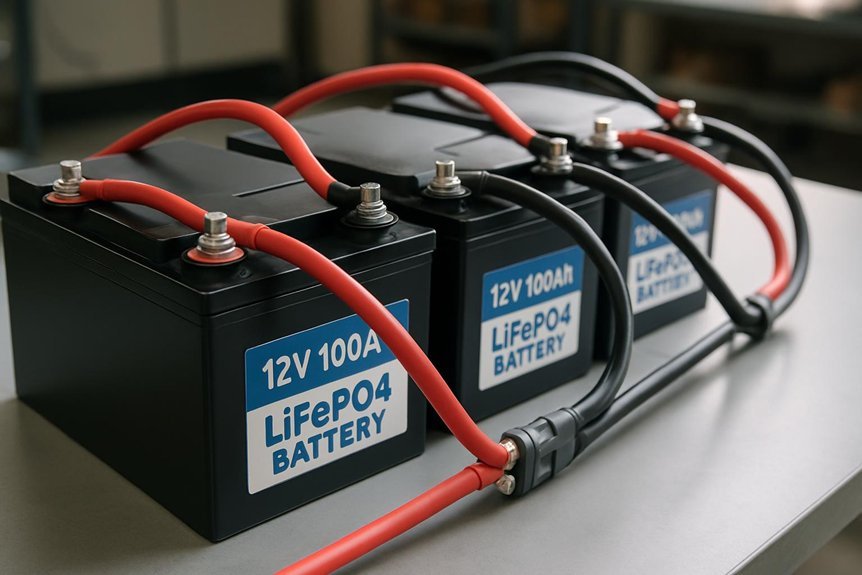
Although charging LiFePO4 batteries individually is straightforward, parallel charging offers significant advantages that we should consider carefully. The unique battery chemistry of LiFePO4 supports stable voltage levels, enabling effective parallel configurations without compromising safety protocols. By charging batteries in parallel, we improve charge distribution, balancing current flow across cells and enhancing charging efficiency. This method also boosts system reliability by reducing the risk of overcharging or imbalanced states that can arise from individual charging. Additionally, parallel charging optimizes power management by allowing higher energy density setups to be charged simultaneously, saving time and resources. Understanding these benefits helps us design robust battery systems that maintain safety while maximizing performance and longevity. Consequently, parallel charging is a critical strategy for efficient LiFePO4 battery management.
How to Prepare LiFePO4 Banks for Parallel Charging
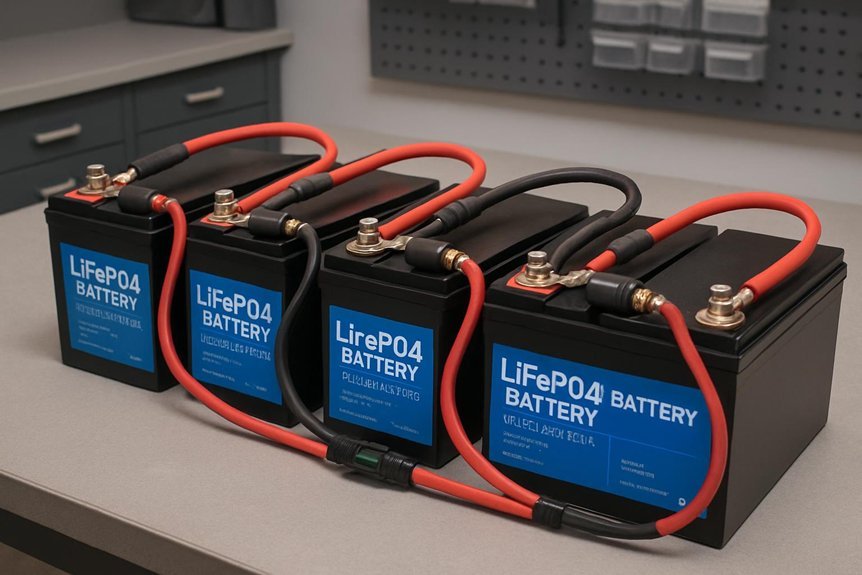
Having established the benefits of parallel charging LiFePO4 batteries, we now need to focus on preparing battery banks to guarantee safe and efficient operation. Proper battery bank preparation involves matching voltage levels, confirming equal state of charge (SOC), and verifying wiring integrity. Adhering to strict safety protocols reduces risks of imbalance and damage during charging.
| Step | Action |
|---|---|
| 1. Voltage Matching | Confirm all banks share the same voltage level |
| 2. SOC Equalization | Balance SOC within ±5% before connection |
| 3. Wiring Inspection | Use equal length, gauge wires; check connections |
| 4. Safety Checks | Verify fuses, breakers, and insulation integrity |
| 5. Temperature Control | Confirm ambient temperature is within recommended range |
Following these methodical battery bank preparation steps is essential to achieve safe parallel charging.
Choosing the Right Charger for Multiple LiFePO4 Banks
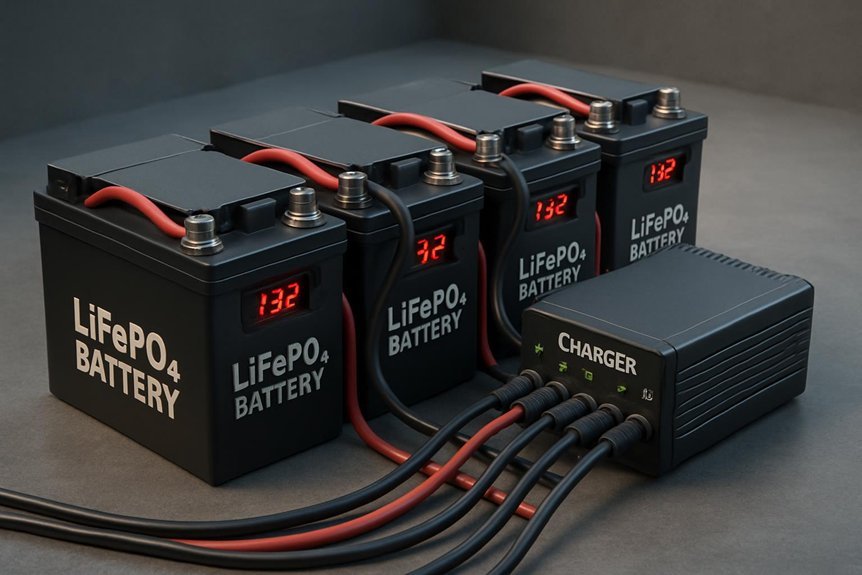
When we select a charger for multiple LiFePO4 banks, we must guarantee it can handle the combined voltage and current requirements while maintaining precise charge control. It’s crucial to verify charger specifications to match the total battery voltage and guarantee current ratings accommodate the parallel load. Charger compatibility with LiFePO4 battery chemistry is critical for optimized charging and safety. We should also prioritize charging efficiency and speed without compromising battery health. Additionally, safety certifications confirm the charger meets industry standards. Key considerations include:
- Confirming voltage requirements align with total bank voltage
- Guaranteeing current ratings support parallel charging load
- Selecting smart chargers for dynamic charge control
- Verifying compliance with safety certifications
- Prioritizing chargers optimized for LiFePO4 chemistry and charging efficiency
Balancing Voltage and Capacity Across Parallel Banks
Since parallel battery banks combine multiple cells to increase capacity while maintaining voltage, we must carefully balance both voltage and capacity to guarantee uniform performance and longevity. Voltage equalization is critical; without it, variations between individual cells can lead to uneven charging and discharging, stressing weaker cells. We achieve this by ensuring all banks reach the same voltage level during charging cycles. Additionally, capacity distribution must be managed so that each parallel bank shares the load proportionally. Differences in capacity can cause imbalanced current flow, accelerating degradation in lower-capacity cells. Implementing precise voltage equalization and monitoring capacity distribution allows us to maintain consistent state-of-charge across banks, preventing premature failure and maximizing overall battery bank efficiency and lifespan.
Monitoring Temperature and Preventing Overheating
We need to implement accurate temperature sensing techniques to monitor each LiFePO4 cell during parallel charging. By continuously measuring thermal data, we can detect early signs of overheating and apply effective prevention methods. Let’s examine the most reliable sensors and control strategies to maintain safe operating temperatures.
Temperature Sensing Techniques
Accurate temperature sensing forms a critical pillar in safely managing LiFePO4 battery charging. To effectively monitor battery thermal conditions and ambient temperature, we rely on precise sensor integration and advanced measurement techniques. Key temperature sensing methods include:
- Thermocouple sensors for direct, rapid temperature readings at critical battery points
- Resistive temperature devices (RTDs) offering high accuracy and stability over time
- Infrared thermography and thermal imaging to non-invasively map heat dissipation patterns across battery banks
- Ambient temperature sensors to contextualize battery thermal data relative to environmental conditions
- Integrated sensor arrays for thorough, real-time monitoring enabling early detection of thermal anomalies
These techniques provide the data foundation necessary to maintain safe charging profiles and avoid hazardous overheating.
Overheating Prevention Methods
Building on the methods we use to capture precise temperature data, preventing overheating requires actively monitoring these measurements and implementing responsive controls. We integrate thermal insulation to minimize external heat influence and maintain stable battery temperatures. Additionally, active cooling systems—such as controlled fans or liquid cooling—are deployed to dissipate excess heat generated during charging. Temperature sensors relay real-time data to a central controller, which adjusts charging current or activates cooling mechanisms when thresholds approach critical limits. This dynamic response prevents thermal runaway and prolongs battery lifespan. By combining thermal insulation with active cooling and continuous monitoring, we create a robust safety protocol that guarantees each LiFePO4 battery bank remains within safe operating temperatures throughout parallel charging cycles.
Wiring Best Practices for Safe Parallel Connections
When wiring LiFePO4 batteries in parallel, we must use balanced wire gauges to guarantee equal current distribution and minimize voltage drops. Secure connection techniques, such as properly torqued terminals and reliable connectors, are essential to maintain consistent contact and prevent resistance buildup. Let’s examine how these practices contribute to safe and efficient parallel charging.
Balanced Wire Gauge
Choosing the right wire gauge is critical to secure safe and efficient parallel connections in LiFePO4 battery systems. Proper wire gauge selection guarantees each battery bank shares current evenly, preventing imbalances and overheating. We must focus on maintaining uniform current capacity across all wiring to optimize performance and safety.
Key considerations include:
- Use identical wire gauges for all parallel connections
- Calculate wire gauge based on maximum expected current capacity
- Minimize voltage drop by selecting thicker wires for longer runs
- Avoid mixing wire gauges to prevent uneven current distribution
- Confirm wire insulation rating matches system voltage and temperature
Secure Connection Techniques
Secure connection techniques form the foundation of safe and reliable parallel wiring in LiFePO4 battery systems. To guarantee peak performance, we must strictly follow established connection protocols, which include using high-quality, appropriately rated connectors and verifying uniform torque on all terminals. Consistent torque prevents uneven contact resistance, reducing heat buildup and enhancing terminal safety. We also recommend using anti-oxidation compounds on connections to maintain conductivity over time. Proper cable management is critical—keeping wires organized and secured minimizes mechanical strain and potential disconnections. Additionally, insulating all terminals and exposed conductive parts safeguards against accidental shorts. By adhering to these wiring best practices, we create a robust parallel battery bank that minimizes risk and maximizes longevity, ensuring safe, efficient parallel charging of multiple LiFePO4 battery banks.
How to Detect and Fix Cell Imbalances Early
How can we reliably identify early signs of cell imbalances in LiFePO4 battery packs? Effective cell monitoring is vital for early imbalance detection. We should regularly analyze voltage and temperature readings of individual cells to spot deviations. Key indicators include:
- Unequal cell voltages during charging or discharging
- Variations in cell temperature beyond normal ranges
- Reduced capacity or runtime in specific cells
- Unexpected voltage drops under load
- Inconsistent state of charge among cells
Detecting these signs early allows us to intervene before damage occurs. To fix imbalances, we can balance cells manually by equalizing charge levels using controlled discharge or selective charging methods. This proactive approach guarantees safety and prolongs pack lifespan without waiting for critical failures.
Using Battery Management Systems (BMS) in Parallel Setups
Anyone working with LiFePO4 battery packs in parallel configurations must integrate a reliable Battery Management System (BMS) to guarantee safe operation and longevity. The BMS functionalities are critical, including real-time monitoring of voltage, current, and temperature across each cell and bank. Proper cell balancing is essential to prevent uneven charge distribution, which can lead to capacity loss or unsafe conditions. In parallel setups, the BMS must synchronize the states of charge among banks, ensuring uniform voltage levels. It also manages overcurrent protection and isolation during faults. By continuously equalizing cells and coordinating charge cycles, the BMS maintains peak performance and extends battery life. Without this precise control, parallel battery systems risk instability and premature degradation, making a well-designed BMS indispensable in these configurations.
Common Mistakes That Risk Safety and Battery Life
Although parallel charging of LiFePO4 batteries offers numerous advantages, overlooking critical safety protocols can severely compromise both battery life and user safety. Common mistakes often stem from neglecting essential charging protocols and proper battery maintenance. We must avoid:
- Mixing cells with different states of charge or capacities
- Using mismatched or inadequate Battery Management Systems (BMS)
- Ignoring temperature monitoring during charging cycles
- Failing to balance cells before and during parallel charging
- Overlooking manufacturer-specified charging voltage and current limits
These errors increase the risk of thermal runaway, capacity loss, and premature battery failure. By adhering strictly to established charging protocols and maintaining regular battery inspections, we guarantee safety and extend battery lifespan. Recognizing these pitfalls helps us implement safer, more reliable parallel charging systems for LiFePO4 battery banks.
Tips to Maximize Performance and Longevity When Charging in Parallel
Five key practices can greatly enhance the performance and longevity of LiFePO4 batteries when charging in parallel. First, guarantee all battery banks have matched voltage and capacity to optimize charging efficiency. Second, use balanced charging systems to maintain uniform battery health. Third, monitor temperature continuously to prevent overheating. Fourth, implement proper wiring with low resistance to reduce energy loss. Fifth, perform regular maintenance checks to catch issues early.
| Practice | Purpose | Impact on Battery |
|---|---|---|
| Matched Voltage/Capacity | Maximize charging efficiency | Prolongs battery health |
| Balanced Charging | Uniform charge distribution | Prevents capacity loss |
| Temperature Monitoring | Avoids thermal stress | Enhances safety |
Following these steps guarantees safe, efficient parallel charging and extends battery lifespan.
Frequently Asked Questions
Can Lifepo4 Batteries From Different Manufacturers Be Charged in Parallel?
We don’t recommend charging LiFePO4 batteries from different manufacturers in parallel due to battery compatibility issues. Mixing brands can reduce charging efficiency and risk imbalance, so we should match batteries carefully to guarantee safe, ideal performance.
How Does Ambient Humidity Affect Parallel Charging Safety?
We understand humidity effects can reduce charging efficiency by promoting corrosion and insulation degradation. So, we monitor ambient humidity closely to maintain safe parallel charging conditions and prevent potential electrical failures or performance losses in our battery banks.
What Are the Signs of Internal Cell Damage During Parallel Charging?
Watch for cell swelling and voltage imbalance—they’re critical signs of internal cell damage. We need to monitor these precisely, as they indicate compromised safety and performance during parallel charging, demanding immediate inspection and corrective action.
Is It Necessary to Use the Same Capacity Batteries in Parallel?
We don’t have to use identical capacity batteries in parallel, but capacity matching is essential to guarantee balanced current sharing and prevent stress. Also, battery chemistry must be consistent to maintain safe, efficient charging and avoid damage or reduced lifespan.
Can Parallel Charging Impact the Warranty of Lifepo4 Batteries?
Yes, parallel charging can affect warranty terms if not done correctly. We should carefully assess parallel risks like imbalance or overcurrent to guarantee compliance, as manufacturers often exclude damage caused by improper parallel charging from warranty coverage.
Conclusion
To conclude, safely synchronizing our LiFePO4 battery banks requires sharp vigilance and systematic steps. By balancing battery banks, selecting smart chargers, and securing solid connections, we safeguard stability and strengthen system success. Monitoring metrics like voltage and temperature meticulously minimizes malfunction risks. Most importantly, managing with a reliable BMS maintains harmony and health across parallel setups. Let’s prioritize precise procedures to preserve performance and prolong the power potential of our LiFePO4 batteries.