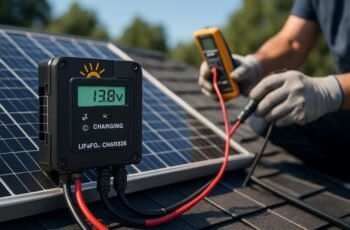
We can monitor charger performance with smart diagnostics tools to reveal real-time health, usage, and thermal trends. By aggregating foundational metrics and time-series data, we’ll spot degradation paths, anomalies, and priority failure modes, enabling targeted maintenance and optimized charging. Our dashboards translate signals into actionable steps, but uncertainties remain in how best to apply predictive insights across a fleet. If we align on data quality and cadence, we’ll unlock meaningful uptime gains and longer asset life.
Key Takeaways
- Smart Diagnostics continuously monitor charger health, usage, and thermal profiles to detect degradation and optimize maintenance.
- Foundational metrics track charge cycles, session times, energy delivered, availability, fault rates, and data quality.
- Dashboards use normalized data, trend-rich visuals, and versioned baselines for firmware-aware insights.
- Anomaly detection flags latency shifts, stalls, and abnormal ramp rates to catch early faults before failures.
- Predictive dashboards forecast faults, enable targeted maintenance, and coordinate remote firmware rollouts.
Why Smart Diagnostics Improve Charger Performance for Your Fleet
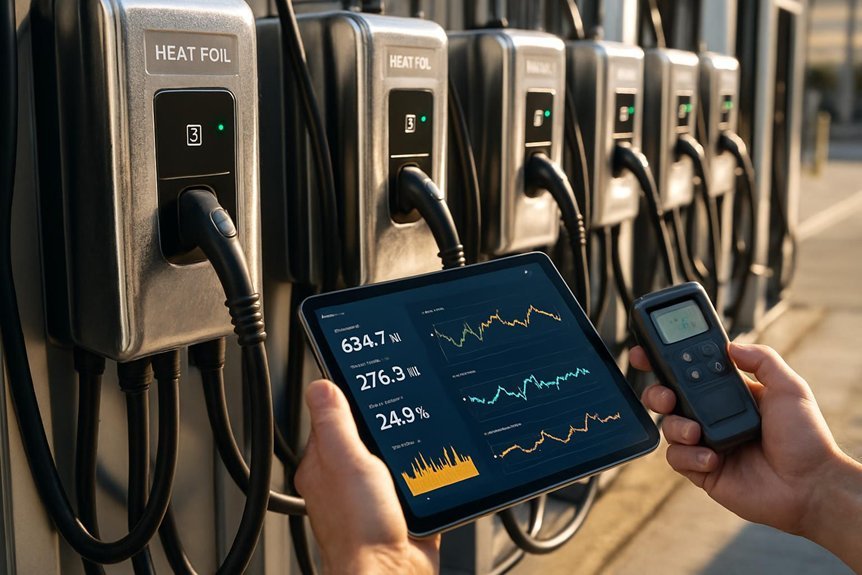
Smart Diagnostics unlocks actionable insights by continuously monitoring charger health, usage patterns, and thermal profiles across the fleet. We explain how smart diagnostics translate to tangible performance gains for your operation. By aggregating real-time data, charger analytics identify degradation trajectories, anomalous behavior, and priority failure modes before they escalate. This proactive visibility enables targeted maintenance, reducing unplanned downtime and extending asset life. With precise anomaly detection, we optimize charging schedules, balancing load and thermal stress to preserve efficiency. We also quantify reliability improvements through standardized metrics, enabling data-driven budgeting and capacity planning. Our approach links diagnostic signals to operational decisions, ensuring rapid response to emerging issues. In short, smart diagnostics yield clearer root-cause insights and more consistent charger performance across the fleet.
Foundational Metrics: What to Measure Before Dashboards
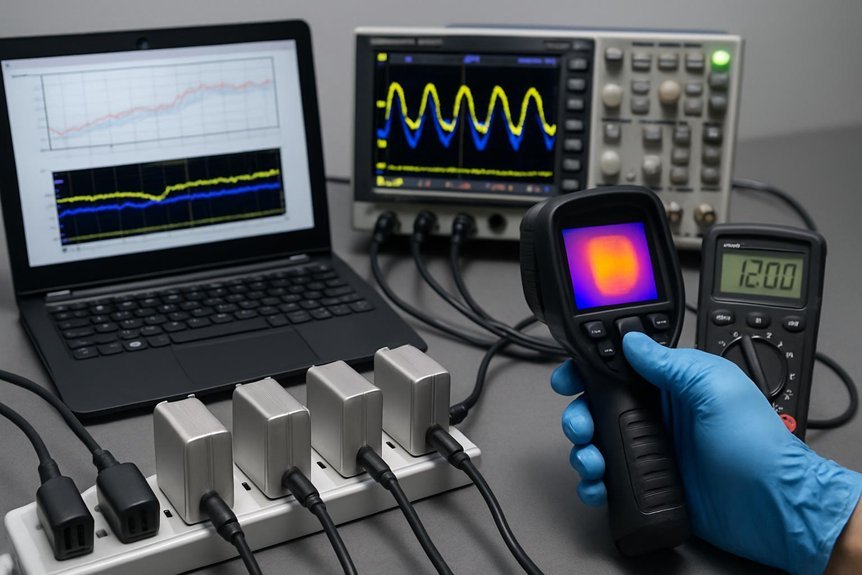
What foundational metrics should we track before building dashboards? We begin by identifying core signals that reveal charger health, reliability, and usage patterns. Foundational metrics include charge cycle counts, average charging time, energy delivered per session, and availability statistics, as they anchor deployment performance. We quantify fault rates, mean time between failures, and triage time for fault isolation to gauge maintenance impact. We measure contention indicators like port saturation and queue depth during peak windows to inform capacity planning. For data quality, we define ingest latency, timestamp accuracy, and completeness rates. In dashboard design, we translate these metrics into stable baselines, acceptable variance thresholds, and standardized units, enabling consistent interpretation across devices and sites. This discipline prevents misleading visuals and supports sound decision-making.
From Metrics to Dashboards: Build Your Charger Health View
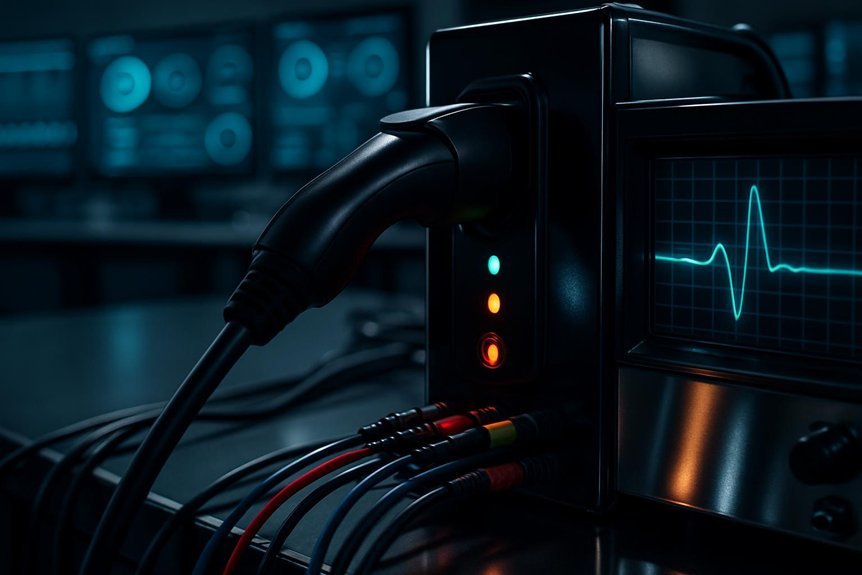
How can we turn raw metrics into actionable visuals that reveal charger health at a glance? We design dashboards that map real-time telemetry to curated indicators. We start with a stable data model, applying data normalization to align disparate sources, scales, and units. Our visual layer emphasizes trend accuracy, labeling, and axis consistency to avoid misinterpretation. We define core dashboards that track charger firmware integrity, thermal profiles, energy throughput, error rates, and uptime, with aggregates tuned to operational ranges. We prioritize modular widgets—time-series charts, sparklines, and status gauges—that automate drill-down paths for maintenance teams. We implement versioned dashboards tied to firmware baselines, ensuring comparisons remain valid as charger firmware evolves. Our approach balances precision, readability, and actionable insight for rapid decision-making.
Detecting Anomalies: Typical Warning Signals for Chargers
When do warning signs first appear, and how can we spot them early? We observe anomalies as deviations from established baselines in charging curves and timing profiles. Early indicators include persistent, unexplained increases in charging latency, brief stalls during high-current phases, and irregular ramp rates that diverge from manufacturer specifications. We track these signals across multiple sessions to distinguish transient noise from systemic drift. Key concerns are charging latency anomalies that extend beyond tolerance windows and subtle shifts in voltage/current trajectories that foreshadow performance loss. We also monitor indicators tied to battery degradation, such as rising impedance and reduced effective capacity reflected in shorter cycle endurance. Precise alert thresholds and continuous cross-checks against historical data help prevent false positives while isolating genuine charger health risks.
Forecasting Charger Failures With Predictive Analytics
We implement a Predictive Diagnostics Framework to translate sensor data into actionable failure forecasts. By monitoring Early Failure Indicators, we quantify risk trajectories and trigger timely maintenance actions. This approach keeps diagnostics tight, interpretable, and aligned with proactive charger reliability goals.
Predictive Diagnostics Framework
Predictive diagnostics for chargers leverages historical failure data, sensor streams, and usage context to forecast unit-level faults before they manifest. Our framework integrates multi-sensor fusion, time-series analysis, and domain-specific failure modes to produce actionable risk scores. We prioritize reproducibility, traceability, and explainability, documenting feature provenance and model assumptions. Data preprocessing emphasizes quality control, segmentation, and alignment across heterogeneous sources to minimize drift. We address predictive challenges by balancing recall and precision, calibrating thresholds, and validating against holdout cohorts. We implement data labeling guidelines that distinguish fault-relevant signals from anomalies, ensuring labels reflect operational impact rather than mere deviations. The framework supports continuous learning with periodic retraining and rigorous versioning, enabling adaptive maintenance planning while preserving auditability and safety compliance.
Early Failure Indicators
What early signals best foreshadow charger failures, and how can we forecast them with predictive analytics? We, the team, track operational metrics that precede faults: voltage sag under load, rising impedance, ripple anomalies, transient overshoots, and thermal excursions beyond baseline. We integrate time-series patterns, degradation curves, and event histories to generate probabilistic failure scores. Our approach emphasizes data governance, ensuring consistent provenance, labeling, and quality checks so models learn from clean inputs and produce defensible outputs. We apply anomaly detection to detect subtle shifts before alarms trigger, then validate with cross-validated forecasts across hardware cohorts. We also align with charging etiquette, preserving user experience while we isolate root causes. Predictive dashboards translate insights into actionable maintenance windows, reducing unplanned downtime and extending asset life.
Remote Monitoring: Keep Chargers in Sync Anywhere
We enable Remote Sync Capabilities to keep all chargers aligned, regardless of location, ensuring consistent configurations and policies. We provide Real-Time Status Updates to verify health, usage, and firmware state across the network, so issues are surfaced immediately. We offer Silent Alerts with flexible Alerts Tuning to balance responsiveness and noise, refining notification thresholds without disrupting operations.
Remote Sync Capabilities
Remote Sync Capabilities enable real-time coordination of multiple chargers across locations, ensuring consistent performance and centralized oversight. We implement synchronized timing, shared configuration sets, and unified firmware rollouts to minimize divergence between units. Our approach reduces diagnostic drift by aligning event timestamps and telemetry intervals, enabling coherent cross-site analyses. By design, remote sync mitigates local variances in power quality, throughput, and release timing, ensuring that charging sessions follow a uniform cadence. We quantify this with metrics on message latency, clock skew, and recovery time after outages. The benefits include faster root-cause isolation and more reliable capacity planning. Nonetheless, we monitor diagnostic latency to confirm end-to-end integrity, guarding against stale data and stale decisions as systems scale.
Real-Time Status Updates
Real-time status updates provide continuous visibility into each charger’s health and activity, enabling proactive interventions before issues escalate. We present a concise, data-driven view of remote monitoring that keeps configurations aligned and usage patterns understood in real time. By tracking operational metrics, we identify deviations quickly and translate them into concrete adjustments for reliability and efficiency. Our focus remains on accuracy, latency, and traceability, ensuring decisions rest on solid evidence rather than conjecture. Data latency and energy accounting are central to this approach, guiding synchronization across the network and validating charge cycles.
- Continuous telemetry streams with timestamped events
- Cross-device health scoring and trend analysis
- Immediate, parameterized remediation proposals based on thresholds
Silent Alerts and Alerts Tuning
Silent alerts and alert tuning enable us to detect subtle deviations without flooding operators with noise. We implement layered thresholds and adaptive baselines to distinguish true faults from normal variance, preserving operational focus. Our approach blends passive monitoring with optional escalation paths, so quieter anomalies surface in a controlled, actionable way. When silent alerts trigger, we correlate context across multiple sensors, time windows, and load conditions to confirm significance before notifying teams. Alerts tuning then allows us to adjust sensitivity, hysteresis, and retry logic without rerunning full calibration. We document drift trajectories and confidence intervals to maintain traceability, ensuring consistent performance history. This disciplined method keeps chargers synchronized remotely, reduces nuisance chatter, and supports proactive maintenance planning through precise, timely visibility.
Turn Insights Into Action: Maintenance Steps After Diagnostics
After diagnostics flag an issue, we translate those results into targeted maintenance steps. We approach each finding with a structured plan, prioritizing safety, data integrity, and long-term reliability. Our method pairs diagnostic signals with concrete actions, avoiding unrelated pairing and off topic pairing distractions that dilute focus. We translate observations into actionable tasks, verify root causes, and document changes for traceability. This discipline ensures that rectifications address the actual fault rather than symptoms, enabling reproducible outcomes and informed scheduling.
1) Prioritize corrective actions based on risk and impact, then align with manufacturer guidelines.
2) Validate fixes through re-testing and data comparison to baseline performance.
3) Update preventive measures, calibration, and logging to prevent recurrence and support future diagnostics.
ROI-Driven Tool Evaluation: Features That Matter
How do we guarantee an investment in diagnostics tools yields tangible returns? We approach ROI-driven evaluation with a structured filter of features that directly influence uptime, accuracy, and actionable insight. We prioritize reliability benchmarking to set objective performance baselines across chargers and environments, ensuring comparisons aren’t skewed by variance in workload or installation. Data normalization emerges as essential for cross-unit trend analysis, enabling apples-to-apples visibility over time. We seek tools that deliver stable data streams, robust calibration, and transparent error characterizations, not speculative promises. Interoperability with existing workflow and clear integration points reduce adoption friction. Usability matters too, but only insofar as it supports rapid hypothesis testing and decision speed. In sum, the right feature set translates data into reliable, cost-aware maintenance decisions.
Case Studies: Real-World Wins With Smart Diagnostics for Chargers
Have real-world results from smart diagnostics for chargers demonstrated measurable reductions in downtime and maintenance costs? We’ve reviewed multiple case studies that show tangible benefits from deploying smart diagnostics. In practice, real-time health signals enable predictive maintenance, reducing unexpected failures and extending asset life. Our analysis confirms that early fault detection correlates with lower spare-part consumption and shorter mean time to repair. Case studies across fleets reveal consistent cost-per-incident reductions and improved charging availability, validating a data-driven maintenance model. Smart diagnostics empower operators to prioritize interventions and optimize upgrades, all while preserving service levels. Below, key insights illustrate patterns we’ve observed across implementations:
Smart diagnostics cut downtime and maintenance costs through predictive alerts and targeted interventions.
- Early fault signals drive targeted interventions, trimming downtime.
- Predictive alerts lower maintenance spend and inventory needs.
- System-wide visibility enables continuous performance optimization.
Frequently Asked Questions
How Secure Is Remote Access to Charger Data?
We consider remote access to charger data fairly secure, with strong encryption and multi-factor authentication. We assess secure data handling, device onboarding rigor, and downtime impact, ensuring secure data during remote access and minimal operational disruption for readers.
Can Diagnostics Handle Legacy Charger Models?
Our diagnostics can handle legacy chargers, but compatibility varies: legacy chargers may need adapters; diagnostic compatibility, multi vendor support, and alert accuracy improve with updates. onboarding downtime minimized; remote access security preserved, we implement robust, scalable solutions.
What’s the Downtime Impact of Diagnostics Onboarding?
We estimate downtime impact as moderate during onboarding, with measurable downtime measurement peaking during initial calibration, then steadily decreasing; onboarding risks include configuration mismatches and temporary service gaps we mitigate through staged rollout and real-time monitoring.
Do Tools Support Multi-Vendor Charger Ecosystems?
We say yes, our tools support multi-vendor ecosystems with robust compatibility standards and vendor interoperability, though sarcasm aside, real-world integration hinges on standardized APIs, open schemas, and rigorous conformance testing to prevent chaos in mixed deployments.
How Are False Positives Minimized in Alerts?
We minimize false positives through alert tuning and strict model compatibility checks, while ensuring security access and remote authentication, preserving legacy support, and assessing onboarding downtime; this stabilizes deployment impact, accelerates vendor interoperability, and expands ecosystem coverage.
Conclusion
We’re guiding a fleet through a lighthouse of data, where each smart diagnostic tool is a beam slicing through fog. Foundational metrics anchor our course, dashboards chart steady courses, and anomaly signals alert us before reefs. Predictive analytics forewarns storms, while remote monitoring keeps every light in sync, no matter the harbor. Turn insights into maintenance, and our shores stay reachable, uptime remains high, and asset longevity grows. In this voyage, precision steers success.