We recently upgraded our fleet with dual-purpose chargers that handle both lithium and lead-acid packs, reducing cross-chemistry errors on the shop floor. These units auto-detect chemistry, manage temperature compensation, and offer selectable profiles for fast, balanced, or trickle charging. They standardize interfaces and cables, yet still adapt to each battery’s safe operating window. If you’re coordinating mixed fleets, you’ll want to weigh compatibility, safety features, and maintenance impacts before you decide.
Key Takeaways
- Dual-purpose chargers simplify maintenance across mixed fleets by standardizing interfaces, cables, and monitoring, reducing downtime and training costs.
- They enforce compatible charging windows and automatically adapt to chemistry, preventing sequencing errors and improper charging between Li-ion and lead-acid packs.
- Key features include selectable profiles, automatic chemistry detection, accurate SOC estimation, and temperature-compensated ramping for safe operation.
- Choose chargers with verified Li and lead-acid compatibility, appropriate voltage/current ratings, and safety standards to protect against overvoltage and miswiring.
- Effective troubleshooting relies on defined charging sequences, monitoring curves, fault indicators, and safe isolation when reconfiguring or testing channels.
Why Dual-Purpose Chargers Matter for Mixed Fleets
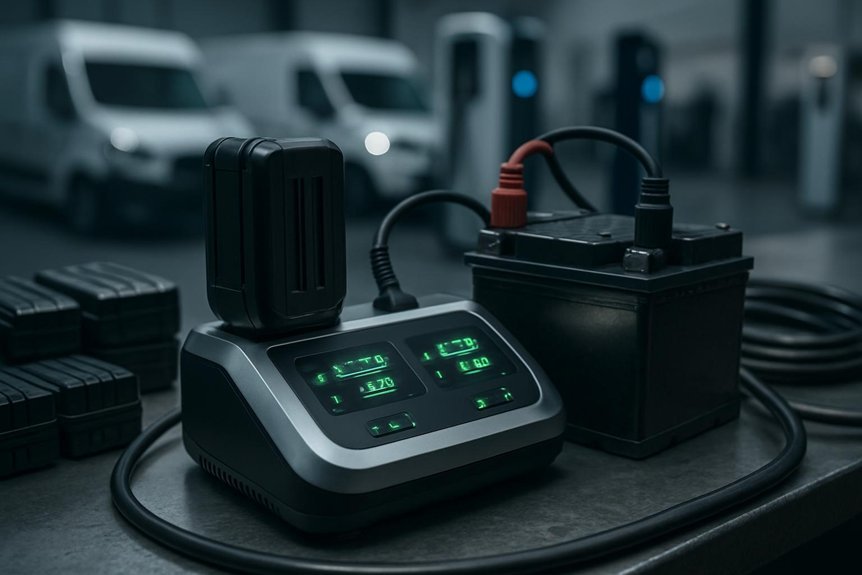
Dual-purpose chargers simplify maintenance and reduce downtime in fleets that deploy both lithium and lead-acid batteries. We recognize that a mixed fleet presents coordination challenges: differing charging profiles, state of charge targets, and thermal management needs. By using a single charger platform that supports both chemistries, we standardize interfaces, cables, and monitoring, which lowers training and inventory costs. This approach minimizes sequencing errors, prevents improper charging, and speeds up vehicle turnaround. In practice, dual purpose units enforce compatible charging windows and automatically adapt to chemistry, ensuring safe, efficient recharges across the fleet. For managers, the benefit is predictable performance and tighter control over uptime. Our goal is reliable power delivery without sacrificing safety or data integrity in a mixed fleet.
How Lithium and Lead-Acid Profiles Differ
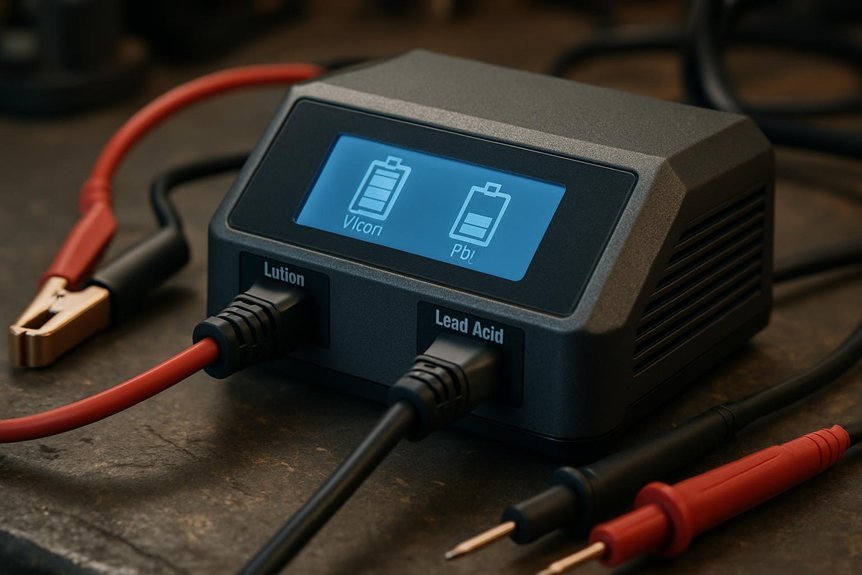
How do lithium and lead-acid charging profiles differ in practice? We compare behavioral traits, voltage curves, and current limits to show practical distinctions. Our goal is clarity, not fluff, so we present the core points succinctly.
1) Lithium charging differences: constant-current until a precise CV tail, tight termination, and higher peak voltages.
2) Lead acid charging differences: longer absorption phase, slower voltage rise, and gentler termination to avoid gassing.
3) Temperature sensitivity: Li-ion reacts quickly to temp shifts; lead-acid benefits from modest thermal management.
4) Charging cadence: lithium favors fast, controlled replenishment; lead-acid tolerates slower cycles with desulfation considerations.
Must-Have Features for Safe, Flexible Charging
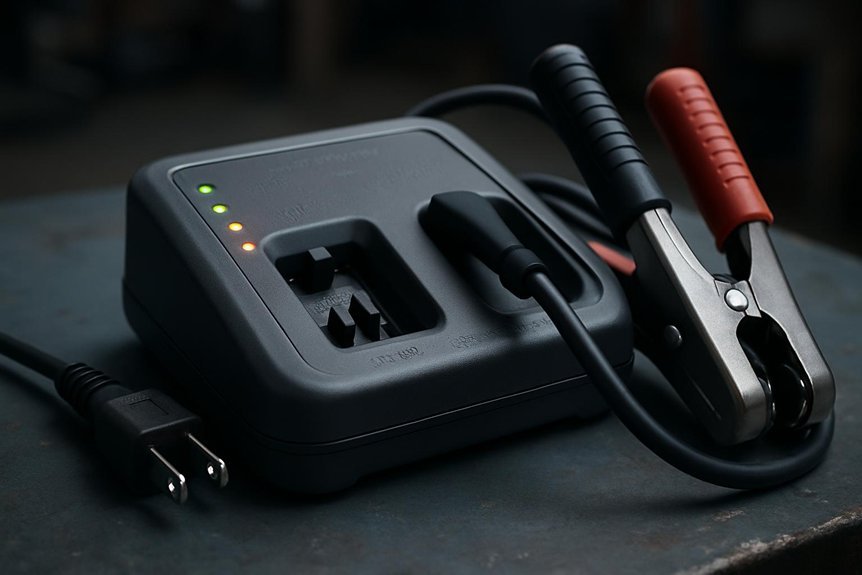
To charge safely and flexibly, we must enforce precise current and voltage controls, reliable fault detection, and robust thermal management. Our chargers must support dual purpose operation, adapting to lithium and lead-acid chemistries without compromising safety or performance. Key features include selectable charging profiles, with fast, balanced, and trickle options, and automatic chemistry detection to prevent cross-contamination or misapplication. Accurate state-of-charge estimation, float and equalization modes, and temperature-compensated ramping minimize aging and hazards. We require galvanic isolation, short-circuit protection, and input abuse resilience. Flexible reconnection logic, stall-safe recovery, and clear fault annunciation improve reliability. Communication interfaces (SMBus, CAN) enable monitoring and logging. In all cases, designs must prioritize safety margins, repeatable results, and seamless transition between chemistries.
How to Pick the Right Charger for Your Setup
Choosing the right charger starts with matching its capabilities to your battery setup. We’ll pick a charger by aligning chemistry, voltage, and current limits with both lithium and lead-acid needs, while validating safety standards. Our approach emphasizes charging profiles that optimize longevity and performance. Below are core considerations:
- Verify compatibility with lithium and lead-acid chemistries and their required charging profiles.
- Confirm voltage and current ratings match your pack configuration and peak charging needs.
- Check safety standards compliance, including overvoltage, reverse polarity, and temperature protections.
- Ensure charger management features provide logging, auto-recovery, and fault indicators.
Troubleshooting Tips and Real-World Integration
Have you ever wished for a straightforward path from problem to fix when a charger misbehaves in mixed chemistries? We approach troubleshooting with a defined sequence: verify input voltage, confirm charger mode, and check battery state. In real-world integration, observe charge curves, monitor termination voltages, and log any deviations. Isolate faults by testing each channel separately, then verify cable integrity and connector contacts. If lithium and lead-acid paths share a charger, ensure proper balancing settings and temperature compensation remain within spec. Prioritize safety: disconnect sources before reconfiguring, use PPE, and follow manufacturer guidance. For ongoing battery maintenance, schedule periodic insulation and capacitance checks, and track performance trends. This disciplined approach supports alternative energy goals while maintaining reliability and user confidence.
Frequently Asked Questions
Can Dual-Purpose Chargers Handle High-Rate Charging Safely?
We can handle high-rate charging safely only with precise control. Our chargers implement temperature compensation, strict CC/CV profiles, and safeguards to prevent overheating, ensuring safe high-rate charging for both lithium and lead-acid cells.
Do They Support Battery Temperature Compensation for Both Chemistries?
Yes, our chargers support battery temperature compensation for both chemistries, enhancing mixed chemistry safety. We actively monitor temps, adjust charging profiles, and ensure precise control, delivering reliable performance while maintaining safe operation across lithium and lead-acid packs.
Are There Maintenance Intervals Specific to Mixed-Fleet Chargers?
We do. For mixed fleet maintenance, we schedule chemistry specific calibration and routine checks, minimizing surprises. We recommend regular calibration windows, inspection of connections, and firmware updates to support mixed fleet maintenance efficiently.
What Warranty and Service Coverage Apply Across Chemistries?
We provide thorough warranty coverage across chemistries and clear service options for mixed fleets, including Lithium and Lead-Acid chargers. Your coverage includes parts and labor, with timely diagnostic support and optionally on-site service and remote assistance.
How Do They Handle Sulfation Prevention in Lead-Acid Cells?
We prevent sulfation via controlled charging profiles and periodic conditioning, plus temperature compensation to adapt voltages. We monitor cell health, maintain ideal float/absorption levels, and alert anomalies, ensuring reliable lead-acid performance while avoiding overcharge or undercharge effects.
Conclusion
We’ve shown how dual-purpose chargers simplify mixed fleets by standardizing interfaces and preventing cross-chemistry errors, while automatically selecting safe profiles. One striking statistic: fleets using mixed-chemistry chargers report up to 40% reductions in maintenance downtime due to faster turnarounds and fewer human errors. With precise temperature compensation, proper termination, and robust safety protections, these systems deliver reliable power and longer battery life, enabling smoother vehicle turnover and lower total cost of ownership.